Civil engineers play an important role in reducing the embedded carbon footprint of the construction industry. Trimble Business Development Manager Sakari Lahti explains how small decisions on the desk can have a huge impact on our planet
One of my interests as a structural engineer is to help other engineers design buildings that are more sustainable. My work is particularly focused on concrete, as this is where our industry has excellent opportunities to make carbon reductions in design, materials engineering and during the construction phase. I joined Tekla in 2013 as an application manager focused on growing our global precast business. As sustainability became a more pressing issue, I soon saw that optimizing a building to minimize its embedded carbon is done with similar mechanisms to those used to calculate material costs. I therefore had the idea to make embodied carbon a design parameter in our software, so we validated the need and continued with the development.
Over the past decade, I have seen that not everyone in our industry is aware of the benefits of BIM, Building Information Modeling. BIM is fundamentally about improving the entire construction process, with data as a value-adding factor.
In the early days of BIM, this was not fully understood. For example, saying "a thicker wall has higher volumes and you can export all this information to a spreadsheet" doesn't really help the designer understand the impact of making the wall thicker. The benefit of BIM becomes much clearer when you can dynamically see both the cost and the embedded carbon impact of a proposed design decision.
Why is this important?
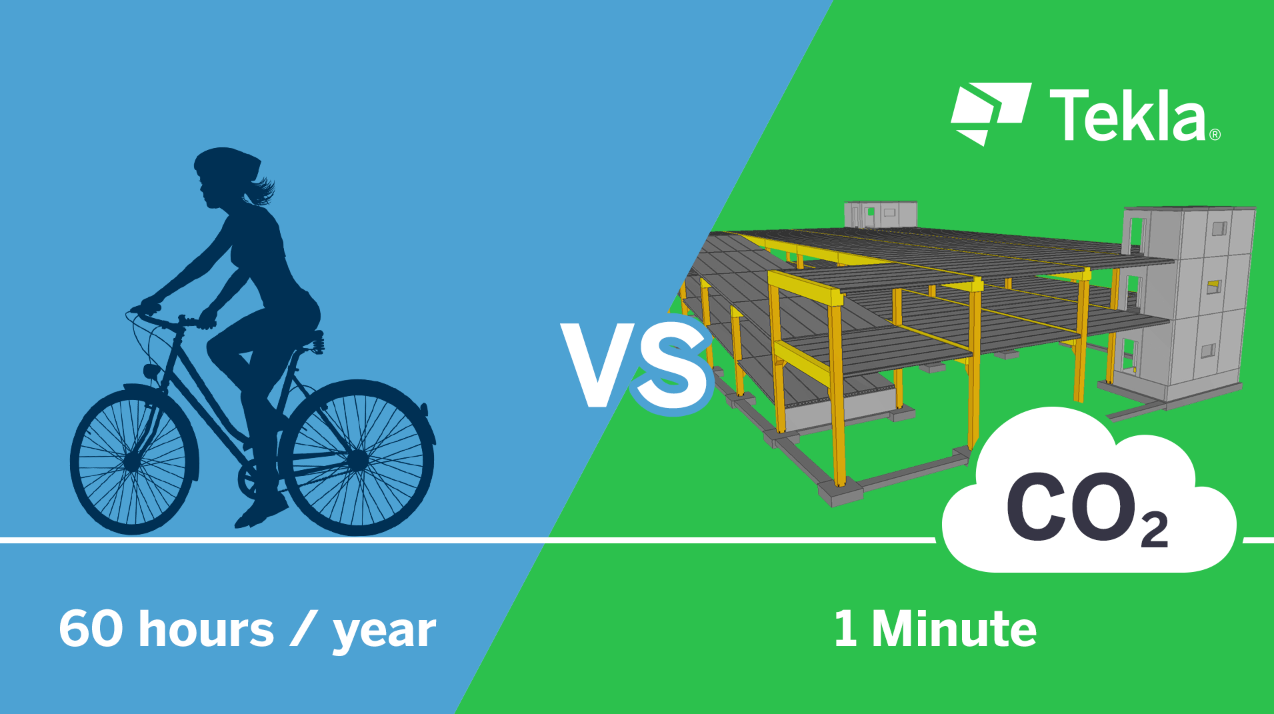
As designers, we have the power to make a huge positive impact on minimizing CO2. Our professional decisions have a much bigger impact than anything we do in our private lives. For example, if I choose not to take a flight from my home in Finland to a city in Italy, I save about 300 kg of CO2. If I go on a plant-based diet, I can save 500 kg of CO2 every year. Driving a hybrid car can save 600 kg over the course of a year, while going completely car-free can double that.
Every bit helps, but the point is that these numbers are minimal compared to the impact a structural engineer can make by optimizing the materials used to construct a building - especially when it comes to concrete. More than 950 tons of concrete are poured globally every second, while around 350 tons are destroyed at the same rate. When we think about all the emissions generated from this concrete, we need to understand that very small percentage changes in certain parameters can make a huge difference to embedded carbon. This is why our profession can have such a profound impact. From the contractor's and manufacturer's point of view, standardizing and repeating a building's concrete design can make sense in terms of getting the job done quickly. Even if the loads on different floors and walls vary greatly, the designer may be asked to use the same columns and slabs for the ground floor, top floor and all floors in between.
However, as end-user awareness of embedded carbon increases and material costs rise, contractors and manufacturers are becoming more interested in optimizing utilization rates.
A standard utilization rate is around 80%. But with just a few optimizations, you can easily get up to 90%. Optimizing a design not only reduces the materials used in the manufacturing stage, it also reduces CO2 generated from transportation.
Sometimes optimization can simply mean using less concrete than needed in walls and slabs, or converting certain elements to a more efficient geometry. For example, simply changing a bearing direction can often lead to a higher utilization rate. Parameters such as wall or slab thickness, materials used and type of reinforcement can all have an impact on embedded carbon. The earlier in the design process you start optimizing, the greater the impact.
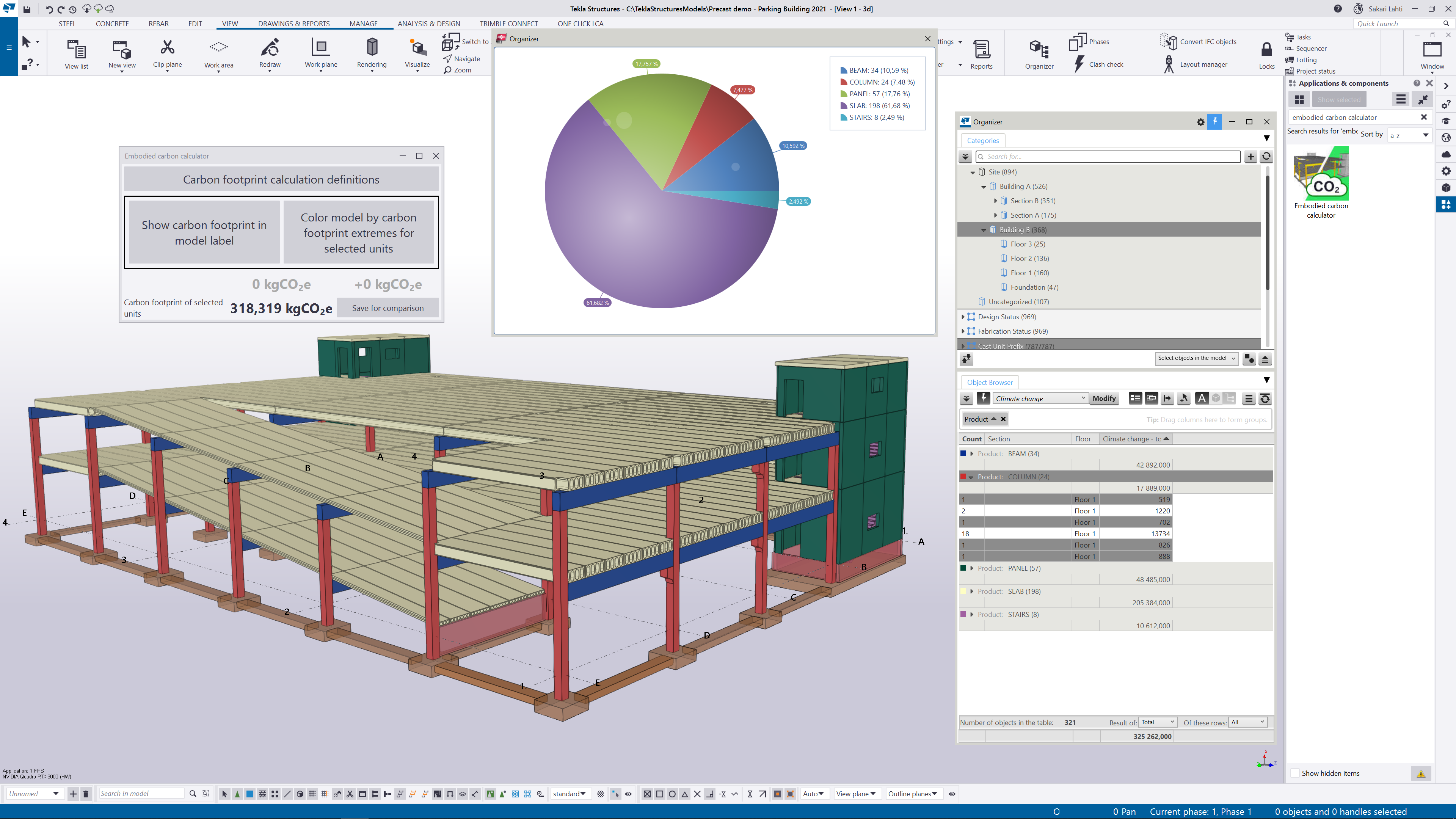
Determining the optimal combination of these parameters is challenging without a tool like the built-in carbon calculator we have built into Tekla. By enabling engineers to easily compare the environmental impact of different design iterations, we are encouraging the industry to make sustainability a key factor in the decision-making process.
Optimization for disassembly and reuse
There is also a future-proof dimension to using Tekla tools to calculate embedded carbon. Tekla is a highly customizable software designed to adapt to the rapidly changing rules and requirements of the circular economy. There is now an increasing emphasis on designing buildings that are easy to disassemble at the end of their life, so that the constituent materials can be reused in new constructions. This departure from past demolition practices requires reconsideration of certain details within a structure. Among other things, I foresee changes in connections and increases in prefabricated construction.
We need to be sure that BIM software can keep up with these developments, as detailed BIM data is of great value to the building owner when considering the materials of a building at the end of its life.
This is an area that is now receiving a lot of attention, with Trimble involved in some important research aimed at finding the way forward.

