Drinking water hygiene plays an essential role in all building projects. Regardless of whether it is a new build or the renovation of an old building, a hygiene flushing calculation and efficient drinking water network planning are essential to keep the drinking water germ-free.
In our article, we explain what exactly both are and why a hygiene flush calculation is so important for cold water.
The most important facts in brief:
Being germ-free is essential for drinking water hygiene, as otherwise people with weak immune systems in particular are sometimes exposed to serious pathogens
One of the most important elements for drinking water hygiene is optimal drinking water network planning
Part of efficient drinking water network planning is an optimal hygiene flushing calculation
Germs endanger drinking water hygiene
Time and again, problems with drinking water hygiene have occurred and continue to occur, especially in rarely used sanitary installations. If these are not in operation for a longer period of time, there is a risk that parts of the pipework or the entire system will be infested with germs.
Proper and legally compliant operation of drinking water networks in accordance with the recognized rules of technology such as the German Drinking Water Ordinance (TrinkwV), VDI/DVGW 6023, DIN 1988 or DIN EN 806-5 is then no longer guaranteed. Problem-conscious planning of new systems and regular maintenance of existing pipe networks are therefore particularly important.
A massive increase in this problem was expected, particularly during the first Covid-19 lockdown phase at the beginning of 2020, as many buildings were not in operation for weeks, drinking water systems were not used and therefore no sufficient and regular water exchange could take place.
This stagnation in the drinking water installation is considered a major risk factor for the formation of biofilm. These organic pipe deposits are an ideal basis for the development and spread of wet and cold water bacteria, such as legionella and pseudomonads.
The latter are considered to cause pneumonia and urinary tract infections, which can be particularly dangerous for people with a weak immune system. Legionella are also bacterial germs which, in rare cases, can cause Pontiac fever, more commonly known as legionellosis. Also known as Legionnaires' disease, this pneumonia caused by droplet infection can also be life-threatening.
Stagnation is only one cause
However, there was no significant increase in cases of legionellosis after the lockdown. This is also seen as an indicator that the relationships in the development of germs in drinking water are more complex and are also influenced by other factors in addition to stagnation.
For example, the prevailing temperatures in the pipes and their surroundings, the installation and insulation, the building construction or the nutrient supply available for the germs.
The main causes are the stagnation of drinking water in the pipe system due to rarely used tapping points, insufficient flow velocities in pipe networks that are too large or inadequate pipe insulation.
Measures against drinking water germs
There are several methods for preventing, minimizing or eliminating germs in drinking water. In addition to ultrafiltration, UV irradiation, chemical treatment and thermal disinfection, regular flushing of the pipe networks using hygiene flushing systems has proven particularly effective.
While germs in hot water pipes can be effectively killed by heating the water for at least three minutes to 60, or better 70 degrees Celsius, measured at the tapping point, the above methods are not suitable for cold water systems, or only to a limited extent.
For cold water networks, forced flushing is often the only way to eliminate germs such as pseudomonads or legionella in drinking water. These regular manual or automatic hygiene flushes are reliable, economical, cost-efficient and enable operators of drinking water systems to operate properly and in compliance with the law. Regular hygiene flushing ensures safe water exchange in pipe areas at risk of stagnation and thus prevents the formation of germs.
More safety with patented hygiene flush calculation
With Trimble Nova 's patented and innovation award-winning hygienic flushing calculation, specialist planners or plumbers can precisely determine the required flow rate and duration for each partial pipe.
Even for large and complex pipe networks, it takes just a few minutes to calculate how long a tapping point needs to be flushed manually in order to flush the system sufficiently after a system shutdown, while using as little water as possible.
The patented process guarantees an optimized and therefore environmentally friendly and sustainable solution in terms of both the flushing time and the amount of water used. Taking into account the dimensioned partial lines and other parameters, Trimble Nova determines the flushing required for hygienic operation of drinking water networks for normal consumption, automatic flushing or manual hygiene flushing.
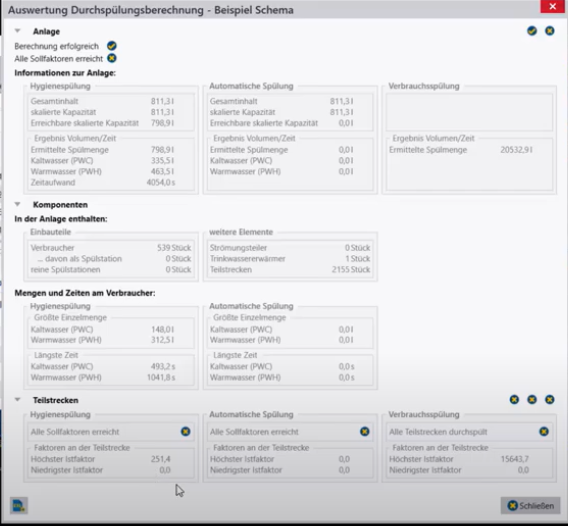
Figure: Evaluation of a flushing calculation in Trimble Nova
The consumption flushing calculation can be used to determine critical pipe sections that are rarely flushed during normal consumption. The results of the automatic flushing can be used to design flushing stations.
The hygiene flush calculation is used to determine the flush time and flush volume for each item of equipment for the hygienic operation of the drinking water system. In addition, a flush log is issued for the cold and hot water network, which lists the flush volume and flush duration in tabular form and sorted by tapping points, rooms and floors.
Safely plan and operate drinking water networks with Trimble Nova
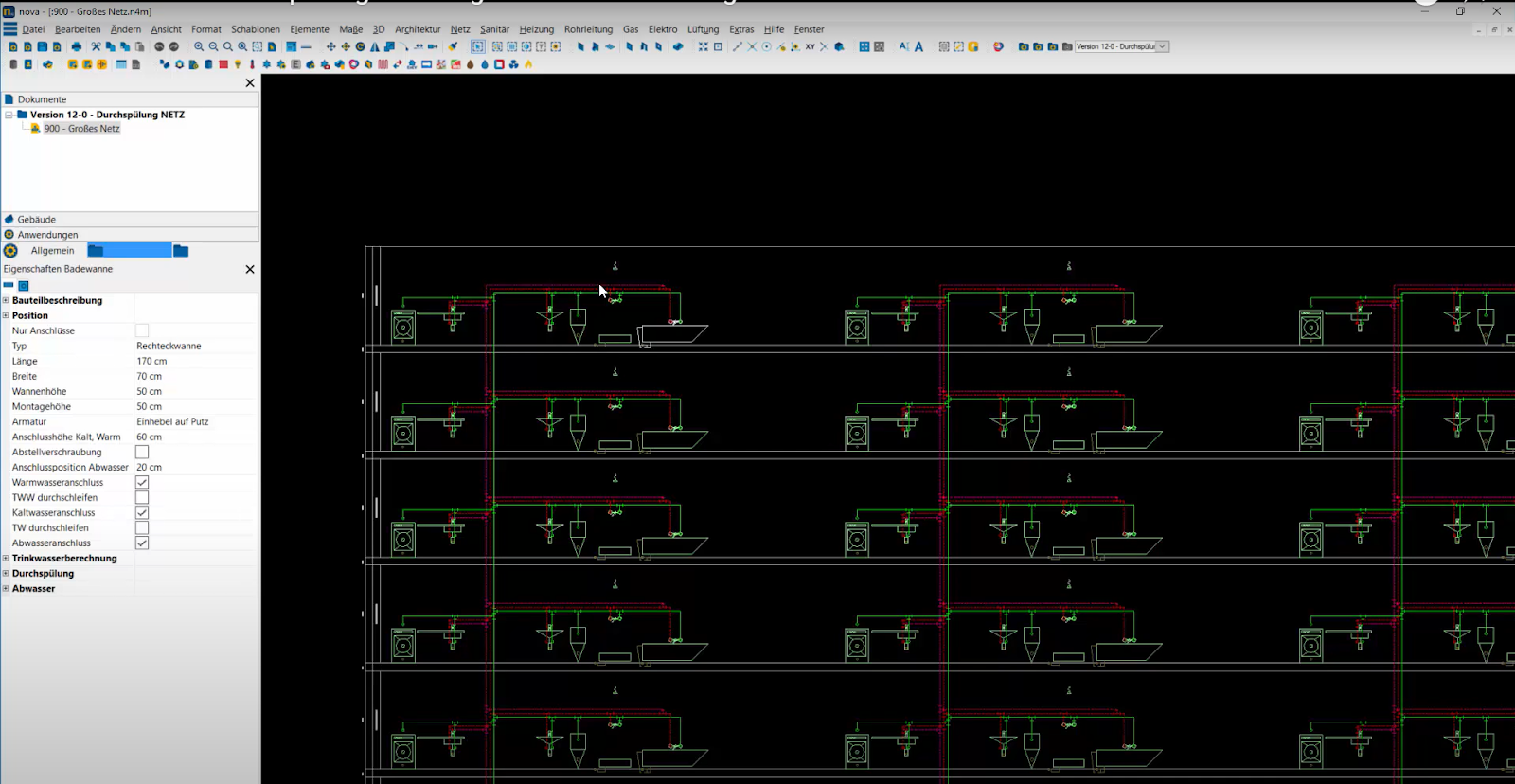
View of flushing network in Trimble Nova
With Trimble Nova's patented hygienic flushing calculation, pipe networks can be planned and maintained in such a way that drinking water hygiene is guaranteed, germ formation has no chance and resources are conserved.
Trimble Nova enables precise analysis for the planning, design and maintenance of drinking water networks. With the hygiene flushing calculation, Trimble Nova also provides all the necessary information for building operators.

