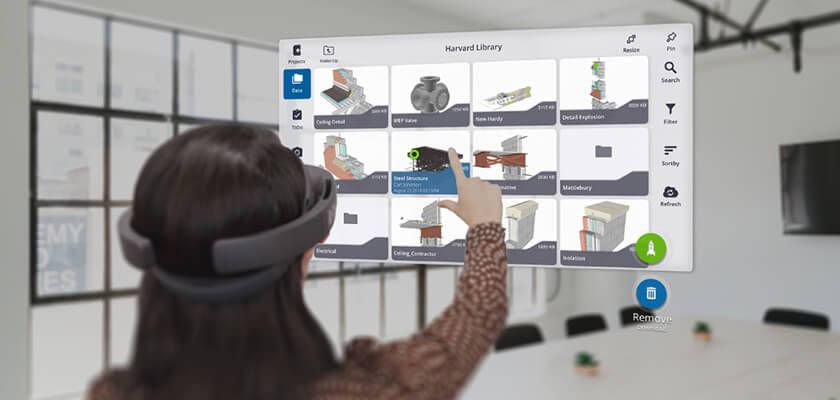
Mixed reality - what exactly is it? And how does the term differ from virtual and augmented reality?
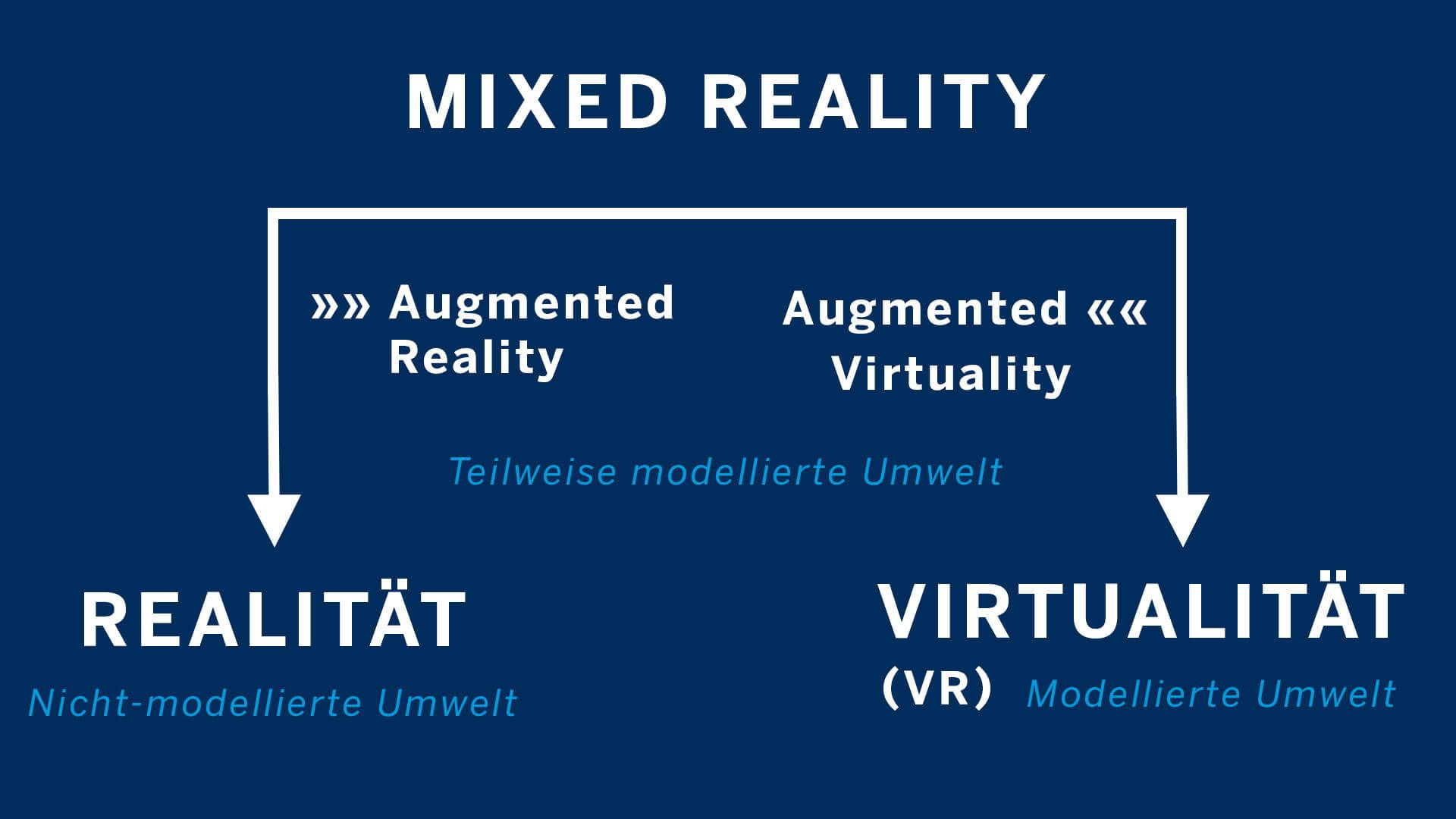
There is no universally valid definition for this. In particular, the terms augmented reality and mixed reality are often used interchangeably. Paul Milgram's reality-virtuality continuum, for example, can be used to classify the terms. It depicts the entire spectrum between the two end points "reality" and "virtuality" (= virtual reality) as well as the transitions in between.
Virtual reality creates new worlds
Virtual reality refers to a completely computer-generated environment without any real elements. Physical reality is completely faded out. This means that the user is immersed in a new world and feels physically present in this simulated, digital world. With the help of VR headsets, users are able to interact with the virtual world using intuitive hand and finger gestures, move around in it and experience it from all sides. Virtual reality (VR) therefore creates an artificial reality that can feel very real. Although VR cannot replace real interaction and communication on an equal footing, it opens the door to spaces, information and experiences that are reserved for no one or only a few people in reality.
" The user only perceives the virtual world, which they can experience with aids (e.g. VR glasses). The real environment is completely blocked out.
Augmented reality expands the real space
Augmented reality (AR) brings the virtual world into reality: instead of transporting the user into a completely virtual environment, digital objects are embedded in the real world. This means that the user perceives the physical reality, which is additionally enriched or enhanced with digital information. With the help of so-called wearables (short for wearable computing = small computers that are worn on the body, such as data glasses and smartwatches), graphics, videos or texts etc. can be superimposed on the real environment in real time. This allows users to see both actual and virtual objects in front of their eyes.
" The user perceives the real world, which is enhanced with virtual content.
Mixed reality as a generic term
Milgram's reality-virtuality continuum describes mixed reality as a generic term. According to this, mixed reality spans the entire area between real reality and pure virtuality (= virtual reality). It therefore measures the entire continuum, excluding the two extreme points, and encompasses all possible variations and combinations of real and virtual objects. This also explains why the three terms virtual reality, augmented reality and mixed reality are not easy to distinguish from one another. To put it simply: Mixed reality combines real and virtual objects. The degree of virtuality is characteristic here, i.e. the degree of virtuality at which we can still speak of augmented reality or already of augmented virtuality:
Mixed reality based on the virtual world (augmented virtuality): Real elements (objects or people) are superimposed onto a primarily virtual world.
Mixed reality based on the real world (augmented reality): The real world is in the foreground and is enhanced with virtual elements, for example by projecting videos, graphics or GPS data into the real environment.
Find out more about the topic of mixed reality. In this article, you can read about the role mixed reality can play in the construction industry.

