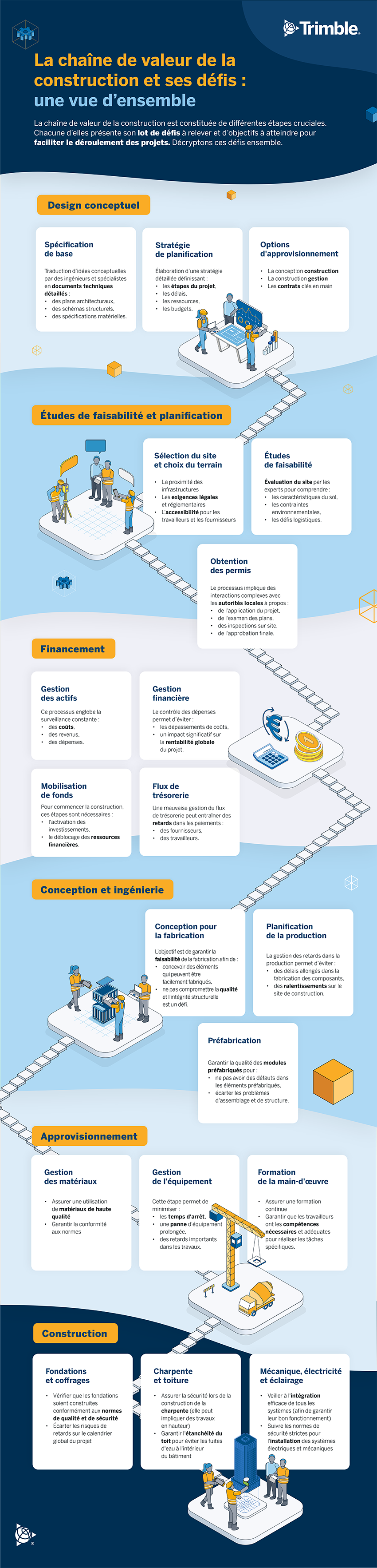
Fragmentation of processes and technologies is a pervasive problem in the construction world. Especially when many companies continue to use disparate - even manual - solutions, resulting in compartmentalized communication and data silos. How can this fragmented approach and its consequences be avoided? The answer in an infographic.
Construction value chain: the negative impact of fragmentation
Construction companies are faced with complex projects, each with its own requirements and challenges. But when data and information are compartmentalized, each stakeholder works with a different set of requirements
different data sources
the result: complex decision-making and inefficient collaboration. Delays, errors and cost overruns become inevitable. To alleviate this problem, there are a few challenges to overcome, not least of which is the choice of "connected construction".
Towards Connected Construction
The solution to these problems lies in adopting a " Connected Construction " approach. The transition to Connected Construction involves the gradual adoption of new technologies and work practices, such as :
the adoption of Building Information Modeling (BIM), which enables the creation and management of intelligent 3D models of buildings and infrastructures;
setting up a Common Data Environment (CDE): a common data environment, where all relevant information is centralized and shared transparently with all project stakeholders - this often takes the form of a centralized CDE platform for storing, managing and sharing project data;
training and skills development: whether in new technologies, interdisciplinary collaboration, or the management of cloud-based collaborative projects.
The benefits of Connected Construction
Simplified workflows
By eliminating duplication and offering a single
unified access
connected construction simplifies processes and reduces friction in construction projects. This means that all employees can work on the same
common data
.
Improved collaboration
The various stakeholders (designers, engineers, project managers or field workers) can collaborate more effectively thanks to a
transparent sharing of information.
Every team member has access to the same data, facilitating exchanges and joint missions.
Improving efficiency
Better coordination and optimal use of resources contribute to the
improved operating efficiency
reducing delays and unnecessary costs.
Improved profitability
By avoiding costly mistakes and optimizing resources, connected construction contributes to a
improved project and company profitability
as a whole. The transition to a connected building is also a cultural transformation that enables companies to leverage technology. The challenge is to overcome data fragmentation and inefficient collaboration. By integrating business intelligence, you can work more harmoniously and improve profitability. It's up to you!

