
While Offsite may be proclaimed as the future of the construction industry, if we are to truly deliver on this Offsite vision and reap the rewards then we need to change the way we are approaching projects.
Here, Duncan Reed, Digital Construction Process Manager at Trimble (UK) explores the Designing for Manufacture and Assembly (DfMA) approach and how it can help to bring the benefits of Offsite to life.
A topic on everyone’s lips, it’s no secret that Offsite is heralded as holding the key to the industry’s modernised, prosperous and efficient future. Its benefits are well-known, from time and cost savings to better construction quality and reduced material waste, and the UK Government has also delivered a clear push on these more modern methods. Featuring heavily in its plans to “build better, faster and greener”, Offsite also dominated the 2020 Construction Playbook, in which the government calls for the adoption of a manufacturing-led approach and the use of innovation and Modern Methods of Construction in the delivery of public works projects.
However, if we are to truly deliver on this Offsite vision and reap its promised rewards – of which there are plenty – it needs to be considered from the very outset of a project. If you take a step back, the success and delivery of any project will often be determined as early on as the initial concept and design phase, with each completed stage in turn influencing and shaping the next. Clearly a change of mindset is required, with the offsite way of thinking and offsite processes required right from the initial stages of a project.
Indeed, despite the title (offsite construction), the process stretches far beyond just the final construction and assembly phase. Only if a project is designed, modelled and detailed with offsite manufacturing and assembly in mind, can the value of these modern methods be truly realised.
This is where Design for Manufacture and Assembly (DfMA) comes into play. DfMA works to take offsite further, from construction to assembly; with an approach that focuses upon driving the design process towards creating a manufactured solution using standardised components, for ease of manufacture and efficiency of assembly. Structures designed in this way can help to push the well-publicised benefits of offsite even further; from a reduced construction programme time through to improved efficiency and productivity levels on site.
Putting it into numbers, a DfMA project could result in a:
20-60% reduction in construction programme time
20-40% reduction in construction costs
70%+ reduction in onsite labour
Better construction quality
Reduced waste
Fewer queries from site
So, how can you best incorporate DfMA principles on your next project? At its heart, is correct-first time products and components, accurate manufacturing and assembly tolerances and a structure that is designed to be easily assembled. Here, digital technology (such as 3D modelling software) is perhaps the perfect partner, with the benefits and capabilities of BIM aligning with the demands and requirements of Offsite. Design can be carried out digitally to ensure the components are defined and detailed in accordance with customer requirements, tested for manufacture and coordinated for assembly.
It goes without saying that one of the key requirements of both Offsite and DfMA is the need for accuracy. With the aim for all structural components, whether it be a load-bearing light metal frame or volumetric pod, to be fabricated and assembled off-site, before being lifted and fixed into place on site, ensuring high levels of precision and exact coordination between components is critical. Failure to satisfy these tight tolerances runs the risk of offsite’s time-saving benefits being lost, with the need for extensive rework or even re-fabrication. In addition to the subsequent delays to the overall project delivery, this could also cause costs to go up dramatically, as well as resulting in material wastage – again going against the core of offsite construction.
This is where BIM comes into play, renowned for its information-rich and highly accurate 3D models. Given the visualisation enabled by the 3D model, it enables you to see the proposed structure before you even get to site, to build it before you actually build it. In turn, this can all provide confidence in the structural design, as well as the assurance that all components work and integrate together correctly.
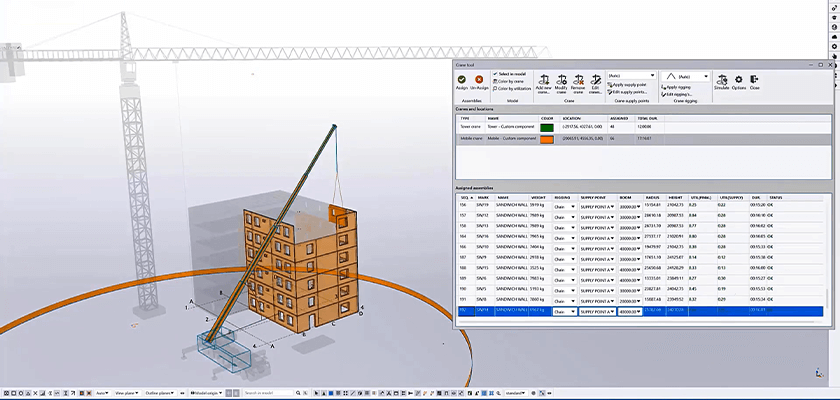
This theme of accuracy carries into another aspect of BIM, mainly the idea of the 3D model acting as the central source of information. Once the main model is finalised, clash checked and approved, all documentation, including quantity take-offs, production schedules, fabrication drawings and project reports, is automatically generated using the data stored within the 3D model. This integrated flow of accurate and information-rich data throughout the construction sequence, from detailing through to fabrication and on-site assembly, can be invaluable, facilitating a more streamlined and efficient process and, in turn, helping to further push the value of offsite construction.
Using a DfMA and BIM approach on the construction of Vita Student Westgate, a large student accommodation scheme in Newcastle, Intelligent Steel was able to utilise the direct link between Tekla Structures and its fabrication machinery, increasing the speed, efficiency and accuracy of the process. Using the 3D model data, the steel-framing machines were able to accurately place all punching and fixing holes, which not only allowed for the frames and trusses to be manufactured with extreme precision but also enabled the frame to be self-locating and jigging, reducing the build-time on site.
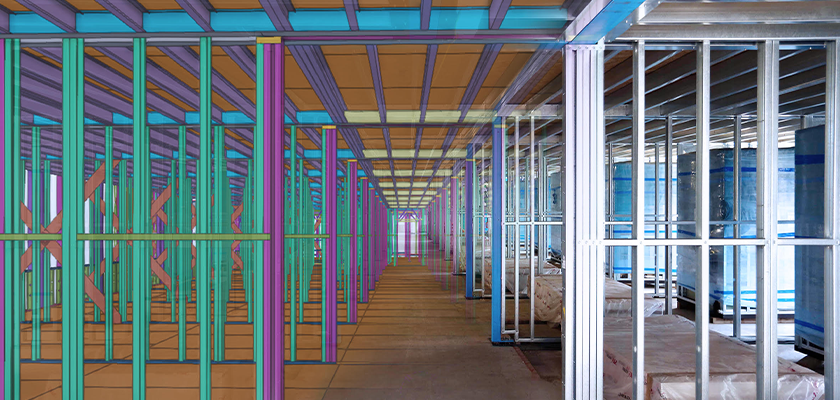
Design & Consultancy is another business operating within the Light Metal Framing sector. Speaking about the use of BIM software, Nik Teagle, Director, said: For us, it’s all about designing with manufacture and assembly in mind. Through Tekla, we’re able to constantly develop the way we detail frames and the fixings and connections we use, all based off feedback received from Frameclad – our framing manufacturer.

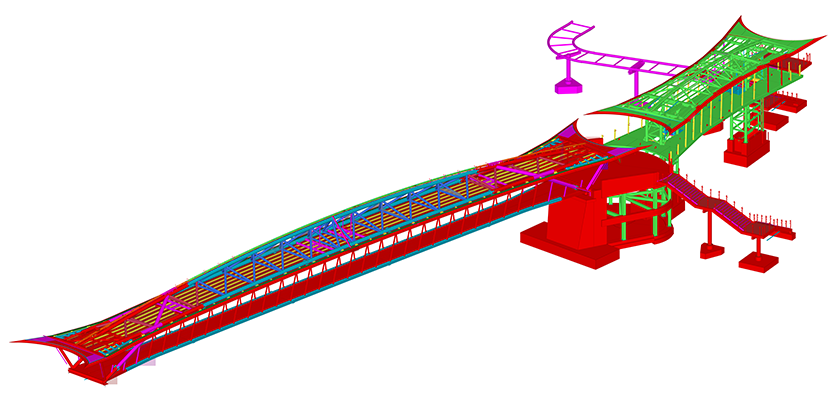
Another example of DfMA in action is the construction of the Telford Central Footbridge. Here, the bridge span was first pre-assembled near to the final site, before then being lifted into place during a road and rail closure. Using Tekla Structures, SH Structures was able to plan and deliver a successful assembly, as Sales and Marketing Manager, Tim Burton, explained: Prior to commencing an installation of this size and complexity, we must first produce a plan that meticulously details our whole assembly method, accompanied by lifting assessments and crane layouts, all of which we were aided by the Tekla model. The software enabled us to extract accurate weights of components and the centre of gravity of complex assemblies, including the bridge structure itself; all information that was crucial for optimising crane locations and ensuring an efficient and safe installation.
While the topic of Offsite may appear to be everywhere, there is still more that can be done if we as an industry are to truly deliver on this modern construction method – starting with a change of mindset. Despite the title (offsite construction), the Offsite principles and ways of thinking need to be present and incorporated at every stage of the construction sequence, starting from the initial concept and design phase, with DfMA a key part of this.

