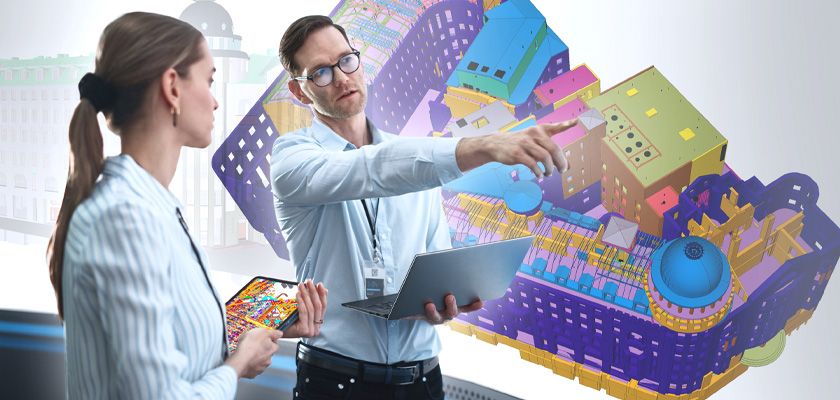
Detailers are confronted with various obstacles that lead to extended work hours and jeopardize the quality of their final output, thus potentially impacting the success of their construction project.
Discover how truly constructible models drive an effective BIM process that improves understanding, drives better decisions, delivers better structures, and builds business value.
1. Ensure you have the right information from design to onsite

The foundation of a successful project is built upon quality information that enables it to stay on schedule and within budget. In construction projects, a significant obstacle is the early design models not being sufficient for fabricators or contractors' needs. Such models often lack the latest information and essential data necessary to commence fabrication work, leaving the contractors to spend precious time waiting for further details. This can severely impact the project schedule.The problem of incomplete or inaccurate data is not confined to contractors or fabricators alone. Even a small mistake can snowball into a significant problem that endangers the entire project. Thus, a 3D model that accurately details the project's constructibility becomes a critical source of truth for all stakeholders involved. With such a model in place, information becomes reliable, shareable, and adaptable to changes. By doing so, your contribution to the project helps the team and partners operate efficiently.
2. Enhance your communication and collaboration

Effective coordination and organization of information is essential for successfully completing any project. From design and detailing to fabrication and onsite execution, all project members must work together seamlessly and cost-effectively. Unfortunately, many companies still rely on traditional methods, such as printing and marking 2D drawings and exchanging multiple files, which leads to chaos, miscommunication, and exhaustion.A better way is to use a 3D model that serves as a unified platform for the entire team to visualize the project, share thoughts, make corrections, and provide all necessary information to each other. This ensures the project is constructible and accurate and everyone has the relevant data they need to do their parts. Furthermore, traditional ways of working are often siloed, whereas a collaborative constructible model helps to share valuable data among all stakeholders and understand the big picture. Therefore, using a 3D model is crucial for making the entire construction process more integrated and effective.
3. Save time and money

Utilizing 3D models can provide numerous benefits regarding both time and cost efficiency. By implementing a constructible model, automation can be introduced into detailing work, reducing the need for tedious manual labor. Additionally, the accurate and intelligent data that underlies such models can speed up and simplify various aspects of steel detailing fabrication and erection processes, thus streamlining workflows.Furthermore, a condensed and comprehensive project view can be achieved using a constructible 3D model, including the necessary elements, space requirements, and logistical considerations. This model can be shared with team members and partners, allowing for collaborative revisions, comments, and corrections. Employing such a model can drastically reduce the hours of revision checks and rework. Moreover, any updates made to the 3D model will also update the relevant deliverables, such as drawings and reports, ensuring consistency and accuracy across all aspects of the project.
4. Guarantee safety onsite

A 3D model that is constructible is composed of precise and accurate information created through an automated process that reduces the likelihood of human errors. The benefits of such a model include the ability to share it with project members, who can detect potential conflicts and make necessary corrections before construction commences. This process minimizes errors that would otherwise require onsite resolution and endanger workers' safety. Additionally, using a 3D model provides a more comprehensive insight into the entire construction project, encompassing both the building itself and its surrounding environment, as well as the logistics involved in its successful execution.
5. Increase profitability and gain more business

During a construction project, numerous variables can change between the initial bid and the final execution, including a company's profit margin. To maintain accuracy and precision throughout the project, creating a reliable 3D model is imperative. Not only does this facilitate an efficient way to monitor the quantities and costs involved, but it also allows you to quickly and easily adapt to unforeseen circumstances. Instead of tediously revising drawings and reports, you can experiment with various options on your model to evaluate and make necessary adjustments.A truly constructible model 3D model has the potential to significantly enhance your team's productivity by reducing the amount of time previously spent requesting information, updating drawing versions, and completing manual tasks. As a result, more time can be dedicated to finding and securing new projects, ultimately increasing overall efficiency and profitability.
Watch this webinar covering modeling tips and tools to create a detailed 3D model efficiently.

