

If there is one constant in modern construction, it's complexity. You're likely juggling a tech stack that includes an ERP for finance, a specialized project management tool, an estimating suite and a mountain of "temporary" spreadsheets. While these tools are powerful individually, they often live in isolation.
When your software doesn't talk, your people can't either. The field team is flying blind, finance is waiting weeks for updates, and your staff is stuck in the "manual entry loop"—re-keying data and risking the errors that come with it.
To solve this, you don't just need more software; you need connected software on an extensible, open platform.
The front door to an open ecosystem
The Trimble Marketplace is how you extend the power of your Trimble solutions to the rest of your business. It is the bridge between your Trimble data and the specialized tools you use every day. This curated, open ecosystem is designed to help you find, vet and deploy integrations that make your existing tech stack work as one cohesive unit.
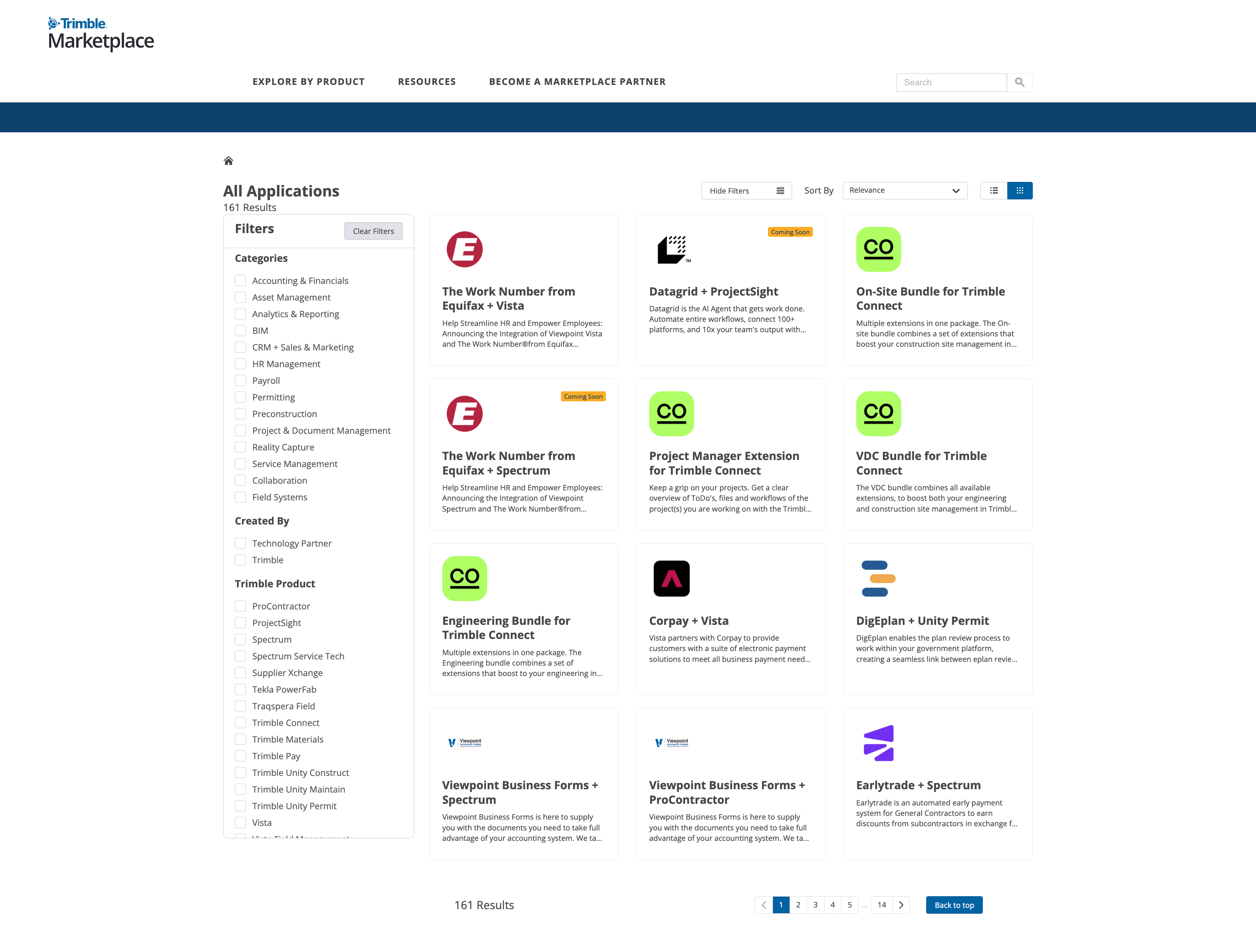
Here's how the Trimble Marketplace helps you close the gap between the field and the office:
1. Integrate with confidence
The biggest barrier to new tech is risk. Is it secure? Will it actually play nicely with Viewpoint Vista or Spectrum? There is a big difference between a vendor who says, "We integrate with Vista," and a true Trimble Marketplace Partner.
When you source integrations independently, the vetting burden falls on your team. The Trimble Marketplace removes that weight with the "Trimble Verified" badge.
Trimble Marketplace Partners are "on the inside," meaning every verified solution has passed a technical evaluation and security review. When you see a partner on the Marketplace, you can trust that the integration performs exactly as described. We ensure the partner is stable, compliant, and committed to the value they bring. You aren't just downloading an app through the Trimble Marketplace; you are working with a company that has gone through the checks and meets the same high standard as your Trimble solutions.
2. Automate and extend your workflows
The Marketplace isn't just a list of apps; it is a catalog of solutions for specific workflow gaps. Whether you are a CFO looking to streamline accounts payable or a Project Manager trying to speed up RFI processing, there is likely a pre-built integration ready to help.
You can find integrations that:
Streamline HR: Automate the transfer of payroll data and employment verification by connecting tools like The Work Number from Equifax directly to Vista or Spectrum.
Simplify payments: Eliminate manual check runs and automate vendor payments through secure solutions like Trimble Pay or Corpay.
Connect operations and finance: Create a bi-directional sync between ProjectSight and your ERP to keep your budget actuals up to date.
3. Achieve a single source of truth
The ultimate goal of connected construction is to ensure everyone is viewing the same data. By connecting specialized tools—for everything from reality capture to expense management—directly into your core Trimble system, you eliminate the "spreadsheet gymnastics" usually required to get a clear picture of your project's health.
Stop re-keying. Start integrating.
Your Trimble technology was built to be the backbone of your business, but it wasn't meant to stand alone. You can extend the value of your existing investment today by simply connecting the tools your team already uses.
Stop wasting hours on manual data entry and start building a truly connected construction business.
Explore the Trimble Marketplace for verified integrations with Viewpoint Vista, Spectrum, ProjectSight, Trimble Connect and more.


