

What does a 200-mph race car have in common with a 30-story office building? For Brad Keselowski and RFK Racing, it’s surprisingly simple: precision.
At Trimble Dimensions 2025, a packed room learned this first-hand in a compelling presentation from NASCAR legend Keselowski, co-owner and driver of RFK Racing.
He was introduced by Trimble SVP, Mark Schwartz, who noted in his opening that one world is measured by the steady rise of skylines, the other by the blur of a car at full speed—but both are unforgiving when you get things even slightly wrong. “In racing, being off by an inch isn’t just a mistake, it’s total failure,” he said. “Just like in construction, if you’re marginally off, it’s game over.”
From tribal knowledge to “Industry 4.0”
Keselowski knows that all too well. The racing champion described what his organization looked like before its transformation into a modern, data-driven powerhouse. It was an operation built on “tribal knowledge”—where expertise lived in people, not systems. RFK had accumulated decades of experience stored in an engineer’s notebook. Meetings were conducted over a car’s hood, and feedback loops were all too slow and fragile. If the person with the answers wasn’t in the room, the answers didn’t exist—and if that person left, the team was in trouble. For RFK, that status quo was “Industry 2.0”—a far cry from the discipline and digital maturity required to compete today.
Everything changed when RFK embraced digital transformation in full, shifting to an “Industry 4.0” approach.
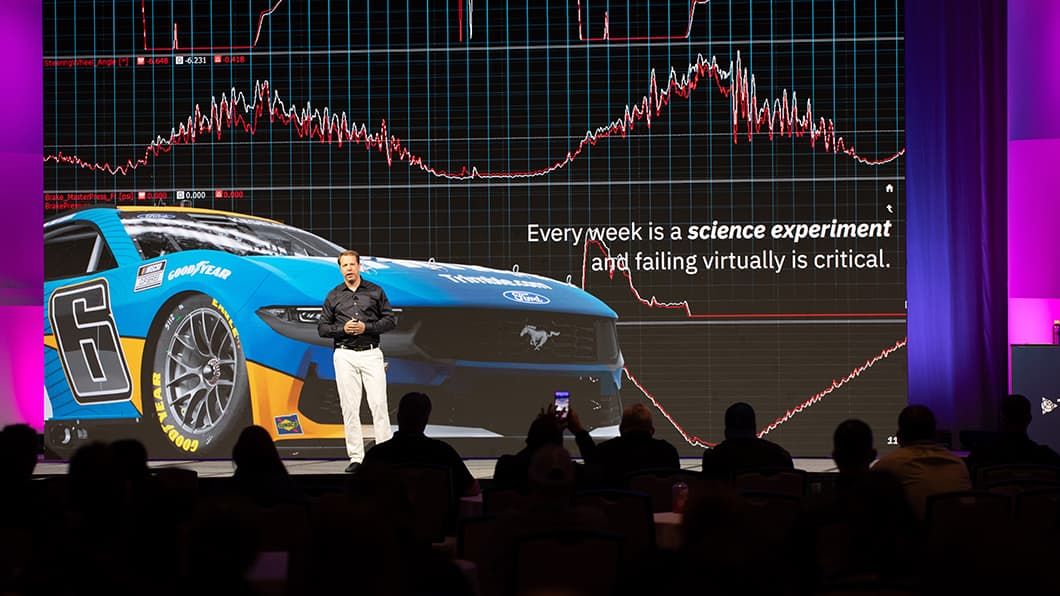
When every week is a science experiment, failing virtually is critical
Keselowski began building a connected ecosystem from scratch: structured databases to capture institutional knowledge, advanced simulation tools to model performance, and real-time workflows to speed decision-making. The goal was deceptively simple: fail digitally, not physically. Before a car rolls onto the track, RFK now runs the equivalent of 10,000 simulated laps, testing setups, tolerances and strategies long before race day. In an era when track time is scarce, virtual repetition is the only way to keep up.
That transformation extends to race day itself. Today, RFK’s operations center looks more like mission-control than a garage, with engineers monitoring more than 10,000 data points per second. AI models analyze thousands of competitor photos to detect micro-adjustments or aerodynamic quirks. Real-time analytics flow directly to the driver’s headset to inform split-second calls—which lane to restart in, when to pit, how to respond to changing conditions. Perhaps most powerful, a breakthrough uncovered by one RFK crew is instantly shared across all three cars.
Driving a culture of accountability
Still, Keselowski was candid about the hardest part: not the technology, but creating a shift in culture. Moving people off their familiar spreadsheets and into a connected system required patience, clarity and accountability. He stressed to the audience in Las Vegas that transformation happens only when teams feel ownership—when sharing data is rewarded, when experimentation is encouraged and when innovation isn’t confined to a single superstar engineer but distributed across the entire organization. As he put it with a smile, “If you don’t like change, you’ll like irrelevance even less.”
By the time the audience filtered out of the room, the parallels between track racing and the construction industry were unmistakable. The systems that carry a race car to Victory Lane—the digital-first mindset, the insistence on precision, the commitment to data-driven workflows and the culture that makes innovation stick—are the same systems reshaping fields like architecture, engineering and construction today.
The worlds of racing and building may seem far apart. But as Schwartz and Keselowski demonstrated, they run on the same principles. And the organizations that harness them will not only go faster. They will build the future of our physical world with greater accuracy, intelligence, and resilience than ever before.


