
History of fire doors in the UK
Many may be surprised about the history of fire doors in the UK. Although the first official British Standard for wooden fire doors came into existence in 1951, they have been used for much longer.
Since ancient civilisations, fire doors are thought to have been used in some form or other. There has always been a need for compartments to help stop the spread of fire. With advances in ironwork and design, doors have been evolving for thousands of years.

Closers must be appropriate for the door type and location.
What are the new fire door regulations?
After the Grenfell Tower disaster in 2017, calls were made to review existing fire regulations with a fine-tooth comb and to make adjustments where needed. When the Fire Safety Act was updated in 2021, it was first required that flat entrance doors be counted in Fire Risk Assessments. Then with the introduction of the Fire Safety (England) Regulations 2022, there became a need to check that self-closing devices and all fire doors are working and in good order.
If faults or needed improvements are found, the Responsible Person(s) will decide how to implement them. However, this excludes doors that don’t meet current Building Regulations standards, as long as they are still in full working order from a fire safety point of view.
What kind of properties need fire doors?
Generally speaking, fire doors are for non-domestic buildings, such as business dwellings, commercial premises, and public buildings. However, they are also relevant for blocks of flats and HMOs.
During the updates to Building Regulations, Approved Document B2 set out some refreshed standards for new buildings and conversions. There are a few key changes that were brought about in the update.
The first is that each flat in an HMO or tower block of flats needs a fire door fitted within the communal part of the building. The second is that any flat located 4.5m above ground level must have fire doors throughout the premises. As long as there are clear fire escape routes, ground-floor flats don’t need internal doors, only the front door needs to be fireproof.
Types of fire doors
"It is equally important to have proof that the installation meets standards."
There are two commonly used types of fire doors, split by their fire durability. The first is an FD30, which gives 30 minutes of protection, and FD60, which gives 60 minutes of fire protection.
Contrary to what you’d expect, not all buildings need the FD60 fire doors. These tend to be reserved for buildings that would require a more complex evacuation plan, whether that be because of the building structure or the amount of people that would be present in the building.
Fire door signage regulations
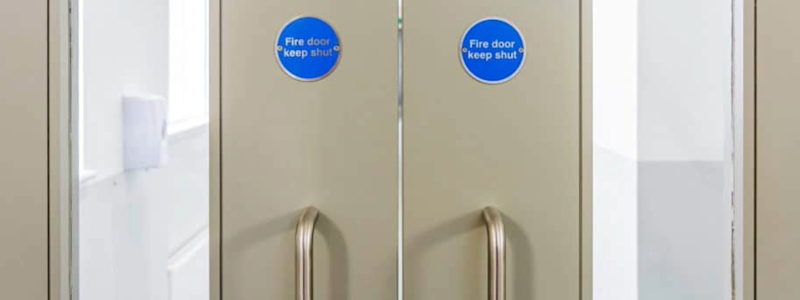
Fire doors should be distinct from regular doors, that’s where BS 5499-compliant signage comes in. Signage must indicate the fire door type, basic instructions for door use, and any extra appropriate safety requirements, such as the nearest exit.
Critically, the location and placement of fire signs must be easily visible, consistent, and in simple language.
Limitations on fire doors
There is a strong emphasis on ensuring that not only is each part compliant, but that they are compliant when installed together.
Some third-party certifications, such as Certifire, are only valid when a particular set of components is used. For example, a door may be Certifire approved, but if an alternate set of hinges is used to attach the door, this will need to go through the Certifire process again.
How can Viewpoint Field View help?
Selecting the right components is just one aspect; it is equally important to have proof that the installation meets standards. This is where a tool like Field View becomes invaluable.
Using the forms functionality within Field View, it's possible to mandate the submission of product specifications and installation proofs, while incorporating an approval process. This ensures that installations are only signed off when all parties are in agreement. If issues arise, there is an opportunity to create a task for corrections, which can then be completed and logged. This process creates a complete audit trail of actions, processes, and outcomes that the Responsible Person(s) can reference if needed.
Customer story: Isoler
Established in 1992 and part of the Northern Bear Group, Isoler works across the UK specialising in fire protection, including active and passive systems, fire door maintenance and installation, fire stopping and compliance surveys.
Josh Watson, Isoler’s Joint Managing Director, said: “When it comes to working in the fire safety industry, delivering traceability and ensuring that everything is recorded thoroughly and made easily accessible for future reference is essential. Not only in terms of legal compliance, on the back of the Building Safety Act 2022, and delivering the ‘golden thread’ of data but also a moral responsibility.”
“As a business, Field View offers us assurances of traceability. We know that everything is logged correctly and stored digitally on the cloud-based system. Our teams can have instant visibility into the progress on site from here in the office, including quality control and installation sign-offs. ” Josh continued, “Working within the fire safety industry has its challenges, but Field View provides us with an easier, streamlined process to deliver the level of compliance required by the Building Regulations.”
Discover how Field View can help your business adapt and stay fire-compliant in all areas.


