

By Lawrence Smith, Senior Vice President, Trimble Construction Management Systems
This article was originally published in August 2026 in Constructor, the magazine of the Associated General Contractors of America.
Across the construction industry, small and mid-sized contractors make up the vast majority of firms. Yet for decades, they have been challenged when it comes to accessing enterprise-level technology benefits supporting larger contractors.
The imbalance is shifting.
Democratization of technology, driven by cloud-based platforms, predictable subscription models and mobile-first workflows, is lowering the barriers to entry and ongoing success. Tools that once required large capital budgets, dedicated IT teams and tech-savvy end users are now purpose-built, easier to use and right-sized for smaller contractors.
At the same time, a range of pressures—from labor shortages to rising competition and tightening margins—are making technology a necessity rather than a luxury. For smaller contractors, accessible tools are becoming a critical force multiplier, helping teams operate with greater visibility, control and consistency across projects. The impact goes beyond productivity. Better data and coordination enable smarter decisions, stronger financial performance and the ability to compete for work that was once out of reach.
Democratizing innovation
For years, cost was one of the biggest barriers to technology adoption in construction. Large enterprise systems required significant upfront investments in software licenses, hardware, and implementation. For smaller contractors, those investments often felt out of reach and reinforced a familiar mindset: the way we’ve always done it is good enough, the cost to change is too high, and the payoff is uncertain.
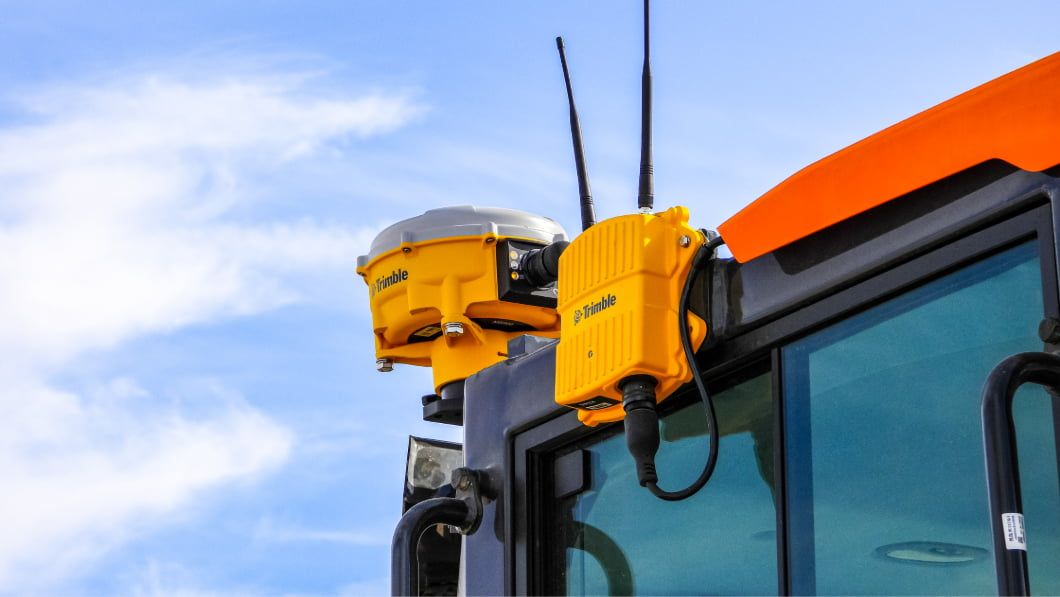
Hardware can now be purchased via subscriptions, lowering up-front costs while ensuring up-to-date capabilities.
That model is changing. Many construction technologies now follow an as-a-service model. Contractors pay for what they need and scale over time. Instead of making large capital expenditures (CapEx), companies can adopt tools gradually via subscriptions that become operating expenses (OpEx) aligned with business growth. Increasingly, vendors are also offering bundled, integrated solutions that combine core capabilities into more accessible, cost-effective offerings tailored to small contractors. An example would be a package that includes integrated applications for estimating, performance tracking, and project and financial management.
Advanced capabilities, from building information modeling (BIM) and connected project management to machine control, are becoming more accessible. In particular, machine control is no longer limited to large contractors with significant capital budgets. Hardware subscription models are lowering the barrier to entry, allowing smaller contractors to access advanced field technology with less upfront investment while ensuring they always have access to the latest upgrades.
Equally important, modern construction software has become more intuitive. Simplified, mobile-first interfaces mean contractors no longer need a long learning curve or a dedicated IT department to get started.
Cloud-based project management platforms, such as Trimble ProjectSight, enable teams to manage documentation and track job progress without complex infrastructure. Financial management tools are evolving as well. Trimble Financials is a new AI-enhanced job costing and financial management software designed specifically to help small to medium-sized contractors track project profitability and streamline back-office workflows. It simplifies complex accounting tasks—such as budget tracking, invoicing and cash flow reporting—through a mobile-friendly interface and an intuitive AI assistant.

Trimble Financials is a new job costing and financial management application designed specifically for requirements of small business contractors.
The broader trend is clear: The benefits of construction technology are becoming more democratized, targeted and practical for everyday use by more contractors of all sizes.
Connected people, workflows and data
While accessibility matters, technology adoption alone doesn’t guarantee productivity gains. For many small and mid-sized contractors, “digitization” has actually created a new problem: the silo effect. When point solutions don’t talk to each other, data gets trapped in the “white space” between.
For years, tightly integrated workflows were something only the largest construction firms could afford. However, integrated software has become the great equalizer for smaller contractors, syncing the office and the field.
Many providers, including Trimble, are integrating applications across estimating, project management, time tracking, ERP and field tools, allowing data to move more seamlessly between systems without a heavy IT lift.
At the same time, common data environments (CDEs), such as Trimble Connect, are becoming more accessible and widely adopted, providing a centralized hub where project information can be shared, updated and managed in real time.
This shift from disconnected tools to connected workflows delivers a meaningful difference in daily operations. Instead of managing information across multiple systems, teams can operate from a shared, up-to-date view of the project.
The benefits are practical and immediate. Shared visibility across teams reduces errors, keeps the office and field aligned and eliminates manual handoffs. For small and mid-sized contractors, even modest improvements compound quickly.
AI: The newest member of the team
AI is another technology reshaping construction workflows by eliminating the administrative burden that slows small and mid-sized contractors down. Many of the most useful workflows are embedded within software applications, helping contractors move faster through tasks that once required hours of manual effort. Increasingly, these tools are intuitive and easy to use. Contractors can interact with them using natural language prompts, without the need for programming or specialized technical expertise.
For example, AI capabilities can extract and analyze data from drawings and models in estimating, project management and other applications, eliminating tedious manual effort. Similarly, AI can now automatically extract information from invoices or categorize job costs. Tools can incorporate these capabilities so contractors can ask straightforward questions like, “Which client has the largest outstanding invoice?” or “How are actual costs tracking against the project budget?” and get answers without digging through paper or spreadsheets
For owners and managers who wear multiple hats, this automation is a lifesaver. When routine administrative work becomes automated, they can spend more time focusing on the build itself.
Technology as a culture, not just a tool
For small and mid-sized contractors, digital transformation rarely happens all at once. The most successful companies start with one or two high-value workflows and expand from there. Over time, these improvements compound into connected construction, where information flows easily between the office and the field.
In an industry defined by tight margins and unpredictable conditions, this level of visibility and coordination can be the difference between simply completing projects and completing them at maximum profitability.
As technology becomes more accessible, it is also becoming a clear competitive differentiator. Smaller contractors that embrace these tools are better positioned to win more work, deliver projects profitably and operate with a level of consistency once reserved for larger firms.
At the same time, modern, easy-to-use technology plays a growing role in attracting and retaining the next generation of construction talent. For a workforce that expects digital tools and streamlined workflows, the ability to offer a more connected, efficient jobsite is no longer a bonus—it’s a requirement.


