Project profile
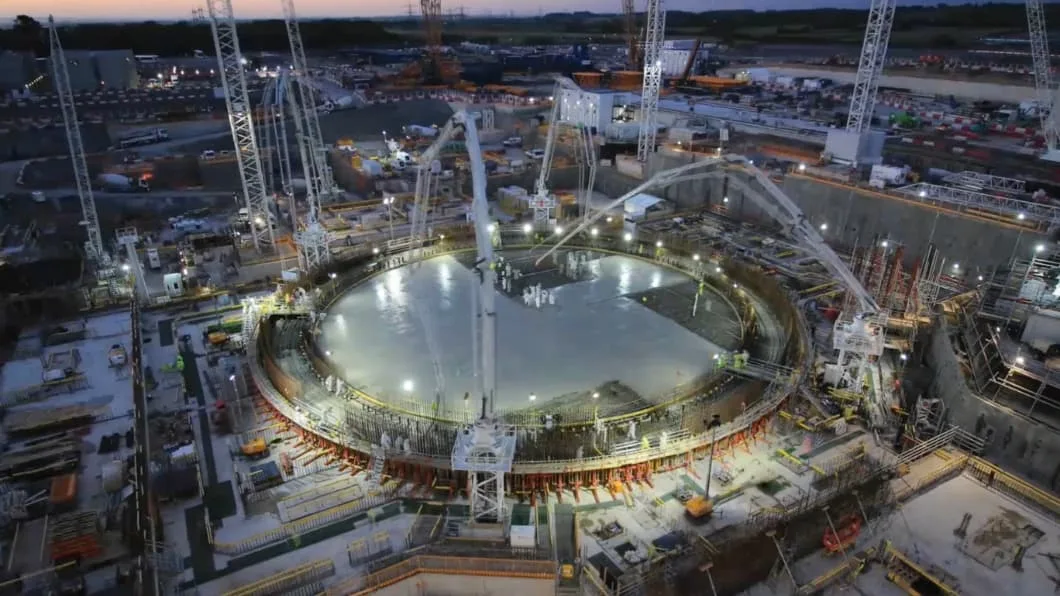
Valued at over £20 billion, the project will take around 10 years to complete, with 5,000 people estimated to be working on-site at any given point. Once completed, Hinkley Point C, located in Somerset, will be responsible for powering around six million homes with safe, secure and low-carbon electricity. It is a truly momentous civil engineering and construction project, marking the first UK nuclear power station to be completed in over a generation.
Customer profile
Responsible for providing the main civil engineering works on the project is BYLOR, a joint venture between Bouygues Travaux Publics and Laing O’Rourke– two of the most dynamic engineering and construction specialists.
They were faced with a business challenge of how to streamline the design and detailing of such a huge, complex project that spans over a decade.
Solution
Viewpoint Field View - Note that this product is only available in the U.K.
Choosing a tool to perform throughout the entire project
Unsurprisingly, digital technology has played a huge role in the Hinkley Point C project and BYLOR’s construction of over 60 major structures, including the buildings that will house the two identical nuclear reactors. As Alina Turda, Quality Systems Engineer - BYLOR said, "For a project of this scale, you would never be able to do anything with just paper."
At the very start of the project, BYLOR was tasked with deciding how to approach the design and detailing process and what software suite to use – a decision that would stay with them for a very long time, throughout the nuclear power station’s construction.
Andrew Jackson, Technical Director & Nuclear Quality Lead - BYLOR, said, "Right at the beginning of the project, we reviewed how best to design and detail such an incredible range of complex structures that we had to build. Having looked at lots of different options, we decided that the project would be delivered using Tekla Structures. This means that all concrete and reinforcement across all structures on site were designed in Tekla; stretching from the design office, to using that design on-site to get the structures built, to producing the records of what it is we have built. One thing that is mind-blowing about Hinkley Point C is the scale – we use the same detailing approach, from a one cubic meter concrete pour in the corner of a building to the UK’s two largest ever on-shore continuous concrete pours."
Benefits of using a digital design and detailing process
For BYLOR, there were two main benefits of employing a digital design and detailing process, as Andrew explained, "The first is the ability to clearly visualize and see what it is that we have to do. As a construction team, this helps us to better understand some of the designers’ complex needs, by spinning around the 3D model and looking inside. Likewise, they can understand our construction requirements and see how certain details may be difficult to build on-site and therefore suggest alternatives.
The second is coordination. Sometimes, as the civil builder, we need to remind ourselves that we are just one cog in the massive machine that is a nuclear power station. Being able to join together all the different complex aspects of the design and ensure that they work together is critical, and it’s only by looking at the 3D model that we can do that. Where issues have arisen on other nuclear power stations, it’s likely because components haven’t fitted together correctly. Often there may have been one designer detailing the reinforcement on one set of 2D drawings and another designer detailing the embeds on a second set of drawings. The first time those 2D drawings will be introduced to each other is in the hands of the team on site that has to make it fit.
By using the digital models, whether it’s the civil design being produced in Tekla or the other designs being produced in different platforms, we can put those together and make sure that, out in the field, everything is going to fit out of the box."
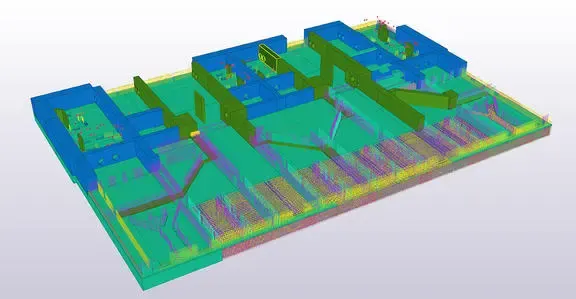
The BIM model for Hinkley Point C
Seeing how everything fits together in Trimble Connect
Given the fact that the construction of Hinkley Point C would span over a 10-year period, flexibility and adaptability were key.
Andrew continues, "We chose very early on to use IFC and that’s a decision that has proven to give us great flexibility in adapting as the industry adapts around us and as we develop. We can bring together in the IFC format all those different elements of design and use that design out on-site, typically using Trimble Connect to see how everything fits together. It also gives us a greater degree of control. Working with IFCs - where the information is issued, frozen, controlled and we can clearly tell who’s made it - we can demonstrate the control required for nuclear quality."
In addition to Tekla’s constructible modeling software, BYLOR also employed the cloud-based collaboration platform, Trimble Connect, facilitating the level of communication and coordination required on a nuclear project of this scale.
Tim Davies, Central Digital Engineering Lead - BYLOR, said, "Our main use of Trimble Connect is to get information that’s traditionally only available on laptops and desktops, such as 3D models and PDF documents, out of the office and onto the construction site. We can then give that information to the workforce, providing them with up-to-date, correct information at the right time. Trimble Connect has been critical in helping us to understand the very complex designs that we have here, designs that are difficult to convey with traditional 2D drawings. By giving the site team the ability to view 3D models out in the field as they are doing the work, makes it easier for them to build the right quality and get it right the first time. As well as allowing us to push data and information out to the field, Trimble Connect can also be used to get data and information back from the field. For example, by using the status sharing tool to track the progress of our installation."
Get the whole story on the construction of Hinkley Point C
Tekla software and Trimble Connect are just a small part of the Trimble portfolio of products that have been used and continue to be used by BYLOR on the construction of Hinkley Point C, one of the biggest and most complex projects in Europe.
In summary, a range of Trimble products have been present throughout the Hinkley Point C nuclear power plant project, through the design process with Tekla, the construction process with Trimble Connect, and the progress reports, records and data traceability with Viewpoint Field View.
A full case study video is available to watch online, where you can hear the full testimonials from some of BYLOR’s key players.
