

Inspiring the next generation at STEM summer camp
Ask any educator or parent how a child discovers a new passion, and they’ll point to a specific moment. A 7-year-old falls in love with football the first time they’re brought to a match. A 13-year-old discovers a passion for welding after taking it as an elective. A 16-year-old discovers their passion for drawing when they visit a museum. In short: exposure to new experiences is essential to every young person’s education.
But what about exposure to new technologies?
That answer can be found at the Summer STEM Camp. There, the Liverpool FC Foundation and the Trimble Foundation have come together to prove that technology can be the catalyst that drives students to broaden their career aspirations while leveling a playing field that too often tilts against those born into less affluent postcodes.
About the partnership
Liverpool FC Foundation, the official charity of Liverpool Football Club, has been delivering STEM programming for three academic years. The Foundation recognized that while schools were eager to develop STEM opportunities for their pupils, many faced barriers: either access to the technology that makes learning exciting, or the specialist knowledge to deliver it effectively.
"Our primary school teachers have to try and be experts in everything, and that's not possible," Matt Parish, CEO of the LFC Foundation, explained. "We're keen to do more of what we're good at and do more where we can have the most impact."
By pairing the deep community roots of the LFC Foundation with Trimble 3D design technology, this partnership connects local needs with real-world career possibilities. What started as hands-on workshops with robots, coding and engineering challenges has grown into a much bigger initiative.
The program replaces abstract classroom concepts with a tactile experience by placing professional 3D modeling tools directly into students' hands. As of the start of last term, participants have been building, refining and sharing their own designs. To build on that momentum, Trimble experts trained LFC Foundation staff so the pilot can be rolled out to more schools in the coming year.
Matt described it simply: “They're not better teachers than the teachers, they're just bringing a different skill set to assist."
Coordinating the STEM summer camp’s activities was Wendy Napier, Schools Manager in the Educational Life Skills department, a woman with enough energy and positivity to wrangle a room full of children and engineers. Wendy oversees a team that delivers educational classes across the Humberside area and writes a STEM curriculum that meets the needs of the young people they work with.
She explained how the partnership has developed. "STEM has mostly been hands-on combinations of different robots, coding and a bit of engineering," she said. "Just getting the young people to work together, to explore, to build, to create, to debug, to test—practicing all those skills that they learn in school by putting it into practical application."
Inside a day of practical STEM application
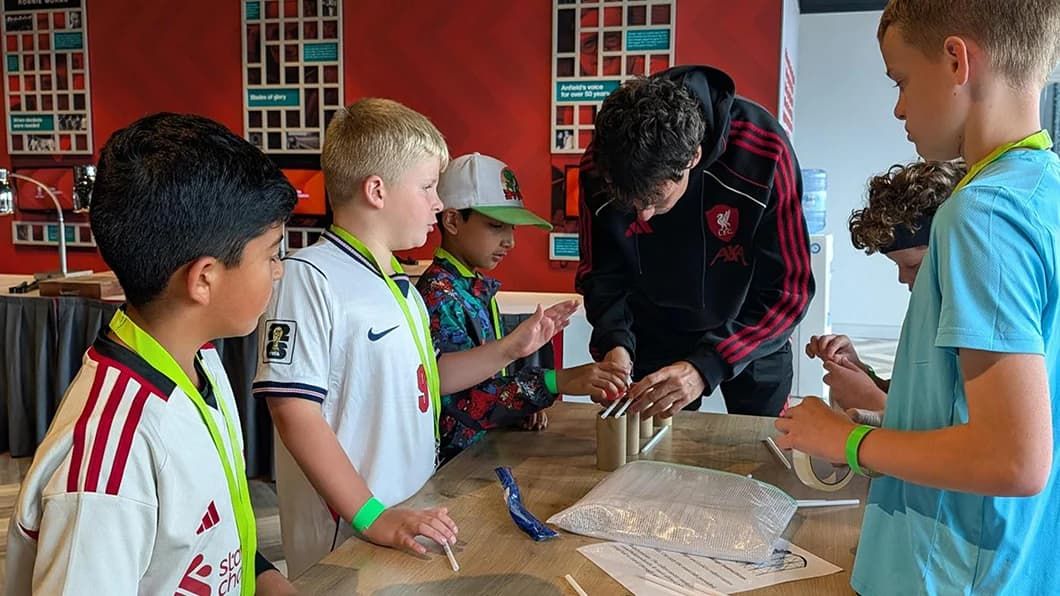
At 10am, around 80 young innovators filed into Anfield’s The Beat Lounge, greeted with big high-fives from a very excited Mighty Red (Liverpool FC’s team mascot).
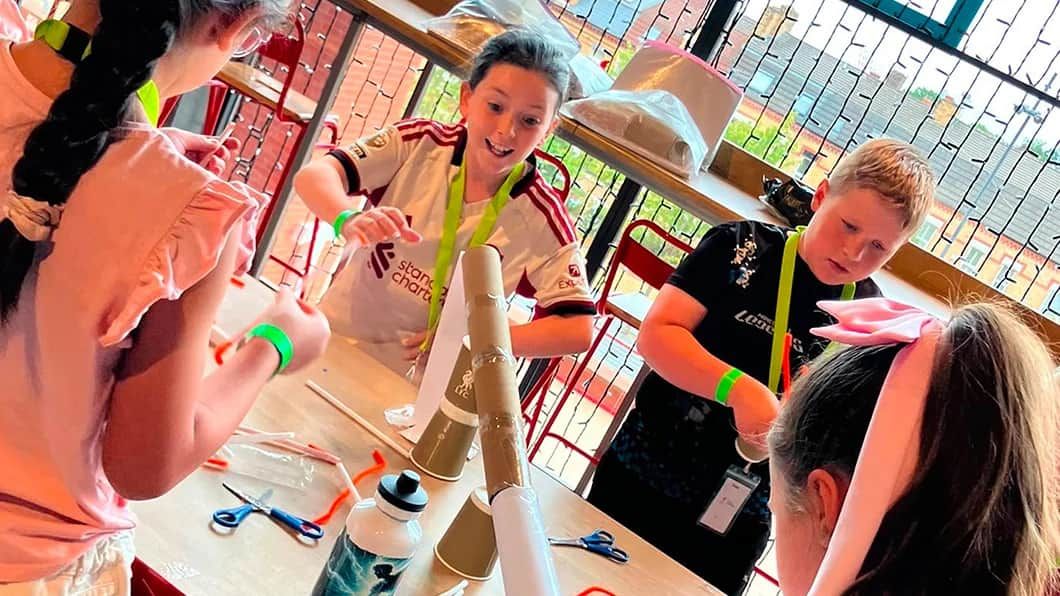
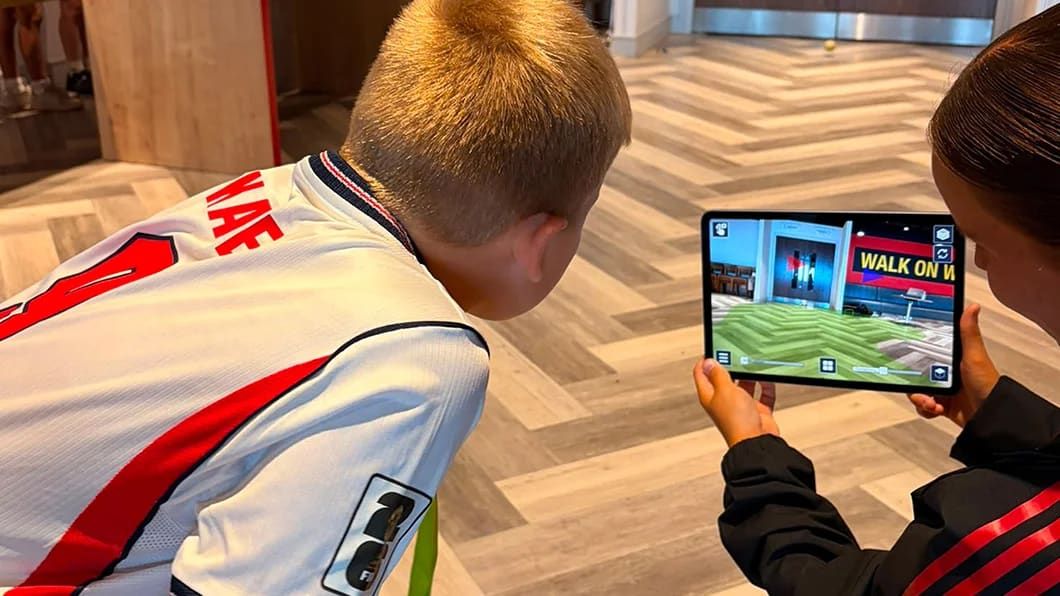
The day was structured around a carousel of interactive workshops led by Trimble experts (one even dialing in from Colorado at 3 am local time). Participants rotated through stations featuring 3D modeling, virtual reality experiences, coding with iRoot robots and an engineering challenge to build a functional mini-rollercoaster. During many of the activities, students were given hands-on access to advanced Trimble hardware and software they might not otherwise encounter, including SketchUp, Tekla Structures, SiteVision and a Trimble X9 scanner.
“There is skill development throughout the day,” explained Wendy Napier. “Exposure to industry professionals, jobs that are out there, the skills required, the journeys it took to get those jobs.”
“Having real people who do these jobs come in and work with them, well, Trimble has been great at that.” Matt said. “It brings these jobs to life for the kids and shows how they might fit into their everyday lives moving forward.”
Beyond the screen
Long before smartphones, teachers and parents worried about how new technology could impact young minds. The dominant narrative around students and technology centers on protecting them from distraction and digital noise. Concerns about shortened attention spans and a lack of effective guardrails are understandable. Yet watching those children work together revealed something entirely different.
Bright-eyed, attentive curiosity spread across the room. Students were engaged, eager and curious about the new technology. They were creating, problem-solving and working together. In the SketchUp workshop, they worked on iPads with partners rather than in silos.
Wendy discussed the importance of nuance when thinking about children’s technology use, “I have lots of conversations with parents that say, ‘My child, they just go on Minecraft, they just game.' I have to say, ‘They’re not just gaming. The skills they’re putting into play by building their own arenas, interacting with people who come from different backgrounds, cultures, who live in different countries—it’s much bigger than sitting in front of that one computer screen.’”
She added, “And the money they can unlock from those skills? It’s huge.”
Open to new opportunities
In the annual BBC Bitesize career aspirations survey, which asked over 4,000 children aged 13-16 about their futures, engineering came out as the second most desirable career choice. But aspiration and access are not the same thing. Just under half (46%) of teens surveyed said their background always or often affects the likelihood of getting the job they want. A sobering statistic, but one that initiatives like the STEM summer camp are actively working to challenge.
“We’re very passionate that irrespective of the postcode kids are born into, it shouldn’t affect their outcomes,” Matt Parish emphasized. “Everyone should have the same opportunities and access to opportunity. This is a big part of that.”
Exposure to new potential career pathways starts with practical spatial concepts. Translating 2D ideas into 3D. Figuring out how structures fit together. Spatial awareness. These are the building blocks of careers in architecture, engineering, game design and countless other fields that students might not have considered otherwise.
"When we think of STEM, we just think of an old-fashioned scientist," Wendy observed. "There's not the understanding that there are so many roles under the umbrella of STEM."
The camp set out to change that mindset. When a Trimble engineer revealed that the day's software was used to design the Big One rollercoaster in Blackpool, and LFC Foundation staff demonstrated robotics careers in action, those once-unimaginable roles felt entirely within reach.
A passion for learning
Matt summed up the importance of the day perfectly: "There's a statistic that often gets quoted. Around 65% of kids in school today will be doing jobs that don't even exist yet. Initiatives like the Summer STEM Camp are imagining into that space."
The two foundations ensure that access to these opportunities isn’t limited by demographics. And when asked what he hoped the children would take home beyond the technical skills and completion certificates, Matt’s answer was immediate.
"Enjoyment, fun, passion for learning," he said. "The world's a big old place and there's so much opportunity for them."
That is the real benefit of programs like these: The children work with highly complex hardware and software, and take joy in that work. One day, one of these students may be asked how they discovered their passion for structural engineering or design. They’ll point to the specific moment at summer camp that turned a once-abstract concept into a future career.
Learn about the SketchUp for Schools pilot being rolled out across Liverpool in collaboration with the LFC Foundation


