

By Karin McConkey, Trimble Senior Product Marketing Manager
Documents and drawing are the lifeblood of construction, coursing across every phase to govern decisions and guide activities. Within them, and in discrepancies between them, hides a lot of the risk inherent in delivering projects on time and budget.
Purpose-built AI gives contractors the intelligence they need to identify that risk early and act on it to avoid profit-crushing consequences that can be impossible to recover from in the field. ROI results of this risk intelligence technology are highly proven, new capabilities are emerging rapidly and benefits apply to small and mid-size contractors as well as those managing the largest operations.
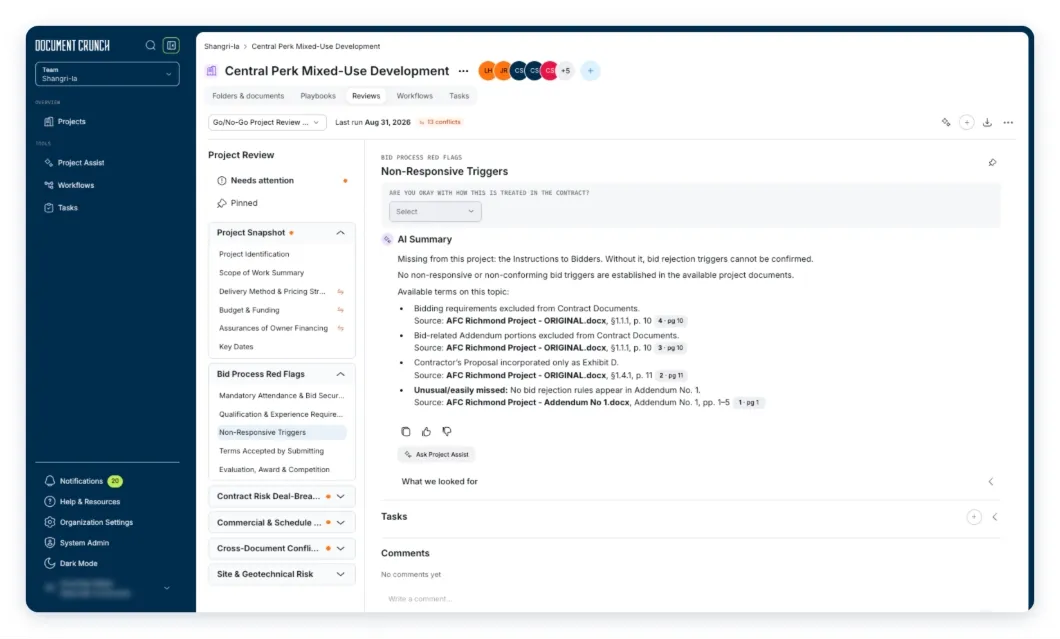
Purpose-built AI finds risk within and between construction documents and suggests how to act on the intelligence.
Finding risk where it hides
As construction projects grow larger and more complex, so have the volume and complexity of contracts, specifications, drawings and countless other documents used from design and preconstruction to closeout. Meticulously reviewing, recognizing and acting on risk within individual documents can overwhelm even seasoned experts.
Individual documents, however, are also only the tip of the iceberg. The most critical and potentially costly risk rarely exists within a single document, clause or line item. Instead, it lurks in conflicts and inconsistencies between documents.
A contract requirement clashes with a specification. Material availability won’t accommodate an installation deadline. An estimating assumption is incompatible with an environmental regulation. A change order expands a subcontractor's scope without a corresponding revision in drawing notes.
Purpose-built AI scales expertise
This is where purpose-built AI comes in and gives contractors that deploy it a differentiating competitive advantage. Trimble Crunch AITM technology supplements human expertise, reviewing and comparing data from construction documents at a scale, speed and level of consistency impossible to match.
General-purpose language models lack the domain-specific understanding required to effectively navigate construction terminology, markups and multi-layered document hierarchies to surface risk accurately and comprehensively.
Purpose-built AI — the engine behind Trimble CrunchAI — infuses the document analysis process with specialized construction industry knowledge and historical insight. These capabilities democratize senior-level expertise across the enterprise, establishing institutional consistency during contract reviews, buyout phases, and risk evaluations. Crucially, domain-specific AI provides complete source-linked traceability, linking every insight directly back to source clauses so teams can verify findings and maintain firm control over critical decisions.
Adding drawings to the mix
The latest advancement in AI-assisted risk intelligence is integration of visual drawing sets into the cross-document analysis mix. Trimble CrunchAI can now extract, index, and query text buried across hundreds of dense drawing sheets, including callouts, allowances, and legend notes. By evaluating drawing sets in tandem with project specifications and contract terms, teams can automatically flag discrepancies, resolve scope omissions and clarify obligations.
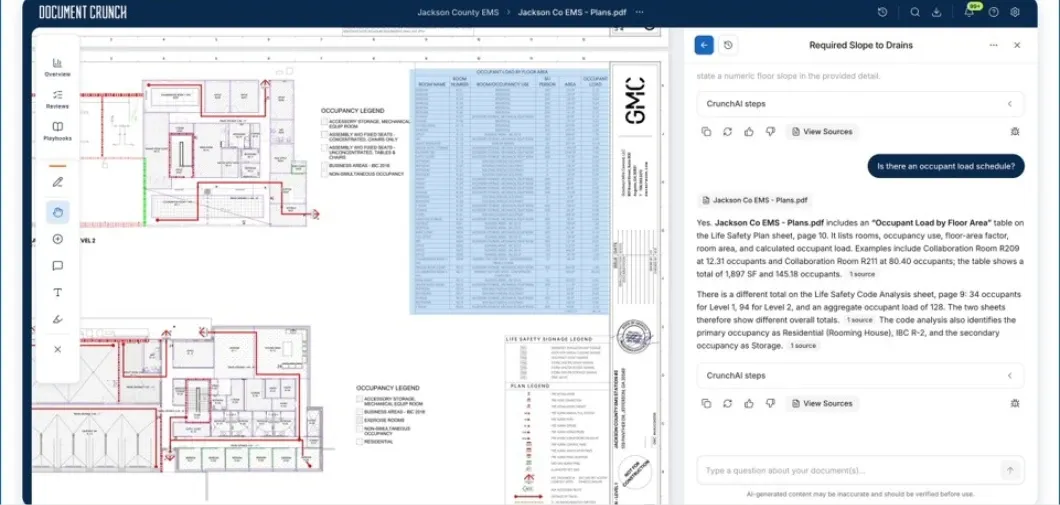
Trimble CrunchAI can now evaluate construction drawing sets, along with a wide range of other construction documents, to surface risk.
Not just for the big guys
Benefits of risk intelligence technology are clear for contractors working on massive projects with a high volume of documents and subcontractors. This is where even single oversights can lead to massive financial losses. These three advantages for smaller contractors, including specialty subcontractors, can be equally important.
Level the playing field: Specialized, in-house legal and contract expertise is common at large construction companies. It’s a luxury smaller contractors rarely have. Risk intelligence technology is an equalizer, spotting high-risk clauses, unfavorable payment terms, and hidden liabilities and translating complex legal terminology.
Bid more competitively: Smaller contractors often have to pad estimates to cover unseen liabilities. Using AI risk intelligence to accurately identify actual exposures upfront, smaller teams can bid more aggressively and confidently pursue more jobs and more complex jobs.
Protect margins: Large general contractors are usually in a stronger position to absorb losses from unrecognized risk. For smaller and specialty contractors, these losses can completely erase project margins or jeopardize business solvency itself, making risk management even more critical.
Accessible, tiered pricing for risk intelligence software and seamless integration with other workflows and applications also allow growing contractors to scale their bid and project volume safely without significantly increasing administrative overhead, turning risk management into a true competitive edge.
Closing the risk gap
Contractors have to accept uncertainty as an inherent part of the dynamic climate they operate in. They should not accept that losses due to risk they didn’t see coming or act on in time are just an unavoidable cost of doing business.
Deploying purpose-built AI that connects contracts, specifications, drawings and other documents within a unified intelligence framework, allows contractors to proactively protect operating margins and optimize project delivery.


