Customer profile
Destia is Finland’s biggest infrastructure service company, with an annual turnover of 603 million euro in 2022 and a team of 1,600 employees working on over 1,000 projects per year. Their projects are mostly for road construction, rail and urban services, energy networks, and maintenance. Destia is part of the International Colas Group, a listed company from France, with Bouygues S.A., a world leader in the construction and infrastructure maintenance of transport infrastructure, as a majority stakeholder. The Colas Group employs 57,000 people in 50 countries on five continents.

Jaakko Taipale, project manager at Destia, has over 15 years experience managing civil engineering contracts and specializes in project management, bridge building, bridge repair and designing concrete structures.
Markku Savola, development manager at Destia, is involved in bridge and concrete structures design and development, with the bridge model process development as one of his key tasks.
Business challenge
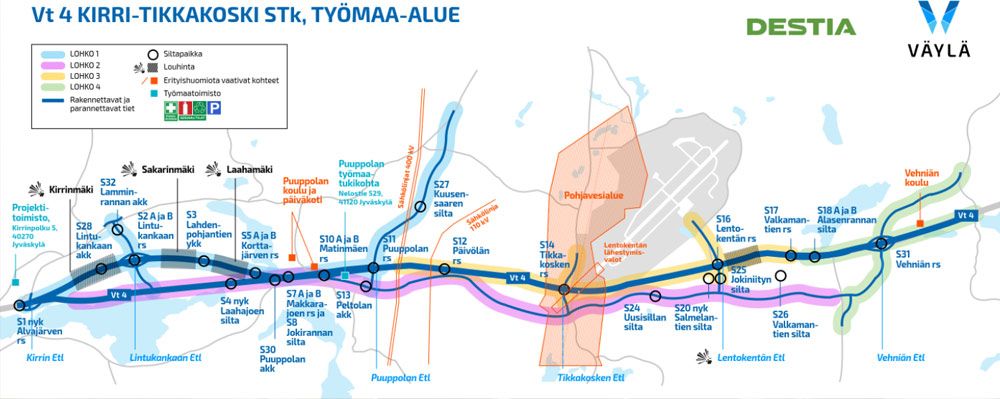
Connecting all the stakeholders on the large scale Highway 4 project, comprising 17 km of four-lane highway, with six interchanges, 20 km of auxiliary road, 25 km of pedestrian ways and a staggering 30 bridges.
Solutions:
Benefits:
Access to detailed 3D models in the field
Connecting all the stakeholders on the project to a single source of the truth
Improved project efficiency and quality by using an IFC model-based process
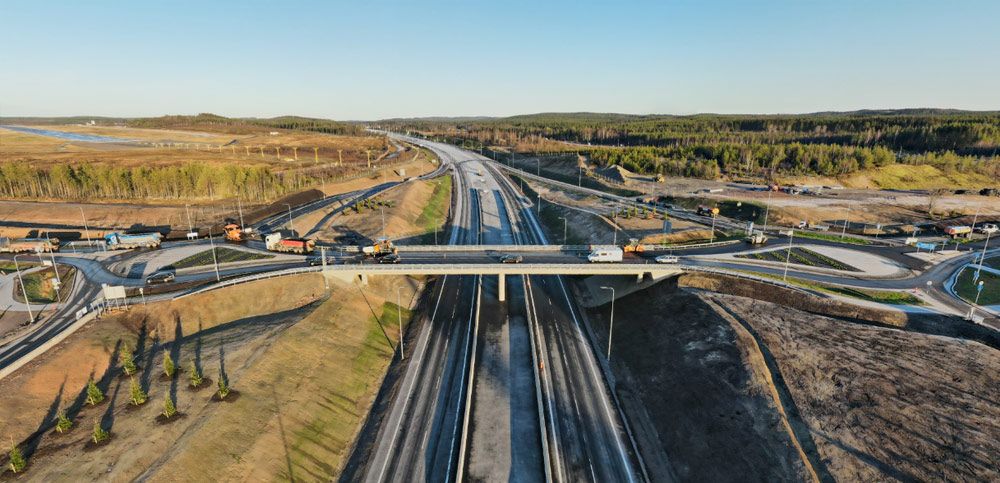
The Highway 4 project is a project owned by the Finnish Transport Infrastructure Agency. The 139 million euro development, design and build construction project north of Jyväskylä in central Finland comprises 17 km of four-lane highway, with six interchanges, 20 km of auxiliary road, 25 km of pedestrian ways and a staggering 30 bridges.
Total earth excavation for the project amounts to 3,000,000 m3, with 1,600,000 m3 of rock blasting to overcome elevation, with the highest cross-section at 30 meters. For the main and auxiliary roads, a total of 350,000 metric tons of asphalt has been laid. The design development phase started in October 2018 with the work finished in October of 2023.
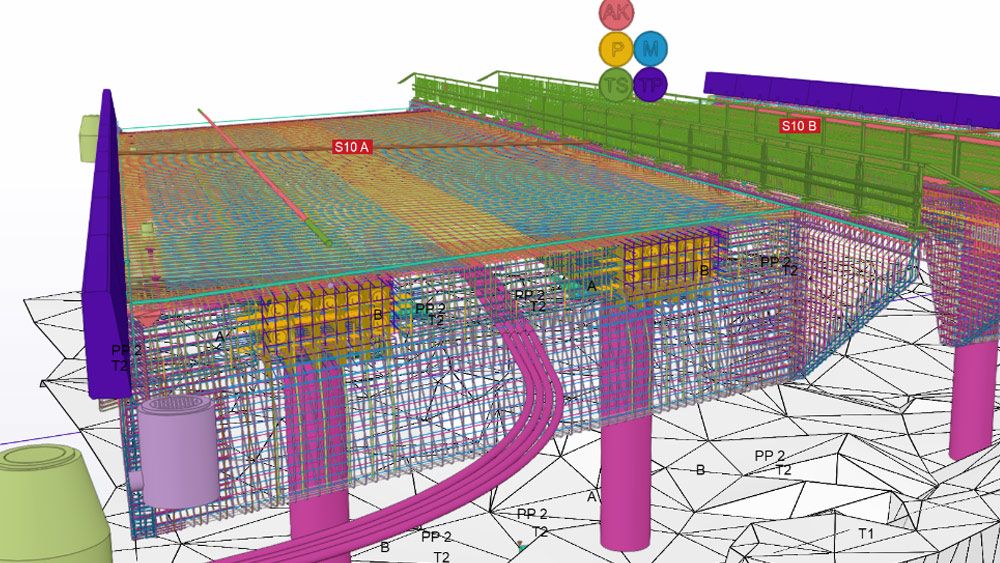
Building Information Management (BIM) was fully utilized with the Trimble Connect cloud-based platform connecting all the stakeholders on the project around 3D bridge models. The designers, the project office, the supervisors in the field, the machine operators and surveyors, and even the customer were able to access the models. Jaakko Taipale explains: “The Finnish Transport Infrastructure Agency was used to working with Trimble Connect for information sharing. They were however not used to working with it at this scale and depth. All designs were approved through Trimble Connect, making it a very impactful tool that played a fundamental role in the project.”
A model-based first for Finland
In Finland, infrastructure clients typically approve the bridge designs (as PDF documents), after which construction can begin. On this project, only IFC models were used for inspections and approvals, making those the dominant contract document.
“That also was a first in Finland,” Markku Savola explains. “Never before had IFC models been at the core of the design approvals process. This also meant that all parties involved, suppliers, subcontractors, and the customer, had to embrace the idea of the models being the absolute truth on the project, and adapt their way of working to that premise.“
Sweco, as a subcontractor for bridge engineering, invested in parametric modeling by using the link to Tekla Structures from Grasshopper software. This method allowed for easy exploration of design alternatives in the early phase. For them, Trimble Connect served as the main real-time data-sharing tool.
For the final inspection, BIM — or in this case rather: Bridge Information Models or BrIM — were shared through the Trimble Connect environment with the project stakeholders (from the designers to the main contractor and back and between the contractor and client).
Jaako Taipale comments: “Applying the BIM methodology to the extent that we have done on this project, has improved the quality throughout the whole process. As with any heavy-impact changes to a process, we encountered some resistance in the beginning. But after completing a few bridges, the transition to model-based project management was no issue anymore and every team member fully embraced model-based production.”
The bridge rebar fabricator was also able to import rebar models for many of the 30 bridges’ concrete reinforcement, created using the IFC standard, directly into its production system using Trimble Connect. Dimensional construction measurements were also taken directly from the IFC models, for formwork measurements for the CIP contractor and for scaffolding design.
“Overall,” Jaakko adds, “the model-based way of working, and more particularly working with IFC models, can be easily integrated into many different applications and enables large-scale automation and development of automated workflows like the calculation of quantities, automatic inspection tools or process logging tools. In coordination models, it makes the integration of structures easy to verify.”
From design to the field
On the Highway 4 project job site, visualizations and virtual construction by BIM provided an improved way of working compared to the traditional drawing-based operations. Both job supervisors as well as surveyors were able to access the detailed 3D models in the field using mobile technology, such as Trimble TSC7 controllers running Trimble Access field software.
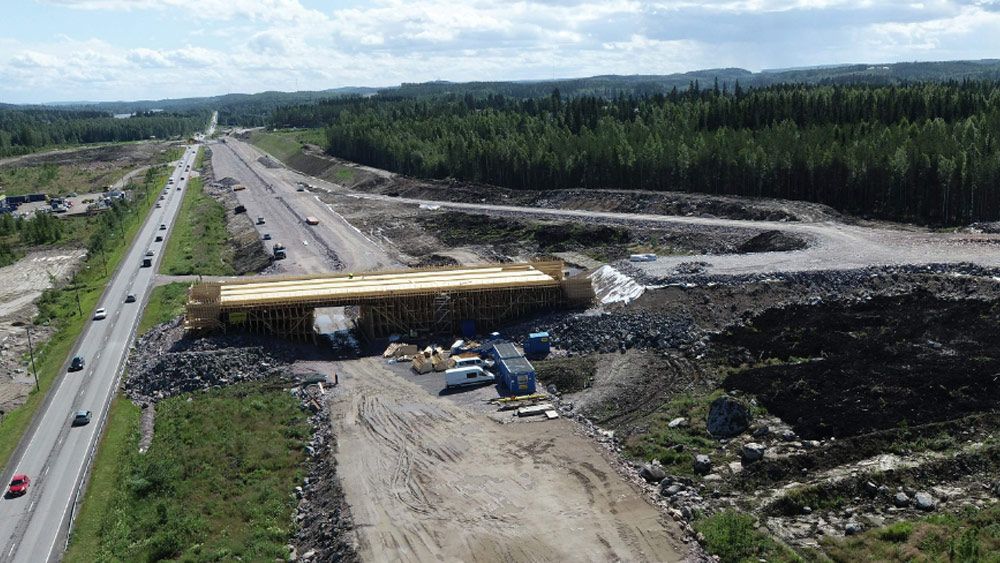
In a traditional setting, about half of the design time is dedicated to producing drawings after the model-based design is complete. However, on this project, the contractor was able to speed up the construction schedule by 20–25 weeks in the bridge design process by not having to guide detailed bridge drawings through inspection and approval.
The development, design and build nature of the project made long-term development possible. And in spite of the initial development work taking time to adopt and get up to speed with processes, the up-front time paid off as the project was completed eight months ahead of time.
The project also proved an important technology milestone for the industry as a whole, as the IFC model unequivocally proved its quality and value. Furthermore, the model-based process improved the efficiency and quality of the project, leading to sustainability gains as a result of minimized rework and highly accurate estimates of required materials.