

Measuring the Kop and mapping passion with precision at Anfield Stadium
Anfield, home to Liverpool Football Club, is widely regarded as one of the most atmospheric grounds in football with a reputation for turning matches on the strength of its noise. Behind the south goal, that deafening sound emanates from a single, continuous wall of spectators: the Kop.
The Kop gives LFC a powerful advantage when playing at home. It’s hard to argue, especially in the seconds after a goal. 12,000 people, shoulder to shoulder, roar and jump and sway. Scarves go up as the clamor reaches a crescendo. It has been sung about, filmed and broadcast to countries across the globe during countless matches.
Now, thanks to Trimble technology, the structure has a living record and, for the first time, a way to map the story of the match by the excitement in the stands.
Kop of Theseus
If you repair and replace the parts of a ship until nothing of the original remains, is it the same ship? Ask a Liverpool fan the same of the Kop, and the answer is clear.
“Of course it’s the Kop. What are you on about?”
Over the decades, the Kop has seen extensive renovations. The concrete and steel that hold it up today aren't the same materials it opened with. Replace enough of a building and the questions stop being philosophical: Which parts are actually there now? What are they made of? Who's keeping track of it all?
In many historical structures, the most useful knowledge lives in the working memory of retired staff and decades of scattered documentation. Architects made drawings in the format of their decade, filed by the department that commissioned them, then stored wherever that department kept things at the time. Later architectural changes were often only partly documented and stored apart from the original plans, leaving Anfield without an accurate record of what stands there today.
The result is a historical puzzle that modern teams have been forced to solve without having all the pieces. Or even knowing what pieces exist. Until now.
For the record
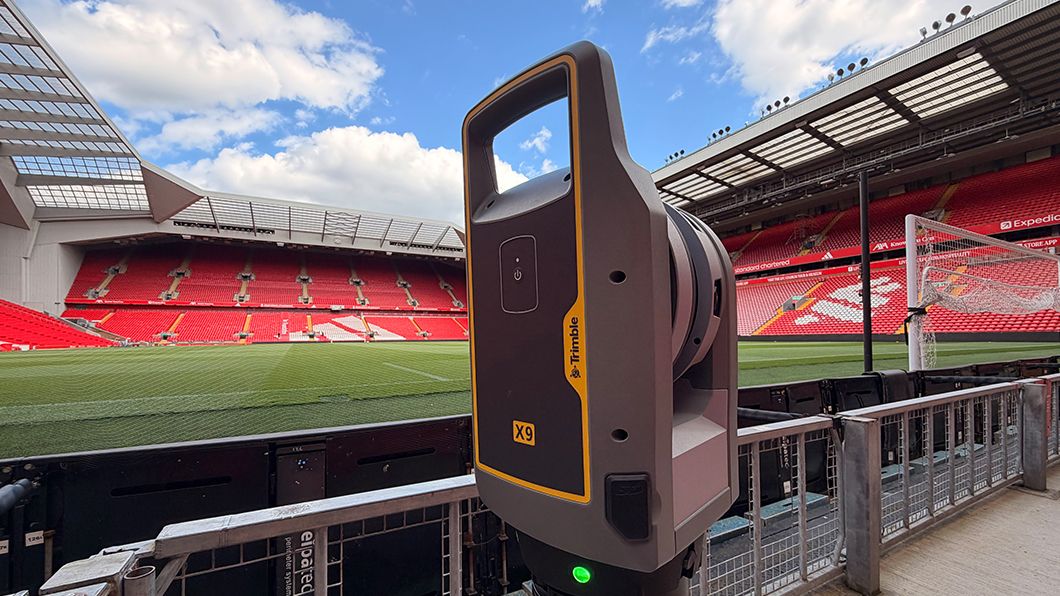
The challenges described above are not unique to Anfield. But scanners like the Trimble X9 and survey instruments like the Trimble SX12 can record a structure exactly as it stands, no matter how much of its history went undocumented. While this level of monitoring is traditionally reserved for heavy civil infrastructure like dams or bridges, applying it to an iconic stadium provides a rare look at structural behavior under live crowd movement. The result is a living model that provides millimeter-accurate measurements and gives teams the certainty they need to understand the past and visualize the future.
Knowing this, Trimble and LFC joined forces and got to work. In one day, the team scanned across the stadium: the Kop itself, taken from more than a dozen instrument positions, the pitchside area behind the advertising boards, three of the stadium's hospitality lounges and the fan zone. The primary instrument used was a Trimble X9, a powerful 3D laser scanner combined with Trimble Perspective software, which automatically registered the scans together and uploaded them to Trimble Connect, a cloud-based common data environment that allows project data to be shared seamlessly across teams.
All that data is then used to build detailed point clouds of the surrounding environment. These renderings capture the most minute details, even down to the individual bolts on a beam, with millimeter accuracy. Shared in the cloud, this interactive model enables teams in different locations to click on any beam to measure it, inspect hidden corners, and spot differences between historical drawings and real-world architecture.
Alongside the Trimble X9, the team used the Trimble SX12 to measure precise angles and distances to specific targets as well as repeatedly scan strategic areas, and capture calibrated, georeferenced site imagery. That data was used to establish the survey control, meaning the network of fixed reference points against which everything else is measured. This baseline gave the team precisely what they needed to see the true impact of fans during a match.
The strength of its sound
Executing a test that had never been done before required bringing together an array of advanced monitoring technology. A vibration sensor that measures energy continuously at a high frequency was placed beneath the Kop and connected to Trimble 4D Control software. The Trimble SX12 stayed in position, continuously re-measuring survey control points using the Monitoring module within Trimble Access.
As the stand filled, the baseline lifted. Another spike was seen at kick-off. The Kop was coming to life. The baseline jumped again after the first goal, and again, when the second goal was disallowed. On it went throughout the match, the movement of the Kop reflecting the action of the game. For every victory cry, frustrated stomp and swaying chant, the readings moved. Halftime settled the line back down. Full-time sent thousands of people toward the exits at once, and the sensors recorded that too, a rising line that plateaued before slowly declining as thousands of fans shuffled toward the exit.
None of the findings had to be reconstructed afterward from memory or guesswork. The story of the match was written into the data as it happened.
A living legacy
Mapping the story of a match provided never-before-seen insights. The impact of the crowd was well within the expected range, and yet there is something remarkable about seeing it. The team, driven and empowered by the roar of the fans. The sound of the fans, amplified and supported by the stadium. The stadium, absorbing and reflecting that excitement as it was built to do. And this is just the beginning.
There are more measurements to be made. More work to be done. Lounges will be remodeled, and with Trimble technology, those who endeavor to ensure every match day gives fans the best possible experience will have a digital record of Anfield that will grow along with it for decades to come.
One thing is constant: no matter what, the Kop will always be the Kop.
Learn more about the Liverpool Football Club and Trimble partnership.


