

If you’re the type to consume construction industry analysis, chances are you’ve lost your appetite for reading about the data center buildout. Lord knows (or at least the AIs those data centers power know) I’ve lost my appetite for writing about it.
Yes, the data center boom is in many ways unprecedented. Yes, the ripple effects are touching everything from labor and material costs to long-term interest rates. And yes, it’s the single most important aspect of the construction industry right now.
Got it? Good. Now let’s see if I can write an entire column without the D-segment again.
Tariffs (remember those?) aren’t done yet
In some ways, tariff-related price increases are behind us. The February 2026 Supreme Court ruling against the IEEPA tariffs materially lowered the effective rate, and some producers who didn’t get relief from that ruling have finished passing on price increases to their customers.
In other ways, tariff-related price increases are ongoing, and that includes just about every way that matters to the construction industry.
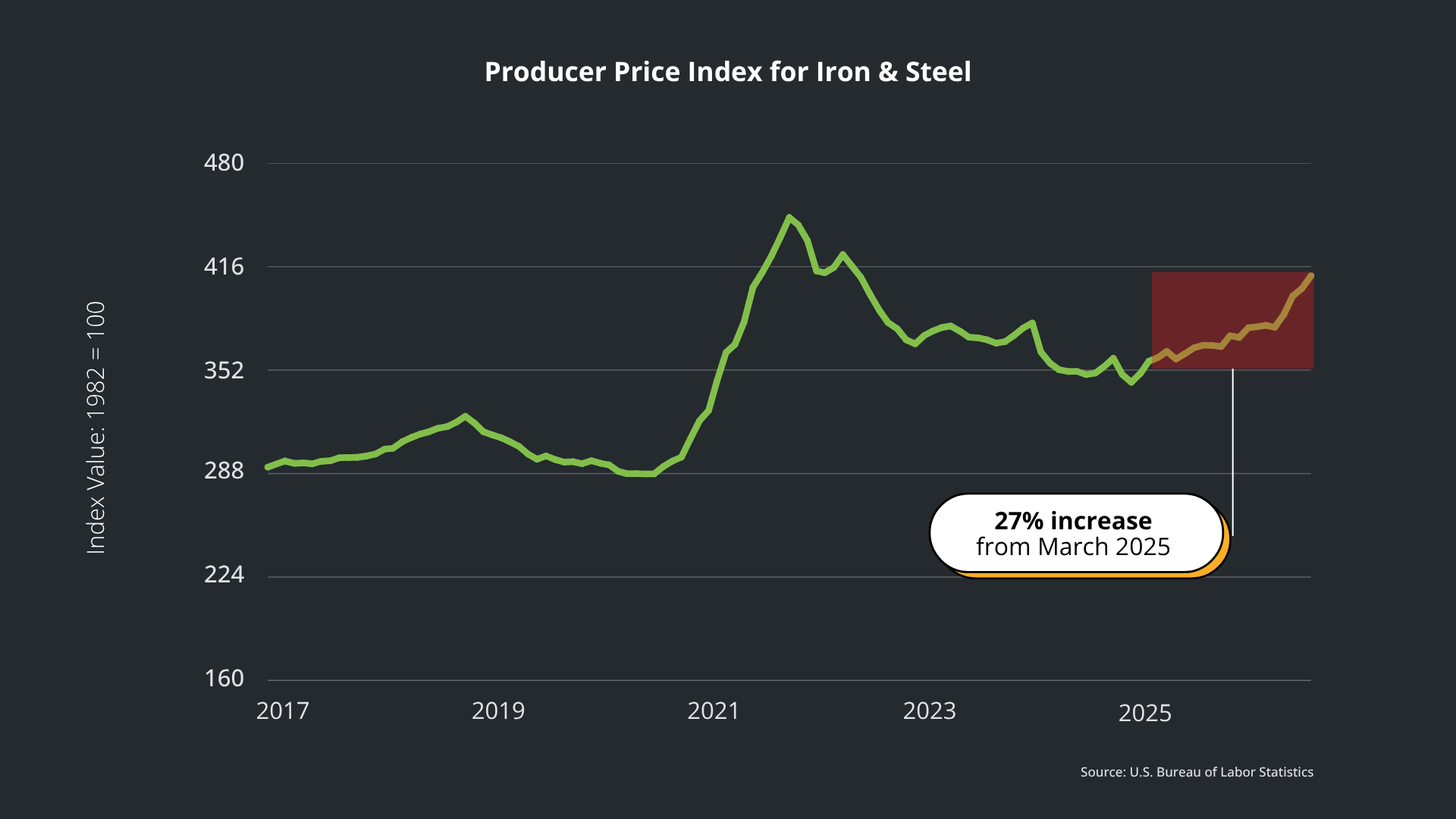
Take, for instance, iron and steel tariffs, which have been implemented using the more legally durable Section 232 of the Trade Expansion Act of 1962. The current round started in March 2025, when 25% iron and steel tariffs were reinstated and expanded. Those tariffs were increased to 50% for most countries in June 2025. Then, in April 2026, those tariffs were restructured to include the full customs value of most derivative products.
Source: U.S. Bureau of Labor Statistics
The result has been a consistent and durable increase in iron and steel prices, which are up about 27% since that initial March 2025 reinstatement, well above the 5% economywide inflation observed over that span. Notably, iron and steel escalation has accelerated in recent months, with prices rising at a dreadful 51% annualized rate since May (yes, that has a lot to do with other factors, discussed below).
Iron and steel are the best example of this dynamic, but they’re not the only ones. Copper and copper product prices are up 31% year over year, while several types of aluminum products have experienced a similar escalation.
Bigger fish than tariffs
If it seems like tariffs aren’t getting the ink (or pixels) they were in 2025, it’s because there are bigger fish to fry on the input-cost escalation front, and you can find those fish swimming in a maritime chokepoint 7,000 miles away from the continental U.S.: the Strait of Hormuz.
Or maybe you won’t find those fish, because they’ve almost entirely stopped traversing the Strait—at least according to official data—since the conflict in Iran started in late February 2026 (the fish are tanker ships in this too-long metaphor, in case that wasn’t clear).
The resulting rise in oil prices has proved upsettingly durable, with fuel price escalation peaking in late September. Average U.vS. diesel prices hit an all-time high of $6.53/gallon during the week of September 21, 2026. Because diesel is used directly in construction and as an input to making and transporting several other construction materials, expect those higher fuel costs to keep rippling through construction prices in the months ahead.
That’s particularly bad news given that construction materials prices are already up more than 11% year over year.
Manufacturing is down, but subsegments are up
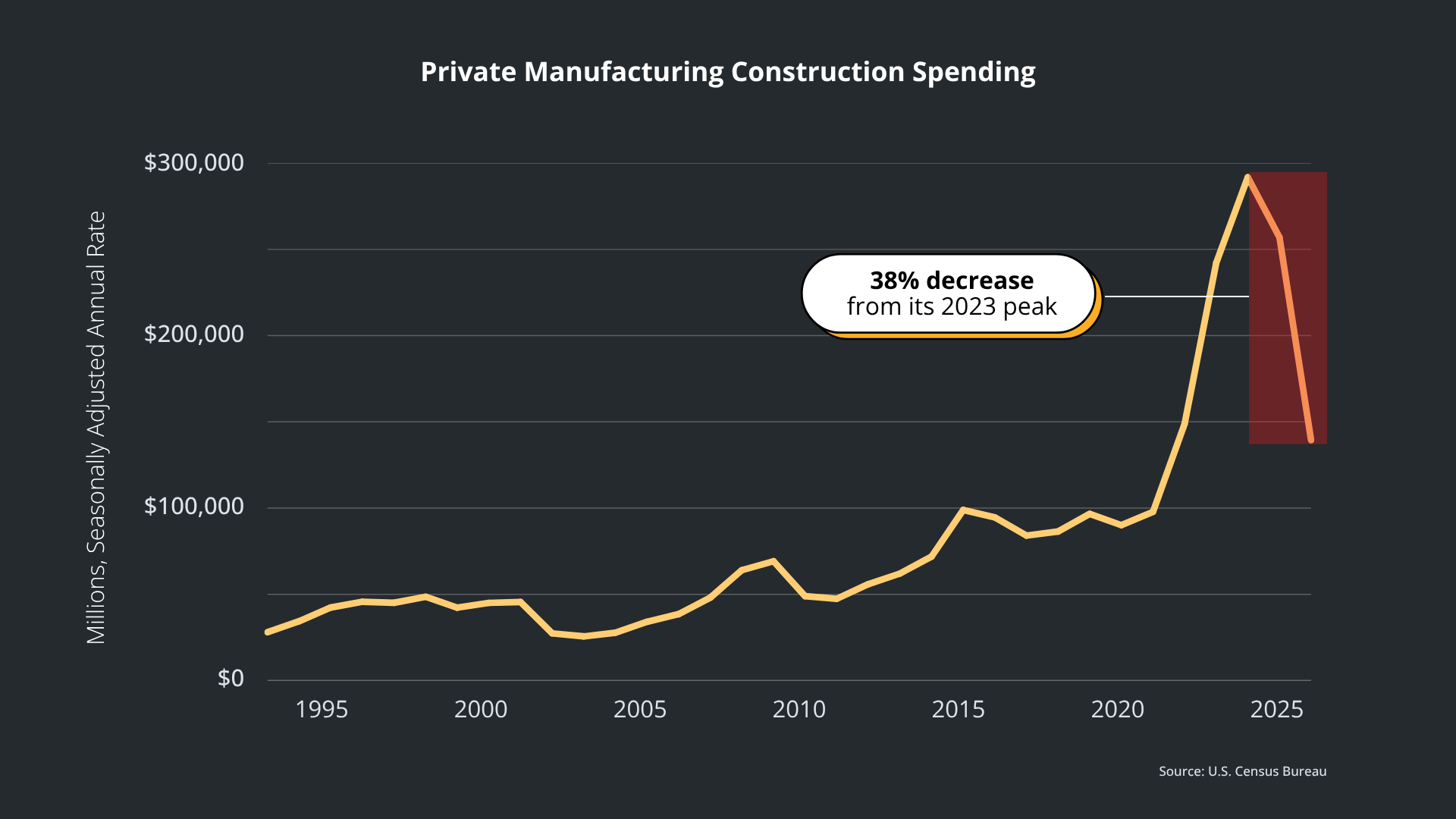
Despite tariff challenges, there is some good news buried in the massive decline in manufacturing spending. The CHIPS Act, along with a supply-chain-problem-induced desire to reshore production capacity, caused manufacturing-related construction activity to take off starting in early 2021. The resulting boom was beyond unprecedented; at the peak in September 2023, manufacturing accounted for nearly a third of all private nonresidential construction spending.
Source: U.S. Census Bureau
The decline, as CHIPS Act-incentivized projects wrap up, has been just as dizzying. Total manufacturing construction has fallen 38% from that peak, while computer/electronic/electrical manufacturing construction is down nearly 60%.
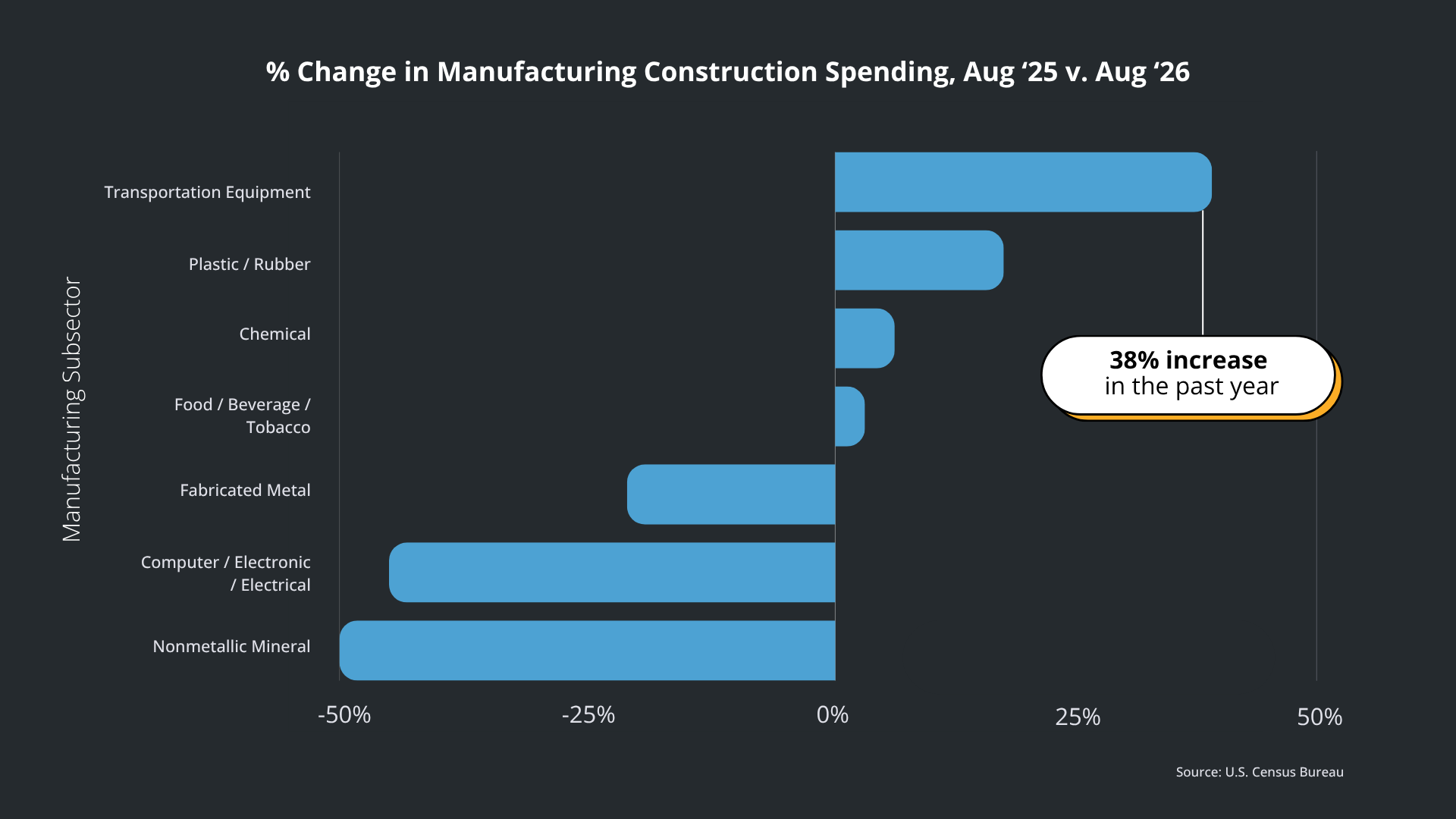
If you’re wondering where that aforementioned good news is, you have to look at a few of the manufacturing subsegments not affected by the CHIPS Act. Transportation equipment (cars, planes, etc.) manufacturing construction activity has rebounded 38% over the past year. If spending in that subsegment continues to grow the way it has since May, it will hit a new all-time high by the end of the year.
Source: U.S. Census Bureau
The chemical manufacturing subsegment—which was by far the largest prior to the CHIPS Act—has exhibited similar dynamics, rebounding over the past 12 months and closing in on a new all-time high.
This momentum, while far from earth-shattering, reflects a U.S. manufacturing sector that has shown definitive—and much-needed—signs of improvement in 2026.
Where do we go from here?
Construction costs will likely continue to rise through the remainder of 2026. While that won’t change the demand for data center construction (sorry, I had to), it will weigh on activity in other segments.
For a deeper analysis of the trends shaping the industry, watch the 2026 Construction Economic Outlook webinar with Dr. Anirban Basu.


