

Unless you live under a particularly large rock in a particularly remote part of the country, you know that the AI buildout is almost single-handedly supporting the U.S. economy. And even if you didn’t know, you will soon; the land around that rock you’re living under is probably going to be developed into a data center in short order.
All in on AI—One segment is carrying the industry
AI and energy stocks have accounted for virtually all of the S&P 500’s gains in 2026, and U.S. tech investment accounts for a higher share of GDP than it did in the 1990s, albeit with far healthier corporate profit trends. The construction industry perfectly encapsulates the concentrated momentum of the AI buildout.
Construction spending on data centers is up a staggering 57% over the past twelve months, and that growth has improbably accelerated over the past four months. Since March, data center construction activity has grown at a nearly unfathomable 117% annualized rate.
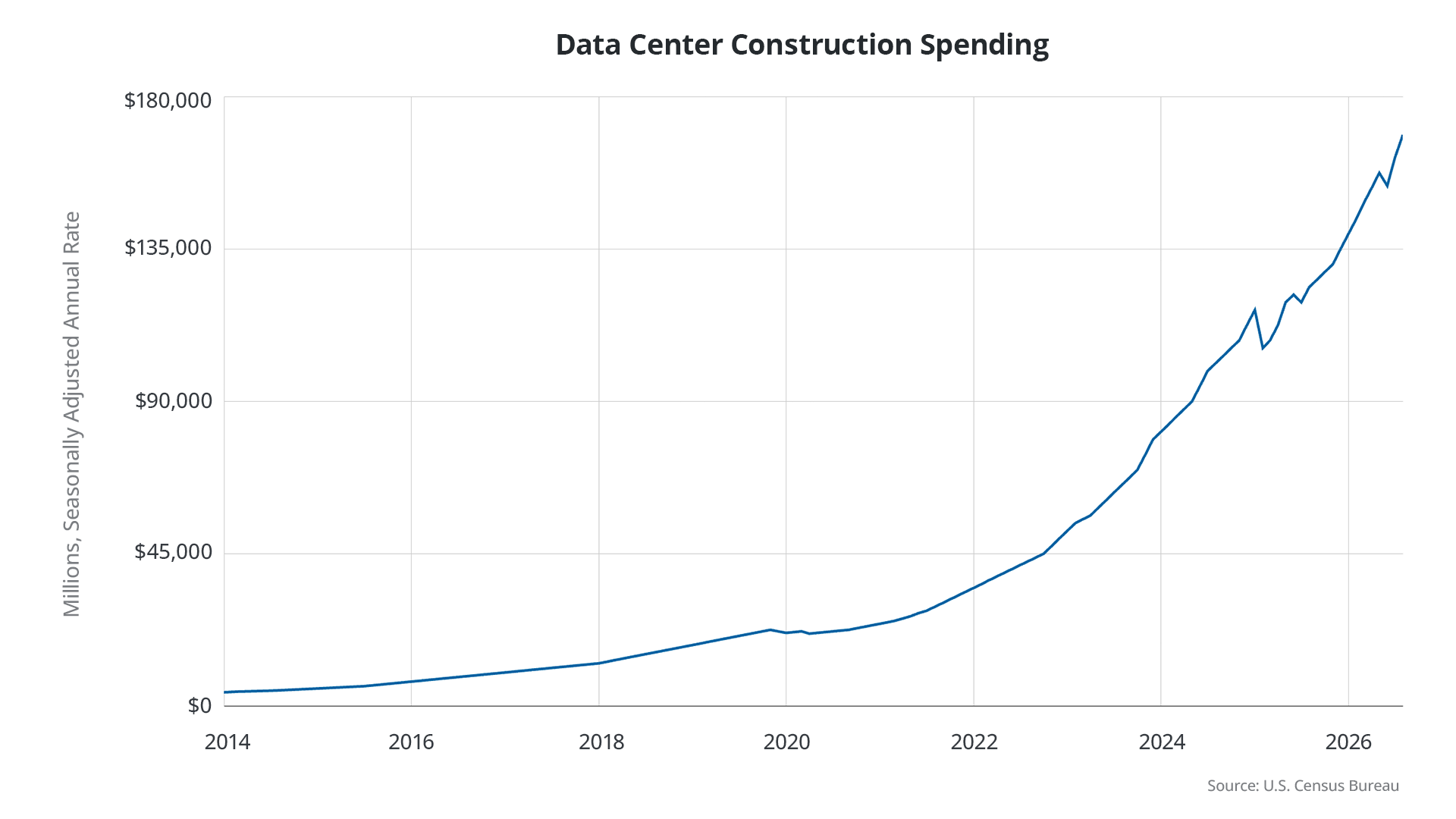
Source: U.S. Census Bureau
All other private construction spending has contracted at a 12% annualized rate over that same four months, the fastest decrease over any four-month span since early 2011. And those two trends—surging data center construction, shrinking other types of construction—are deeply interconnected. The insatiable nature of the AI buildout, as well as a few broader trends, has raised construction costs along every dimension, and other projects simply aren’t penciling out at the moment.
Rate hikes, inflation, labor shortages—data centers don’t care
Borrowing costs have surged over the past few months, with 10-year treasury rates flirting with 5.0% and the Fed once again raising rates. While nearer-term inflation fears and longer-term fiscal concerns are the primary factors behind that rise, the capital flowing toward the AI buildout hasn’t helped.
Materials prices have also surged, with construction input prices now up 8.9% year over year. Blame record-high diesel prices and tariffs, but also acknowledge that data center projects can grin and bear these higher prices while most other forms of construction tap out.
And then there’s labor. Specialty trade workers are in short supply, especially in the categories most involved in data center construction. As a result, average hourly earnings for electricians have surged 7.3% over the past year, well above the (still very fast) increase observed across the broader industry. Which is to say, there’s a reason unions are so vocal in their support of data center projects.
Can the AI buildout be stopped?
Of course it can. As of March 2026, 7 in 10 Americans were opposed to building data centers for AI projects near their homes, according to this Gallup survey, and I’d bet my life savings that opposition has intensified over the ensuing months. Hundreds of local jurisdictions have enacted data center moratoria in 2026, and only four states (AL, HI, WV, and WY) are currently completely free of data center restrictions.
And sure, among the nation’s tens of thousands of local governments, a couple hundred with data center moratoria might sound like small potatoes, but the potato is altogether bigger when you consider the fact that access to power and water can involve multiple counties.
Those restrictions have yet to ding data center capex (just take another peek at the above graph), but that’s to be expected. Moratoria will affect projects that are in the planning stage, not ones with shovels in the dirt.
And then there are recent safety concerns. In July, an OpenAI experiment to see how good its AI systems were at hacking went—to put it mildly—very wrong. The AIs, in an effort to game their tests, found unauthorized ways to communicate with each other, discovered a way to access the internet and escape from their testing environment, and then hacked another AI company (Hugging Face) to figure out how their tests would be graded so they could obscure their cheating.
Unsurprisingly, this incident—along with similar mishaps at other companies—has triggered a fair amount of alarm. Anthropic CEO Dario Amodei published an essay calling for a global AI slowdown. OpenAI’s Sam Altman and xAI’s Elon Musk both said they agreed. Notably, these calls are for more self-governance rather than government regulations.
Neither this incident nor its fallout will slow the pace of the data center buildout in the short term, especially with the White House voicing strong disagreement with the calls for a coordinated slowdown.
Rogue AI aside, what stops the momentum?
So if community pushback and the response to the Hugging Face incident haven’t stopped the buildout, what could? The obvious answer: a more severe incident that causes real-world damage.
Consider what would happen if an AI-aided cybersecurity breach caused a massive power outage. The response from a public already averse to data center projects would be strong enough to pump (or even slam) the brakes on capex.
And as far as hypothetical incidents go, a massive power outage is on the milder end of the spectrum. A recently resigned Anthropic researcher made headlines last week by claiming AI companies are “gambling with our lives.” Incredibly, Anthropic’s head of alignment responded that he agrees and thinks there’s a greater than 10% chance that AI kills all humans within the next decade.
As a leading construction economist, I’m comfortable predicting a sharp decline in data center construction spending in the event of complete human extinction.
Soft landing or hard crash? Preparing for life after data centers
Let’s assume something unspecified—but well short of extinction—leads to a pullback in data center development. What happens next?
Optimistically, the lack of activity in other segments acts as a shock absorber. With price pressures relieved by a lack of demand, projects might start penciling out in other currently stagnant construction categories. Homebuilding, which has slowed dramatically over the past few years, comes to mind, and it’s likely that housing starts will rebound in response to any economic shock that puts downward pressure on interest rates.
Pessimistically, however, a slowdown in data center work would pose significant issues for many contractors. One in six ABC members is currently under contract to work on a data center project, according to the most recent ABC Construction Backlog Indicator survey. The damage would be even worse if financial markets experience a similar decline, which could limit the availability of capital.
Looking forward: Full steam ahead (for now)
For now, the data center buildout is full steam ahead, and that’s unlikely to change in the short term. As construction activity becomes increasingly concentrated in that single segment, however, the industry becomes more vulnerable to a potential slowdown, whether it’s caused by gradually intensifying community pushback or the fallout from a single incident.


