

Cost escalation strikes back
Perhaps the most fundamental law of economics states that higher prices, all else equal, suppresses demand. The construction industry became excruciatingly familiar with that law in the early 2020s when costs began to escalate on three distinct fronts, an episode that is unfortunately once again relevant to industry dynamics.
The horror of the post-COVID era: Materials, labor and borrowing costs
First came an unprecedented increase in materials prices. Tangled supply chains, resurgent demand and suppressed production conspired to bolster construction input prices by a staggering 49% between April 2020 and April 2022.
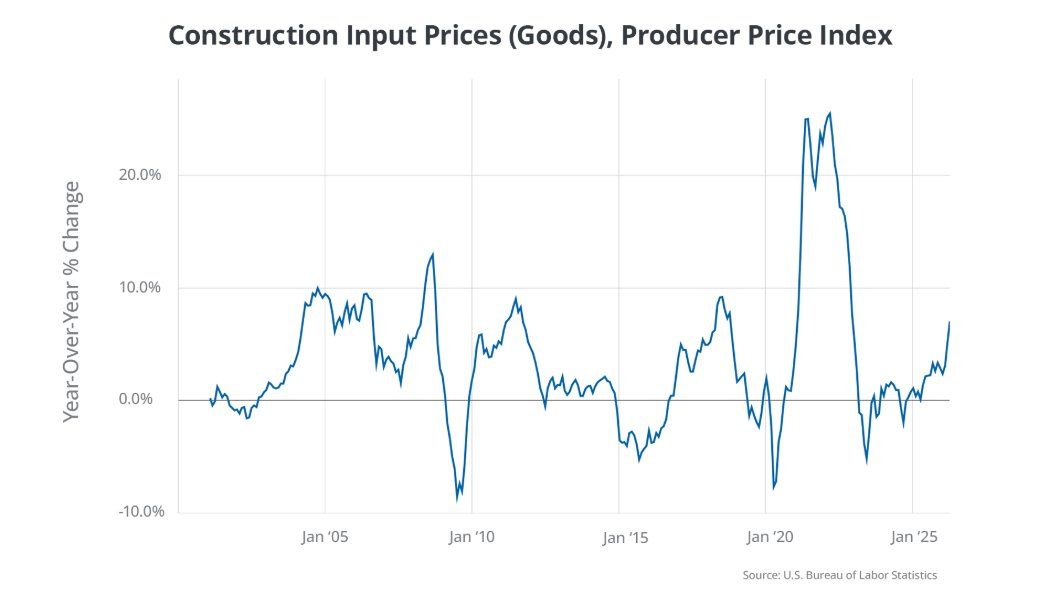
Construction cost inputs (Goods) have begun to spike again, up 7% year over year. Source: U.S. Bureau of Labor Statistics
That pace of escalation dwarfed economy wide inflation, which is up just 30% over the 6 years since April 2020. And yes, it’s perhaps misleading to say, “just 30%,” because that period included the fastest economywide inflation in over 40 years, a caveat that drives home the sheer absurdity of the rise in construction input prices from 2020 to 2022.
That meteoric rise in materials prices coincided with equally incendiary labor cost escalation as contractors struggled to stay adequately staffed in the midst of a severe labor shortage. Average hourly earnings for construction workers took off from the middle of 2021 to the end of 2023, rising at the fastest pace since the early 1980s.
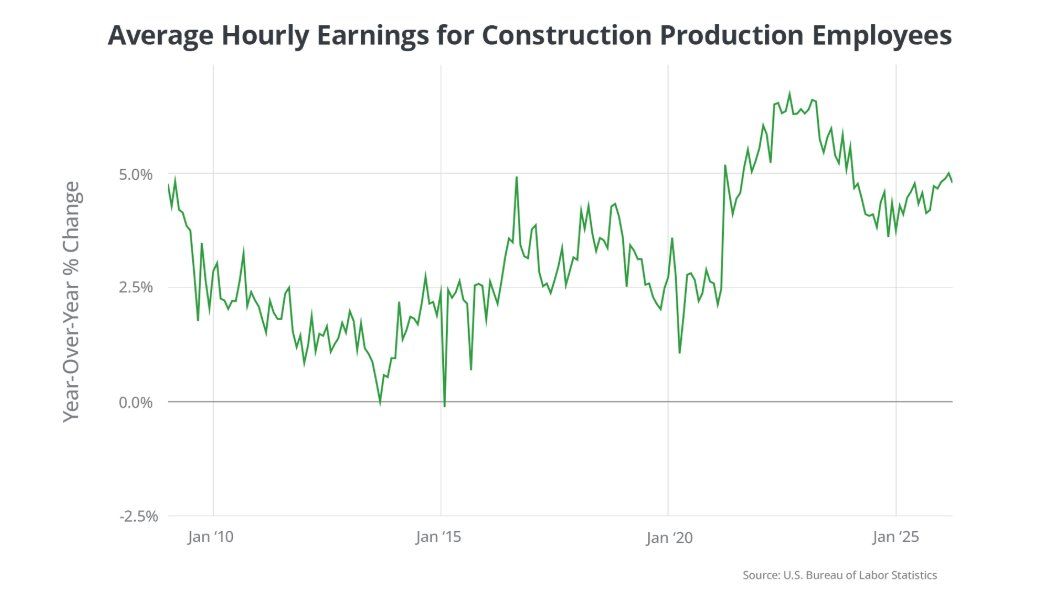
Labor costs for construction have also ballooned in the past year, up 4.8% year over year. Source: U.S. Bureau of Labor Statistics
Then in March 2022, right as the construction material price escalation was beginning to cool, the Federal Reserve started raising rates—too late, some would say—in an effort to quell broader price increases. Fifteen months and the equivalent of 21 quarter-percentage point hikes later, borrowing costs had risen to a level not seen since the Clinton Administration.
2023-2025: A two-year reprieve or a false plateau?
Mercifully, those cost pressures eased starting in 2023. Materials prices were essentially unchanged from January 2023 through the beginning of 2025. Labor cost escalation cooled, with earnings up just 3.7% year over year by November 2024, a pace in line with the years prior to the pandemic. And the Fed, for its part, began cutting rates in mid-2024, and even if that didn’t result in lower borrowing costs, it mostly stemmed additional increases.
For a two-year period, the industry operated in a tame, perhaps even tepid, cost environment.
2026: Here we go again—different reasons, similar result
Unfortunately, construction is a cyclical industry, and history is doomed to repeat itself; the past is prologue, time is a flat circle. You get it. You also probably get that contractors would have appreciated it if this particular historical episode had taken a few more years before coming back around. Unfortunately, the industry is once again facing emerging materials, labor and borrowing cost escalation.
Materials-maxxing: War, oil and tariffs
Input prices were up 7.0% year over year in April, the fastest increase since late 2022. While that has a lot to do with the run-up in oil prices in the wake of the conflict in Iran, tariff-affected materials prices continue to rise far too quickly. Steel mill product prices, for instance, are up 13.3% over the past year, while copper wire and cable prices have jumped 11.8% over that span.
Labor: Higher wages driven by data center competition and immigration policy
Labor cost growth has also rebounded, with construction earnings up 4.8% over the past year. While that may reflect immigration policy and reemergent worker shortages, it’s also the result of the insatiable demand for data centers and the outsized wages those projects are paying to certain specialty trade contractors.
Remember when we were hoping for a rate cut?
And then there’s borrowing costs. Most forecasters expected between one and four rate cuts in 2026, but that was before the conflict in Iran and the resulting rise in treasury yields. As of this writing, markets suggest that rate hikes are now more likely than cuts this year. Banks have responded by ratcheting lending standards even tighter for construction loans, according to the Fed’s Senior Loan Officer Opinion Survey.

Lending standards have tightened since the Iran war started, making it harder and more expensive to borrow money. Source: Federal Reserve System, Senior Loan Officer Opinion Survey
Ultimately, the construction industry is facing three-headed cost escalation for the second time this decade, and that is going to put downward pressure on construction starts over the next several months. While a near-term reopening of the Strait of Hormuz would serve as a critical first step to quelling cost escalation, pre-March 2026 conditions will prove elusive for some time.
Recording of last month’s economics webinar—how right was Dr. Basu in his predictions?
Disclaimer:
The views and opinions expressed in this article are those of Dr. Anirban Basu and do not necessarily reflect the official policy or position of Trimble Inc. This content is provided for informational purposes only and should not be interpreted as financial, investment or economic guidance from Trimble.


