

This article was written by Anthony Davis and originally appeared in the trade publication Highways Today in July, 2026. Published with permission.
Trimble has made its construction financial software available to the smallest customers it has ever formally courted, and the significance sits less in the product than in the direction of travel. Trimble Financials, generally available in the United States from July 2026 after a preview the previous November, is a job-costing and accounting tool aimed squarely at contractors turning over around $10 million a year or less.
For a company whose construction accounting heritage runs through enterprise platforms such as Vista and Spectrum, and whose own marketing claims a four-decade lineage serving a large slice of the ENR 400, deliberately building a simplified product for firms that have only just outgrown spreadsheets is a strategic statement rather than a routine release.
The move matters because it lands at the precise moment the market is folding in on itself from three directions. Intuit, whose QuickBooks has been the default ledger for small builders for a generation, spent early 2026 climbing up-market with a purpose-built construction edition of its Enterprise Suite. Procore, the dominant name in project management, has been extending downward from the field into financials.
Trimble is now descending from the enterprise tier it already owns. The contest is no longer about who sells the best accounting package to a particular size of firm. It is about who captures the growing contractor early, holds the financial system of record as that contractor scales, and monetises the relationship across a widening software estate for years afterwards.
Briefing
Trimble Financials, a construction-specific accounting and job-costing product for contractors with revenues of roughly $10 million or less, became generally available in the United States in July 2026, offered standalone or inside vertical software packs for MEP, civil and general contractors.
The launch takes Trimble down-market from its enterprise Vista and Spectrum ERP platforms, filling a long-standing gap in its portfolio at the entry tier historically dominated by Intuit’s QuickBooks.
Each software pack bundles Financials with Trimble ProjectSight for project management, Trimble Connect as a common data environment and vertical estimating and performance-tracking tools, positioning the pack rather than the ledger as the true commercial wedge.
The timing coincides with Intuit launching an AI-native construction edition of Intuit Enterprise Suite in February 2026 and Procore adding financial capability, compressing the mid-market from three directions at once.
Trimble ended 2025 with around $3.57 billion in revenue and roughly $2.5 billion in annual recurring revenue, yet only about 20 per cent of its customers buy more than one product, framing Financials as a top-of-funnel entry point for a cross-sell opportunity management has valued at some $1.4 billion.

A deliberate descent from the enterprise tier
Trimble did not arrive in construction accounting through the small-contractor door. Its position was built at the top of the market, reinforced by the 2018 acquisition of Viewpoint and the Vista and Spectrum ERP systems that serve large and complex contractors with multi-entity structures, sophisticated work-in-progress reporting and heavy compliance requirements.
Those platforms remain the company’s answer for firms with genuine enterprise resource planning needs, and Trimble has been careful to keep Financials clearly separate from them rather than diluting either proposition. What changed is the recognition that the entry tier, the population of firms still running the business on paper or in a spreadsheet, had been left almost entirely to Intuit.
That gap carried a real strategic cost. Trimble’s growth engine is its Connect and Scale strategy, a land-and-expand model that depends on getting a customer onto one product and then broadening the relationship across estimating, project management, field data and finance. Management has been candid that only around 20 per cent of customers currently buy more than one product, describing the remaining base as a clear penetration opportunity and putting a figure of roughly $1.4 billion on the cross-sell and upsell potential inside the existing estate.
A small contractor who begins their financial life on QuickBooks and stays there is a customer Trimble never gets to land in the first place. Financials is, in effect, a wider mouth on the funnel, designed to capture firms early enough that they grow inside the Trimble ecosystem rather than defecting into it later, if at all.
The job-costing case against generic ledgers
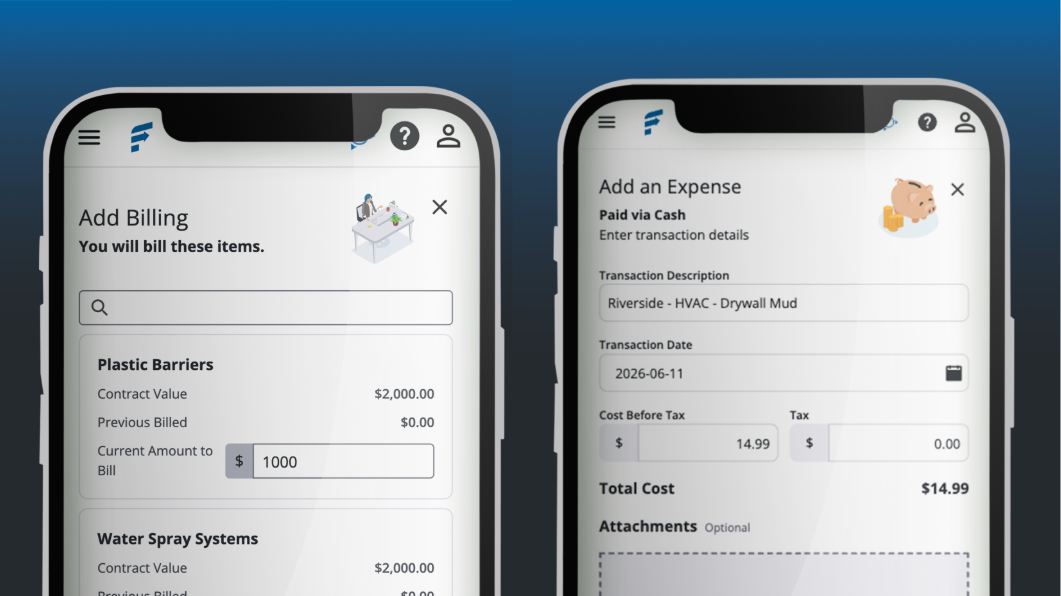
The technical argument Trimble is making is narrow and, on its own terms, sound. General-purpose accounting software treats a construction business like any other, organising the world around invoices, bills and a chart of accounts. Construction runs on job costing, the discipline of tracking every dollar against a specific job, phase and cost type, then comparing what was estimated with what was actually spent while the work is still in progress.
That distinction is where contractor margins are won or lost, because a project can look healthy in the bank while quietly bleeding against its budget, and a generic ledger will rarely surface the problem until the job is closed and the money is gone. Trimble Financials is built to make estimated-versus-actual visible in contractor-friendly dashboards as work progresses, and to convert that data automatically into formatted financial statements.
The commercial consequence reaches beyond tidy bookkeeping. Cleaner, construction-native work-in-progress data feeds directly into the two constraints that govern a growing contractor’s ceiling: bonding capacity and access to credit. Surety agents and lenders read WIP schedules to decide how much work a firm can safely carry, and contractors who cannot produce credible job-cost reporting find their growth capped regardless of how much work is available.
Jon Fingland, a vice president at Trimble, framed the target customer plainly, noting that “Contractors running small businesses don’t want to — and shouldn’t have to — become accounting pros,” and arguing that the product suits firms “growing beyond financial management and analysis limitations of paper or spreadsheets” while offering “usability and job costing advantages over generic, off-the-shelf accounting options.” The pitch is less about replacing an accountant than about giving a small firm the financial legibility it needs to be trusted with bigger work.
The pack is the product
The standalone subscription is the headline, but the more revealing part of the launch is the set of vertical software packs. Each one bundles Financials with Trimble ProjectSight for project management, Trimble Connect as the shared data environment and vertical-specific estimating and performance-tracking tools, tailored separately for mechanical, electrical and plumbing, civil and general contractors.
A contractor buying a pack is not really buying an accounting system. They are buying an entry point into an integrated office-to-field environment where estimating, project management, timekeeping and finance share a single data spine, and where the friction of moving between systems, the manual re-keying and reconciliation that eats small-firm overhead, is engineered out from the start.
This is the Connect and Scale thesis executed at the smallest end of the market, and it borrows directly from the Trimble Construction One commercial framework that has driven most of the company’s recurring-revenue growth in its construction software segment. That segment has been the engine of the wider business, delivering operating margins in the mid-forties and double-digit recurring-revenue growth while Trimble reshaped its portfolio around software, contributing its agriculture business to a joint venture with AGCO and selling its Mobility division to concentrate on construction, geospatial and civil workflows.
Selling a bundle to a small contractor does two things at once: it raises the value of a customer who might otherwise have started on a single cheap tool, and it embeds the contractor in a workflow that becomes progressively harder to unpick as the business grows and the data accumulates. The ledger is the hook. The ecosystem is the catch.
AI arrives in the back office
Trimble Financials ships with built-in artificial intelligence that lets contractors get support through plain-language prompts rather than hunting through menus or manuals. On the surface that is a usability feature, aimed at owners who are estimator, foreman and bookkeeper in one person and who work from a truck rather than a desk.
The deeper point is that natural-language assistance lowers the competence threshold for running construction-grade financials, which is exactly the barrier that has kept small firms on simpler generic tools. If a contractor can ask a question in ordinary English and get a usable answer about a job’s margin or the state of their receivables, the historic trade-off between construction-specific power and everyday usability starts to dissolve.
The feature also situates Trimble inside a broader movement of intelligence into construction’s financial and document workflows. Trimble spent around $250 million in 2026 acquiring Document Crunch to strengthen construction-focused AI document analysis, a signal that the company sees language-model capability as a core part of its AECO offer rather than a bolt-on. Intuit, for its part, has positioned its construction edition explicitly as AI-native, with automated budget insights and workflow agents.
Across the sector, AI is being applied first to the tasks that small contractors find most painful and least differentiating, namely the paperwork, the reconciliation and the interpretation of financial data. That is a productive place for the technology to land, because it frees scarce owner-hours for the work that actually builds the business, and it does so without asking the contractor to become the accounting professional Fingland says they should not have to be.
The pincer: Intuit climbing, Procore crossing
The competitive picture explains why Trimble is moving now rather than at leisure. Intuit remains the incumbent at the entry tier, and its strength is less the product than the ecosystem around it: nearly every construction CRM syncs natively to QuickBooks, every bank supports its feeds, and virtually every construction-literate bookkeeper and CPA already knows the system.
That network effect is a genuine moat, because switching away means asking an accountant to relearn, a CRM to rebuild an integration and years of reconciled history to be migrated. In February 2026 Intuit stopped merely defending that base and went on the offensive, launching a construction edition of Intuit Enterprise Suite with cost groups, AIA-style invoicing, certified payroll and enhanced job costing, aimed at the mid-market contractors who used to outgrow QuickBooks and leave. Intuit is now climbing the ladder Trimble is descending.
Procore approaches from a third angle, extending from project management into financial workflows and encouraging contractors to treat accounting as part of connected construction operations rather than a separate ledger. The result is a convergence squeeze on the growing contractor at the $5 million to $15 million mark, the firm complex enough to feel the limits of generic bookkeeping but not yet large enough for a full ERP implementation.
Each contender is trying to own that customer from a different starting position, Intuit from the books, Procore from the field, Trimble from the enterprise. For contractors, the immediate effect is welcome: more capable, more construction-aware software is being aimed at a segment that has long made do with tools built for someone else. The strategic effect is that the choice of accounting system is increasingly a choice of which company’s entire ecosystem a contractor is prepared to grow inside.
Why the small contractor is worth fighting for
The prize justifies the effort. Construction is frequently sized at around $2 trillion in the United States alone, and the overwhelming majority of firms within it are small, precisely the population Trimble Financials, IES and Procore are now competing to serve. In a land-and-expand model, the lifetime value of a customer captured early and grown through successive product tiers dwarfs the modest subscription revenue of the initial ledger.
A contractor landed at $3 million in revenue on a simple financial pack, then expanded through estimating, project controls and eventually enterprise ERP as they scale toward and beyond $50 million, is worth many multiples of the entry price, and is far cheaper to retain than to win. Owning the financial system of record is the strongest possible anchor for that relationship, because finance is the last thing a business rips out and replaces.
That is why the entry tier, long treated as a low-margin afterthought, has become strategically central. The firm that controls a contractor’s books at $5 million is well placed to control their entire software stack at $50 million, and every competitor now understands this. For Trimble, Financials is insurance against a structural weakness in its own model, the risk that its cross-sell engine has nothing to cross-sell to because the customer was never landed.
For the industry, the intensifying competition should mean better tools, faster innovation and, over time, keener pricing at a level of the market that has historically been under-served. The contractors best placed to benefit are those who treat this moment not as a simple software purchase but as a decade-long ecosystem decision, and who choose accordingly.
Reading the market signal
The clearest way to read Trimble Financials is as a portfolio company reconciling two facts about its own position. It has one of the strongest enterprise franchises in construction software and one of the weakest presences at the tier where most construction businesses actually begin. Closing that gap is less about chasing the modest revenue of small-firm subscriptions and more about protecting the top of a funnel that feeds everything above it.
The vertical packs, the embedded AI and the shared-data architecture all point in the same direction, towards capturing the contractor before a competitor does and keeping them as they grow.
For infrastructure and construction leaders, the practical takeaway is that the software decisions made by their smallest subcontractors and supply-chain partners now carry more weight than the price tags suggest. As Trimble, Intuit and Procore converge on the same customers, the tools spreading through the lower tiers of the industry will increasingly determine which data flows cleanly between office and field, which firms can produce the financial reporting that unlocks bonding and credit, and how quickly productivity gains propagate through a fragmented sector.
The competition arriving at the small contractor’s door is, in the end, a competition to shape the digital foundations of the wider construction economy, and that is a contest worth watching closely.
Author Anthony Davis includes additional “key industry questions” and “strategic takeaways” in the original article in Highways Today.


