

Thanks to rapid technology adoption, what construction looks like today would be unfamiliar to someone in the industry even a decade or two ago. From the increasing centrality of computer-aided design, through the emerging use of Building Information Modelling (BIM) tools, to the growing reliance on Enterprise Resource Planning platforms, there has been no shortage of digitalisation in the industry. According to NBS’ Digital Construction Report 2025, for example, 72% of construction firms in the UK say they have adopted BIM.
These investments have created real advantages for businesses, from enabling more creative flexibility in design processes to modernising how employee and contractor time is scheduled. However, the evidence shows that the top-line productivity gains that digitalisation promises haven’t always been realised.
According to McKinsey, construction productivity has grown by just 0.4% a year since 2000, compared with around 2% a year across the wider economy and 3% a year in manufacturing. Closer to home, the latest data from the Construction Leadership Council shows that construction workers in the UK generate £35.69 of output per hour, around 13.5% below the economy-wide average. And ONS data shows that productivity in the sector deteriorated by 2.2% in Q2 2025 compared to the same period in 2024.
That productivity gap has real-world implications. It is, for example, increasingly at odds with the government’s target of delivering 300,000 new homes a year. In 2024, completions fell to 185,000, down from 195,000 the previous year. And between January to March of 2025 only 39,000 new homes were finished, the lowest Q1 performance since 2014.
If the technology isn’t paying dividends, though, it’s not because the tools are wrong: it’s because they’re not working together.
Cementing technology together
A major part of the advantage in using a CAD platform like SketchUp as the creative and collaborative meeting point for architects, designers and engineers comes less from the capabilities these tools have for the individual user, but from the fact that when they do their daily work, they are inherently producing data. That simple fact completely changes how easily, compared to traditional processes, people can interact with their colleagues’ work, split off new versions of plans to try out creative ideas, or get input from partner organisations.
Integration matters because it ensures that the power of data holds between teams as much as it does between individual members of a team.
We could compare this to a building under construction. We ideally don’t expect an electrician to re-verify the structural work that they’re fitting cabling into, and a team laying foundations shouldn’t need to question how the site clearance was performed. Instead, value created at each stage of the process is carried forward, enabling each professional to focus their resources on their specialism.
To truly create productivity, construction tech needs to do the same thing, handing insight and value forward through every stage in a building’s lifecycle, from conception to management and, ultimately, to decommissioning. That demands a platform that can spread and connect, like a foundation, the whole construction ecosystem.
A foundation for the future
There are multiple possible approaches to implementing connectivity between digital tools at different stages of construction. However, to be both effective and future-proof, that foundational connectivity shouldn’t be introduced on a case-by-case basis. Instead, it should offer an open API architecture which can plug into existing and future IT environments in a vendor-neutral way. This includes supporting open industry standards such as IFC (Industry Foundation Classes) for model exchange and BCF (BIM Collaboration Format) for issue coordination. It’s only by designing for flexibility that businesses can deliver a truly end-to-end data approach.
Once a platform such as Trimble Connect is integrated, information is shared in real time, version control is automated, and silos are broken down: once a fact about the project has been established, it’s reliably available for any team to access, right through to building completion and beyond.
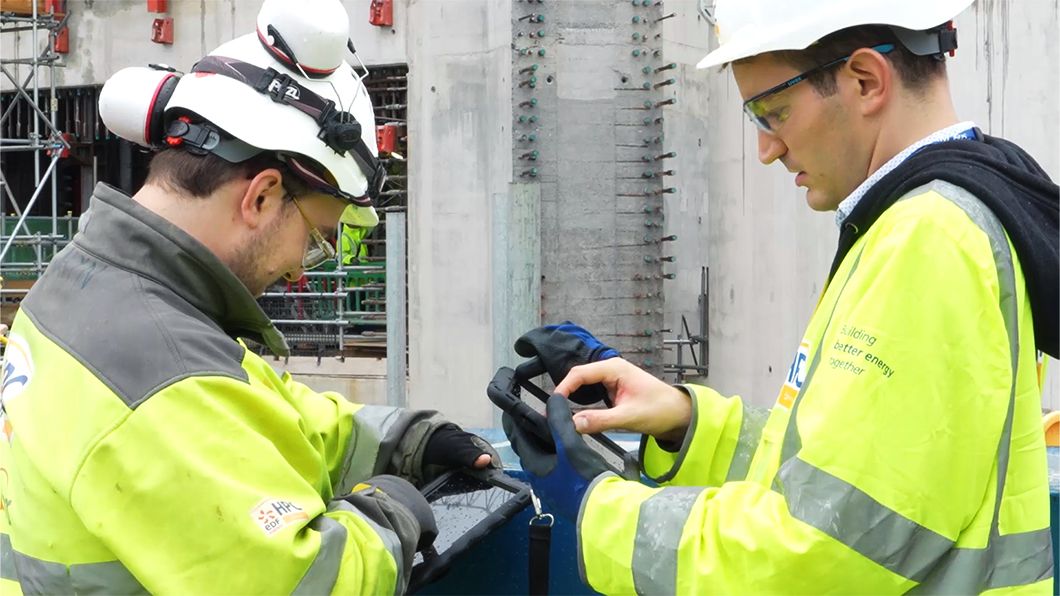
Bylor team utilising Trimble Connect onsite at Hinkley Point C.
In practice, this connected approach is already shaping delivery on complex construction programmes. Hinkley Point C is a case in point. The £20 billion project ranks among the largest infrastructure undertakings in Britain, spanning decades and coordinating over 5,000 people. To manage that scale and complexity, BYLOR – the main civil engineering works for the project – adopted Trimble Connect as a shared data platform.
“Our main use of Trimble Connect is to get information that’s traditionally only available on laptops and desktops out of the office and onto the construction site. We can then give that information to the workforce, providing them with up-to-date, correct information at the right time. Giving the site team the ability to view 3D models in the field makes it easier for them to build to the right quality and get it right the first time,” says Tim Davies, Central Digital Engineering Lead, BYLOR.
This kind of experience illustrates how connected data environments can translate directly into day-to-day delivery improvements. With everyone working from the same data, errors are reduced and accurate handovers become a significantly smaller burden on precious employee time. And, the existence of a coherent single source of truth means that, when problems do arise, they can be assessed and fixed more quickly through clearer communication.
Digital transformation in the construction industry will not slow down. New tools like digital twins, augmented reality, and AI-powered analysis are quickly becoming as necessary as CAD became not so long ago. The businesses that navigate this wave most successfully will be those that have the right starting point: an architecture which puts data at the heart of every step of a project.
To learn more about how Trimble can support your journey towards connected construction

