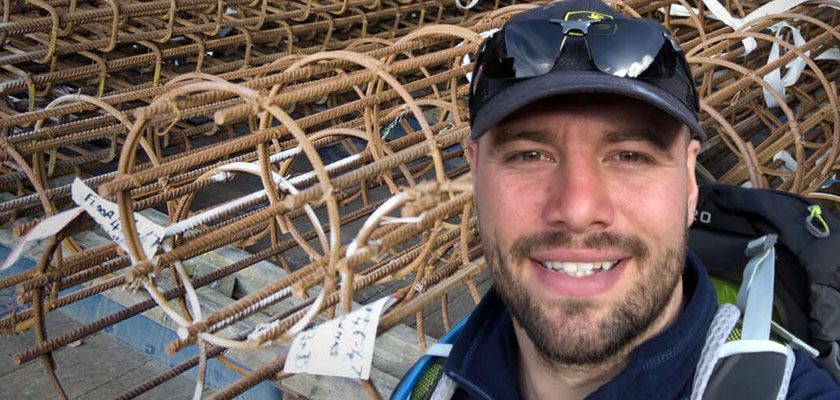
Tekla Product Manager Sam Cummings explains how 3D software helps rebar detailers make their job easier, safer, and more cost-effective.
Please tell us something about your background. How did you become an expert in rebar-detailing software?
I’m originally from Yorkshire in the North of England, and joined Trimble in 2014 from a well-known precast manufacturer in the town of Barnsley. I first worked as a Technical Specialist in the UK, helping our contractor and engineering customers learn and implement new 3D workflows to improve their processes. From there I moved to a sales role, concentrating on engineering customers in the UK. Then in 2016, I moved to our office in Atlanta, serving our concrete customers all over the United States.
Today, I’m based back in the UK, working as our Global Product Manager for reinforcement in Tekla Structures. I look after our workflows, from design in Tekla Structural Designer, detailing and documentation in Tekla Structures, through to field management and fixing with Trimble Connect.
Can you please describe the rebar detailer job and some of its challenges?
Rebar detailing is basically putting reinforcement bars in specific locations and of specific sizes into the concrete to build structurally safe and legally compliant concrete constructions.
The rebar detailer’s job varies from country to country, but, generally, as a process, one of the main tasks is to create shop or placing drawings. These 2D drawings, schedules & fabrication files are then passed on to a fabricator, who manufactures the bars, and to a fixer, who takes the information to the site, reads the drawings and places the right bars in the right places.
The workflow might sound simple; however, the detailer must create a “constructible” plan that is feasible for a contractor to realize. The rebar detailer might face different challenges at the various stages of the process. For that reason, the detailer needs to take many things into consideration to ensure efficient and accurate design data is projected into the constructible drawing.
There are five key things rebar detailers need to consider when detailing rebars:
Bar handling: A rebar starts at 10 millimeters in diameter and goes all the way to 50 millimeters, so you can imagine how heavy a 50-millimeter rebar is when it is about 10 meters in length. The construction team needs to be able to handle the different sized rebar onsite, including taking it off the delivery vehicle and manually moving it into position.
The clashes: Those lines might look pretty on paper, but are those bars going to fit in the hole onsite? Are they clashing with other accessories, such as embeds and bolt locations?
The fabrication requirements: Checking fabrication place realities, including space limitations to create different shaped bars, the geographical location of the fabrication shop, and even the resources (e.g. machinery) to bend the bars on site.
The efficiency of fixing: How are the bars going to be fixed in place? Are they possible to fix in advance, e.g. in a factory?
Value engineering: the value that the detailer adds based on his/her professional experience. He/she might suggest better options and arrangements than those in the original plans.
Traditionally, the rebar detailing work has been done with a 2D workflow, using flat drawings – with lines drawn on a page. But 3D modeling offers an opportunity to get this job done in a much better way, facilitating the work of the detailer and integrating the rebar-detailing workflow into the entire construction process.
In a fast-paced construction environment, how exactly does 3D modeling help rebar detailers?
Now more than ever, the industry is undoubtedly a very fast-paced environment. There is constant scrutiny of all parts of the construction cycle: How can we be more efficient? How can we be more productive? In this kind of environment, you need 3D modeling software that allows you to increase your productivity, speed-up your work, and collaborate with the rest of your team and other people involved in a project.
The beauty of 3D modeling is that it integrates with the construction flow and allows lots of people in the construction cycle to see these 3D models, including the end client who is funding the whole project, the rebar detailer, and the people onsite. You can enjoy the benefits of using 3D modeling from the very beginning of the construction process. When you’re at the rebar detailing phase, there is nothing tangible about the project yet – not even a hole in the ground – so end clients appreciate being able to see a 3D model, which shows the early results from their investment.
When it comes to the software itself, the first thing that Tekla Structures has to offer is its geometry recognition. This means the software can accurately model the 3D geometry of a rebar plan. These are not just 2D lines on a page; they’re physical objects, their real representation. This model can be passed around to anyone who needs it, even to those using HoloLens, AR and VR. This helps integrate the rebar detailing process into the entire construction workflow.
There are also loads of features that detailers specifically need to do their job properly. Grouping, layering, lapping, cranking, couplers, hooks – we’ve designed Tekla Structures to have all of these things so the rebar detailer can perform the actions automatically, increasing productivity and speeding up the rebar detailer’s job. The software also takes a lot of the manual work out of scheduling and numbering.
Another advantage of using Tekla is the way you can pass information from stakeholder to stakeholder. The model sharing and cloud connection capabilities are particularly useful when people located in different geographies can share information, take the info somebody from a different time zone created and continue the work around the clock. The cloud connection capability is not only about sharing information. It is more about consuming the data, using the information to create more, developing the model, commenting on it, or even showing it to the client.
Can a 3D model also help with making onsite work safer?
Absolutely. When you study the model, you can identify areas that would clearly require a lot of risky manual work from construction crews. For instance, crews sometimes need to operate high above the ground, which requires fall arrest. The 3D model allows a contractor to identify these risk areas in advance. Then any tricky work can be done beforehand in the relative safety of a factory, rather than onsite. When using a 3D model you can also get more accurate geometries and quantities. This means that you will be able to see, for example, how long the bars are going to be, how long the route is for transporting them to the site, what kind of machinery is needed to move them from one side to another, and even how much and what kind of space you need to store them.
If a detailer wants to try out the software, who should they get in touch with?
The best way to get a close look at our software is to start a free trial. You can also request a demo by contacting your local sales office or submitting a request through our website.

