Skip to content

The history of BIM: rich in innovation

2 minutes read
| |
July 17, 2023

Share this post:

BIM wasn't invented yesterday, and it wasn't invented in a day... The history of BIM is the result of a series of innovations all over the world: in the United States, Central Europe and Japan. Discover the innovations, and the people behind them, that have led to the creation of Building Information Modeling.

An (ever) necessary reminder

Building Information Modeling is an integrated approach that involves the creation of an intelligent 3D model containing geometric information, as well as data relating to the building's physical and functional properties (components, materials, energy performance, costs, deadlines, maintenance, etc.).

The beginnings of BIM date back to the early days of computing, in the 1960s.
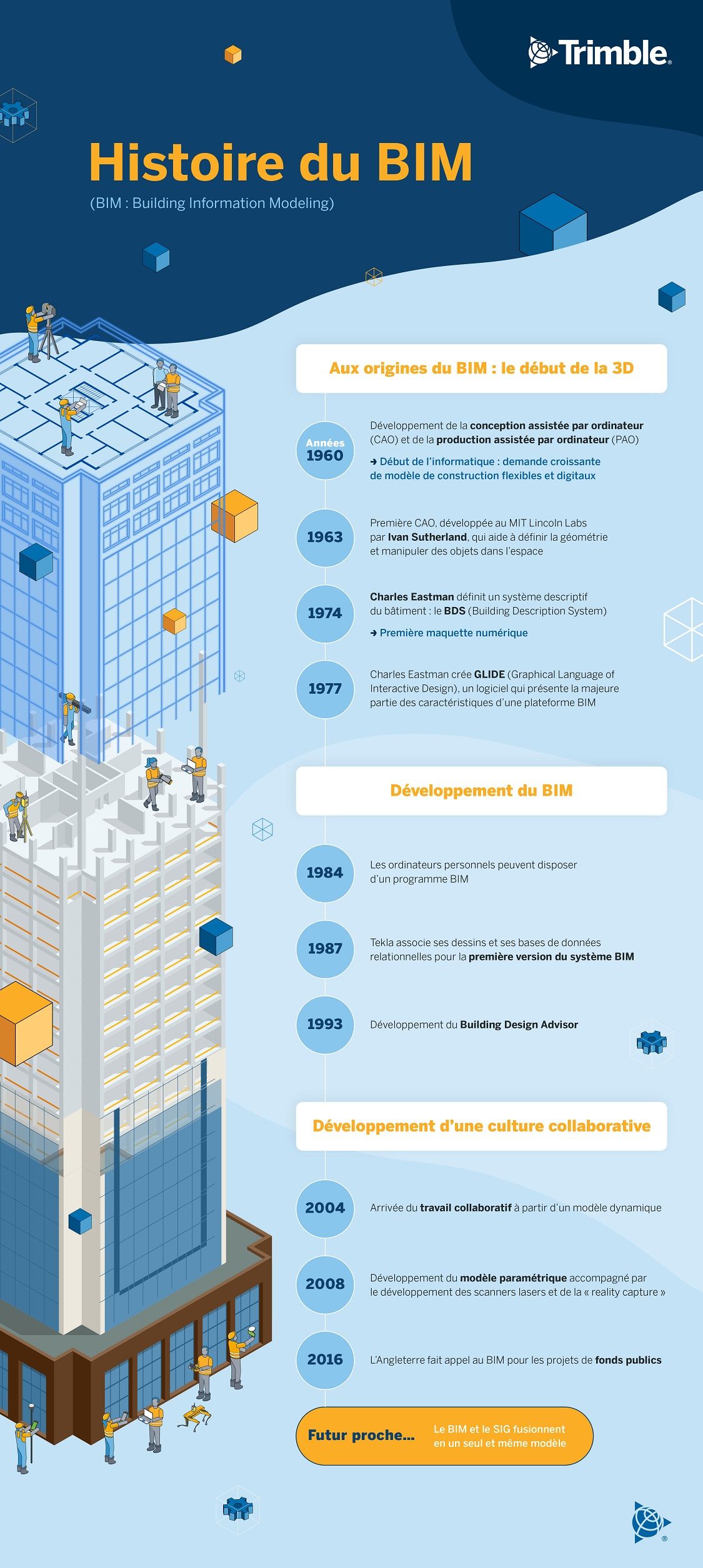
Infographic timeline detailing the history of BIM from its origins in the 1960s to its future developments.

History of BIM: the beginning in 5 dates

1957: the FAO

In 1957, Patrick J. Hanratty designed the first commercial computer-aided manufacturing (CAM) software, called Pronto.

1962: BIM theorized

In 1962, in his article "Increasing the Human Intellect", engineer Douglas Englebart imagines the architect of tomorrow, suggesting object-based design, parametric manipulation and relational databases.

1963: Sketchpad

In 1963, at MIT Lincoln Labs, Ivan Sutherland developed the "Sketchpad Program", the first computer-aided design (CAD).

1975: BDS

In 1975, Charles Eastman introduced theBuilding Description System (BDS), based on the principles of BIM as we know it today.

1977: GLIDE

In 1977, in the CMU Lab, Charles Eastman created GLIDE (Graphic Language for Interactive Design), which had most of the features of today's BIM platform.

In the 1960s and 1970s, there were few developments in the field of

Building CAD

- the first software programs were "calculation" oriented, but not very "design" oriented. The first CAD programs were mechanically oriented, for automotive or aeronautical design.

Fun fact not so irrelevant

The first car to be designed in CAD was the Renault 14, in 1976. Design time was cut by 2 years compared with manual design (CAD: 3 years, manual design: 5 years).

Image source: Wikipedia Commons

A teal Renault 11 hatchback is shown from a three-quarter front view.

In the 1970s, the SOMEL system was virtually the world's first 2D structural steel CAD software.

1980s: development of BIM

In the early 1980s, several programs were developed in England and the United States. The one that changed the course of BIM was Gábor Bojár's development of Archicad in 1982. But another essential milestone was set by Diehl Graphsoft in 1985. He developed Vectorworks:

  • one of the first CAD programs,

  • one of the first 3D modeling software packages,

  • the first cross-platform CAD application.

In 1987, Tekla perfected its drawings and relational databases for the first version of the BIM system.

The 2000s, SketchUp and the evolution of BIM

In the 2000s, programs such as Revit and SketchUp (in 1999, to be precise) saw the light of day. They use a parametric modification engine made possible by object-oriented programming, all within a time-allocation platform.

This is what BIM software is all about: building a digital model that takes into account all the parameters of a project to facilitate collaboration between the various trades.

In 2004, collaborative working from a dynamic model became a reality in all BIM programs. In 2008, the development of the parametric model was supported by the use of laser scanners and reality capture.

At the same time, the development and implementation of common data environments (CDEs) such as Trimble Connect further facilitate collaboration between the various parties involved in a construction project.

The BIM story doesn't end there: in the near future, we should see BIM merged with GIS (Geographic Information System) to create a single, integrated model. This convergence will enable better visualization and management of both spatial and non-spatial data, opening up new possibilities for the construction industry. But that's another story.

Related articles

Article

Agentic AI: a foundation for physical industries

Just as electricity powers entire cities rather than lightbulbs alone, AI is evolving from simple ch...
Read full article
Article

AI change management: empowering people first

AI adoption starts by empowering your team. By automating repetitive tasks, organizations elevate em...
Read full article
Article

Data fragmentation: AI’s true ceiling

AI's true limitation isn't the technology, but data fragmentation. To unlock AI's potential, busines...
Read full article
Attention

We tried to combine the products in your guest cart with your saved cart, but we encountered an issue while merging them. When choosing a subscription, please select either monthly or yearly as they cannot be combined. Kindly review your cart before proceeding to checkout.

Cart updated
Some items in your cart are not available for purchase in your region, so we removed them. Please review your cart before proceeding.

Items Removed:
Attention

The software you are trying to purchase is not available in your country or region.

Cart updated
The items in your cart have been updated for two reasons. Firstly, the prices now match the currency linked to your account address. Secondly, some items have been removed because they are not available for purchase in your region. Please review your cart before proceeding.

Items Removed:
Cart updated
The items in your cart have been updated for two reasons. Firstly, you've added too many of one item to your cart. Secondly, some items have been removed because they are not available for purchase in your region. Please review your cart before proceeding.

Items Removed:
Cart updated
The items in your cart have been updated for three reasons. Firstly, the prices now match the currency linked to your account address. Secondly, you've added too many of one item to your cart. Thirdly, some items have been removed because they are not available for purchase in your region. Please review your cart before proceeding

Items Removed:
Cart updated

Your currency has been changed to match the currency associated with your account address.

Cart updated

Your cart has been updated for two reasons. First, the prices now reflect the currency associated with your account address. Second, you've added too many of one item to your cart. Please review your cart before proceeding.

Cart updated

While combining the products in your guest cart with your saved cart, at least one item in your cart has exceeded the maximum allowable quantity. Please review and correct your cart before proceeding to checkout.

Attention

We were unable to access your account information. Please contact customer support for assistance.

Attention
Unable to update shopping cart information. Please refresh the page to resolve the issue. If this issue persists, please contact Trimble support.
© 2026 Trimble Inc.

Trimble is a global technology company that connects the physical and digital worlds, transforming the ways work gets done. With relentless innovation in precise positioning, modeling and data analytics, Trimble enables essential industries including construction, geospatial and transportation. Whether it's helping customers build and maintain infrastructure, design and construct buildings, optimize global supply chains or map the world, Trimble is at the forefront, driving productivity and progress.