

The evolution of Trimble Connect
The construction industry is familiar with chaos. Unpredictable weather events, design changes, incorrect materials and shifting timelines are just a few hazards that threaten to tear projects apart. But the greatest risks teams face today do not start in the field. They build in the gaps between single-purpose tools, specialized teams and complex workflows.
How can gaps form between tools, teams and workflows?
Let’s think of the construction lifecycle like a solar system. Every planet has a distinct orbit around the sun. The gravitational pull of the massive star holds them in place, preventing them from flying off into space or even colliding with one another. Similarly, there are experts on projects that operate simultaneously but independently. A detailer models steel connections in the office while a layout crew marks points. Two crews moving in separate orbits bound to the same project.
These teams have specialized systems to support them. But each tool is bound to its own team's work and knowledge. Without a center of gravity, teams drift in different directions and critical information gets lost in the gaps. Field changes never reach the office. Teams build from different versions of the same drawing. Hard-won knowledge walks out the door when a veteran superintendent retires. We open the project to risk. But we don’t have to.
Why evolution is necessary: The myth of “acceptable” risk
There are some who believe a certain level of risk in construction is acceptable. But Trimble believes any avoidable risk is unacceptable. With the rapid advancement of AI, the greatest risks stem not from a lack of software but a lack of connection. The specialized systems that enable complex work to get done also force people to spend their time moving information and filling the gaps between tools. Because the capacity to do this is shrinking, the rift between jobsite reality and office awareness is widening, and profits are slipping through those cracks.
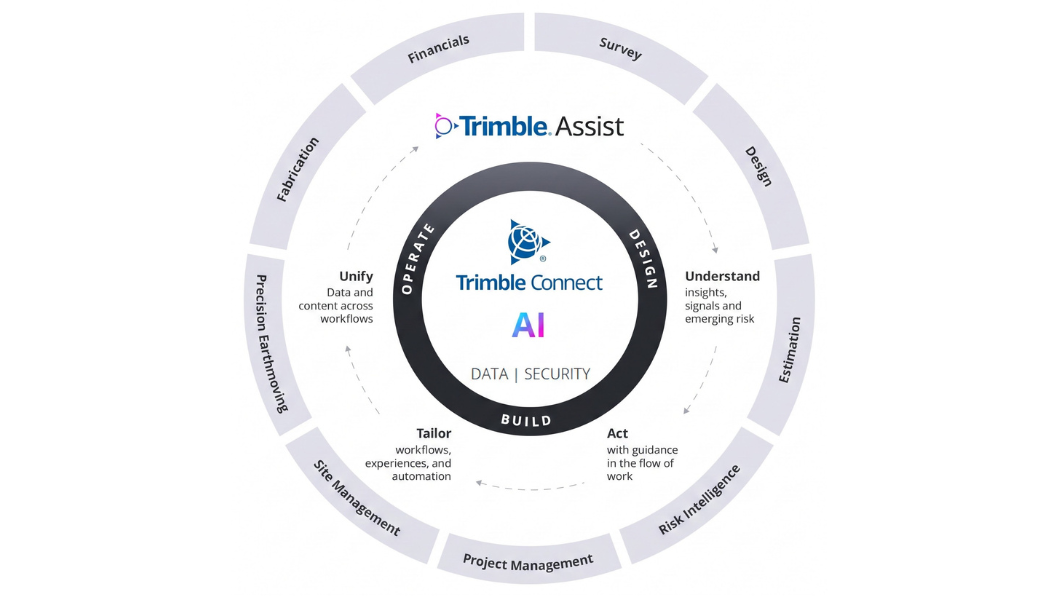
Trimble released Trimble Connect in 2014 as a solution to this exact problem. This common data environment, or CDE, gave project information a shared home. This year, at Dimensions 2026, Trimble CEO Rob Painter announced the natural evolution of that technology into a platform that builds on the foundation of collaboration to increasingly connect jobsite information with design, cost and operational workflows. With Trimble Connect as its center of gravity, teams can prevent risk across the project lifecycle.
To understand where this connected vision is heading, it helps to look at how Trimble Connect has evolved to make it possible.
How has Trimble Connect evolved?
The foundation
Trimble Connect was originally released as a common data environment and collaboration platform where teams could share project information like models, drawings and documents without having to rely on emailing data back and forth. In this original state, it was a technological cornerstone for developers to build on.
And build they did.
Where Trimble Connect is headed
Trimble Connect has always been a place where teams share project information. Now it's becoming the data foundation their workflows live on: a broader, shared space for specialized applications, with expanding workflow connectivity that only Trimble can deliver. A truly connected, office-to-field, digital and physical solution that brings teams together.
In practice: Design models stay aligned with cost, commercial and operational tools. Contract risks and obligations are checked against the physical reality on site, measured through field and reality-capture data. And because Trimble Connect supports open formats, project management and partner tools plug in too, whether they're built by Trimble or not.
Each of these connections links the jobsite to another part of the project, whether that's the design, the schedule or the budget. Trimble Connect is the center of gravity that keeps teams and their specialized tools in orbit. Teams can already put these connections to work through capabilities built into the Trimble Connect platform:
BIM-to-field and real-world site visualization: Syncing 3D constructible models directly with robotic total stations and AR tools
Point Cloud feature extraction and site capture: Streaming live 3D laser scans, point clouds and drone photogrammetry straight into the platform to compare physical work-in-place against design intent at millimeter precision
Progress-to-plan tracking: Continuously verifying actual site progress against scheduling baselines to spot delays before they derail critical paths
Integrated job costs and verified billing: Linking progress measured on site to billing, so completed work can be verified and paid faster
The value of these connections continues to deepen as you explore the extensibility of the open platform and the host of integrations and extensions available through Trimble Marketplace or the APIs available to build your own. Yet even as Trimble Connect expands what’s possible, its foundational promises haven't changed.
What’s the same: Ground truth meets intelligent action
Whenever a platform evolves, the most critical question for any project team is simple: What happens to the tools and data I rely on today?
Here is the answer: Trimble Connect has been extended, not replaced. Your data stays where it is, and your teams keep working from the same models, drawings, schedules and cost records they use now. This evolution builds on the specialized tools teams already rely on. Product-specific guidance will explain how expanded capabilities affect access, administration and existing workflows.
Generic, all-in-one software packages and AI solutions cannot produce the level of detail and fidelity that specialized construction roles require. For this reason, purpose-built applications like Tekla Structures, SketchUp, and Trimble FieldLink will remain the deep, domain-specific capability engines they have always been.
What has changed is the pace: AI can accelerate your work by making the handoff between those tools effortless.
What’s changed: Keep the specialization, lose the fragmentation
These updates begin rolling out today across Trimble's construction portfolio, starting with unified project visibility. More capabilities will arrive in phases throughout 2027. The first updates include:
Intelligent workflow assistance: Trimble Assist provides a connected interface for AI agents to support tasks across capabilities, keeping you in control while context and knowledge move alongside your work.
Centralized administration: More products are moving into the Admin Console, where enterprise administrators manage account provisioning, security, licensing and workspace permissions in one place.
Project visibility: A single, high-level view of all your active work lets you check status across projects without opening each project separately.
In-app assistance: You will see contextual guidance available directly within your active workflows.
Empowering experts and accelerating progress with AI
Across the construction industry, teams are facing a shortage of skilled workers. Associated Builders and Contractors estimates that the industry will need 349,000 new workers this year, and in a separate article, ABC's chief economist noted that in 2026, most of that demand for new workers was due to retirements. AI can assist with this issue, if implemented correctly, not by replacing workers but by multiplying teams’ capacity for work.
Trimble Assist, our unified conversational AI interface, is now built into the Trimble Connect platform. As shared project context expands, specialized AI can help teams understand information, identify potential risk and support action within their workflows. The aim is to amplify human judgment and extend the capacity of experienced teams.
Of course, AI is not the only update. At Dimensions, an additional announcement was made for Trimble Connect Scheduling. This new capability brings real-time schedules into play, so office planners and field superintendents work from the same sequence of events. With Trimble Connect Scheduling, changes to plans are shared across the team, as everyone sees the updated schedule at the same time.
Real-time updates. Connected software. Built-in intelligence.
An expanding platform for an evolving industry
In his Dimensions keynote, Rob Painter provided an inspiring parallel. When Paris set out to build its metro 125 years ago, its chief engineer, Fulgence Bienvenüe, built the plan around connection. Teams constructed stations close enough together that anyone in the city could walk to one. It was a bet on what the city would need. More than a century later, autonomous trains keep the city moving. A strong foundation can support technology that its creators hadn’t even imagined.
Trimble has been laying the same kind of groundwork from the start. Decades of building the technology crews use to measure sites, guide machines and lay out work made it possible for office teams to run with accurate data from the jobsite. That same technology laid the foundation for Trimble Assist. That field experience and supporting framework are why Trimble is uniquely positioned to meet the needs of the ever-evolving industry.
Today, construction needs a center of gravity: one system that ties design intent, site ground truth and financial truth together. By continuing to expand Trimble Connect, Trimble is reducing friction between specialized tools and helping teams work with greater context, less manual coordination and greater confidence at every turn™.
To learn more about the Trimble Connect platform's capabilities, visit our Platform page.
Visit the Trimble Connect page for more information on what these changes mean for current Trimble Connect users.


