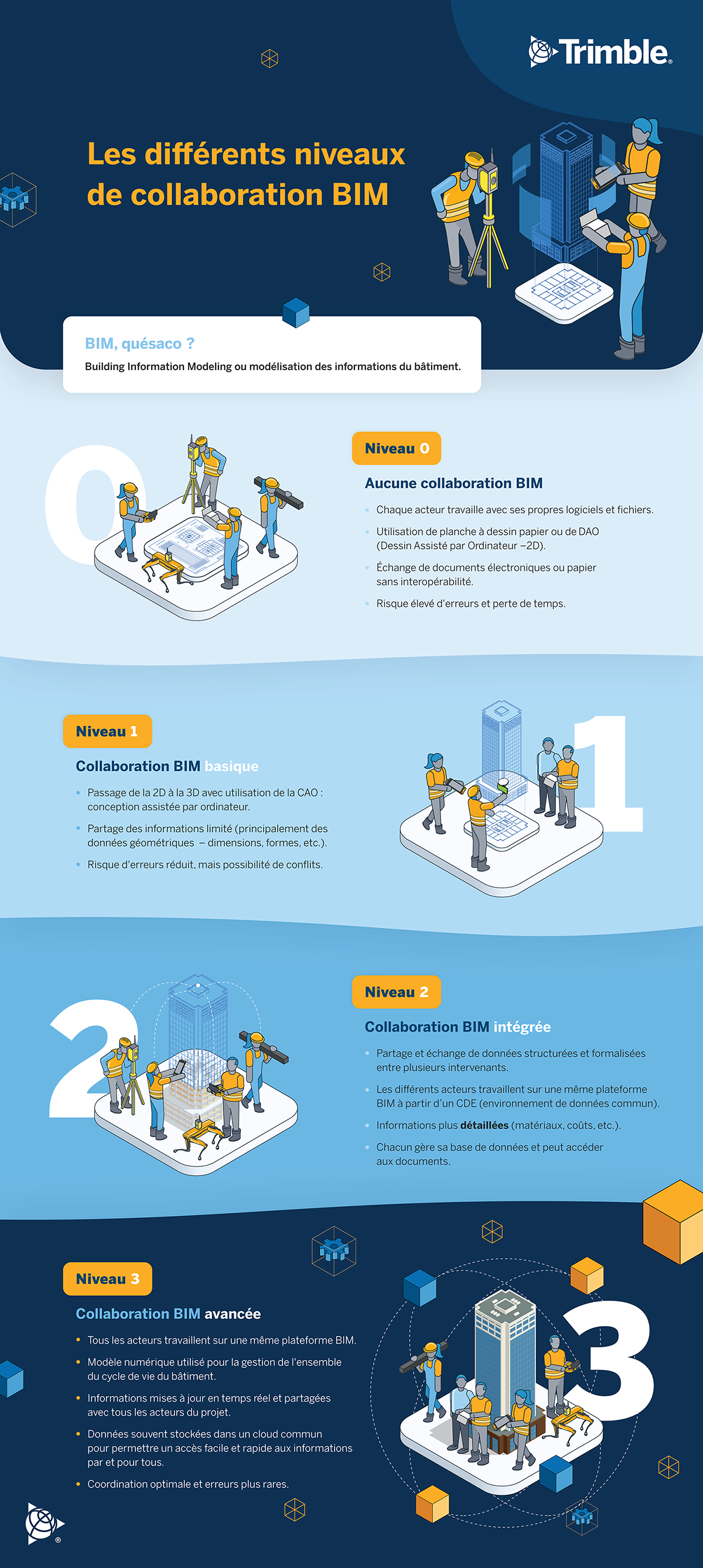
BIM is the process of creating a digital model of a building to facilitate collaboration between all construction stakeholders (from design to maintenance). Degrees of use vary according to the level of collaboration desired by stakeholders: from level 0 (no BIM collaboration) to level 3 (100% BIM collaboration). Here's how it works.
The 4 levels of BIM collaboration
Ranked from 0 to 3, the levels of BIM(Building Information Modeling) collaboration correspond to the maturity of the players involved in each modeling project. The levels also coincide with different degrees of complexity and data integration in the digital model. And different degrees of efficiency!
Level 0: no BIM collaboration
Level 0 corresponds to the lowest level of BIM collaboration. At this stage, 2D drawings are produced using external CAD (computer-aided drafting) software or in paper format. These are then used to design and document the project. Also, all collaboration-related exchanges are carried out by sending electronic or paper documents.
This mode of operation is not conducive to collaboration, for several reasons:
Graphic standards are not uniform - they are left to the discretion of each individual.
Information is neither structured nor centralized.
The majority of projects are not georeferenced, i.e. they are not associated with geographic coordinates and therefore have no spatial location.
Level 1: Basic BIM collaboration
Level 1, also known as lonely BIM, is the first level of collaborative BIM. This mode of collaboration combines the use of 2D CAD software for drawing plans, and 3D digital models for the design part.
However, BIM Level 1 still limits information sharing. This is because information is often stored in separate files, rather than in a common environment.
On the application side, a digital model can be used to ensure coordination between the various players involved in a project, but it cannot yet be used for design management.
Level 2: advanced BIM collaboration
Often considered as the first level of advanced BIM, BIM level 2 focuses on information sharing between the various project participants. Data is centralized in a CDE (Common Data Environment), a securely accessible common work environment. Everyone can then access and extract documents to exploit the information they contain.
BIM standards are often used to guarantee data interoperability from one player to another, and from one software package to another. However, Level 2 collaboration does not require team members to work on the same 3D CAD drawing models. Indeed, in most cases, each team member takes the liberty of using the CAD model that suits him or her (and that is part of his or her modeling process).
Level 3: Integrated BIM
Level 3 is the ultimate level of BIM maturity. It enables the digital involvement of all project stakeholders, for the management of the entire building lifecycle (construction, installations and assets). Information is stored in a single, shared cloud and updated in real time, making it easier for all parties to access and update data.
In Level 3 BIM collaboration, all participants work on a single, scalable 3D model. This incomparable source of information and precision is central to the process. It compiles all the data on a project's physical, technical and functional characteristics.
Level 3 of BIM collaboration is the most optimal: it improves the reliability, efficiency and quality of construction projects. The key: choose the right level of collaboration right from the start, to optimize working conditions for the various players, reduce errors and improve the quality of the final project.

