Skip to content

How BIM and ERP work together for better precast workflows

3 minutes read
| |
September 27, 2019

Share this post:

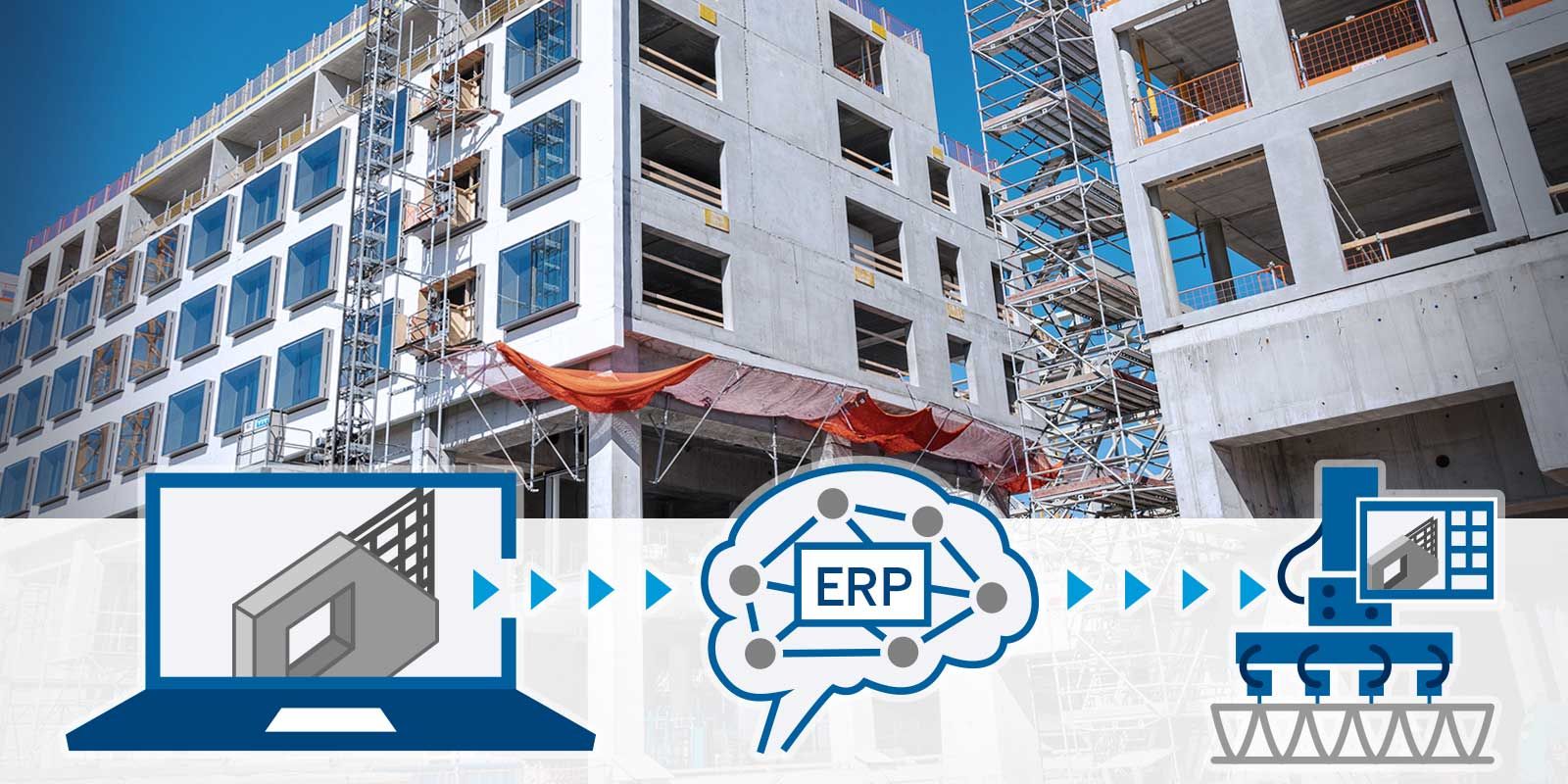
An illustration shows a building under construction, a laptop displaying a 3D model, a brain graphic with ERP inside, and a 3D printing machine.

In the concrete construction industry, costs are everything. To keep costs and processes under control, organizations often rely on enterprise resource planning (ERP) software. These planning and financial management solutions eliminate guesswork and provide answers to the questions that organizations must stay on top of, such as “Are we in the green or the red?” and “Are we manufacturing on time or are we facing capacity problems?” When combined with building information modeling (BIM), ERP software is an invaluable part of the workflow.

The role of ERPs in precast is changing

ERP software is nothing new. For decades, there have been ERP mammoths that can do just about anything—even manage your DVD collection at home, if that’s how you want to use it. But when it comes to precast, a solution that can seemingly do everything might not be the best fit, as it could lack specific key functionalities. This is why ERP systems that are purpose-built for precast - sometimes also called manufacturing execution systems (MES) - have become more and more important over the years.

ERP and BIM systems are natural complements, and together they can create a truly optimized, profitable workflow. ERP is all about the money and numbers, while BIM greatly contributes to overall success by providing the ERP software with the right numbers. Think of it this way: if the ERP is the brain, then the model is the data in the brain. And without that data, you cannot crunch the numbers or do the manufacturing. One depends on the other.

ERP turns information into numbers

This relationship is quite remarkable, not only in the precast industry but within the whole BIM world. Many people who didn’t “get” BIM in the past are now able to clearly understand what all the BIM fuss is about. Information becomes transparent and it just makes sense. Someone creates a model, and once he or she adds a piece into the model, it has characteristics. These characteristics can then be translated into numbers, which can be used in the commercial department to create a tender. The information is there right away. 

With real-time information about quantities, you can, for example, know up front how many pieces or how many square meters of mesh a project will need. Organizations that understand the importance and benefits of BIM bring their ERP people to the meeting table early so they can start piecing together the big picture and provide cost estimates as soon as possible. 

Accurate numbers equal better profits

When it comes to BIM and ERP integration, things are getting better all the time. For example, thanks to the work of the IFC4Precast project, we’ll have one file format in the future. This means we’ll have both production and ERP in a single information set—previously, they’ve always been parallel, resulting in separate processes. Bundling this meaningful information in one data stream will benefit the industry in a big way. Stakeholders throughout the process will be able to work from the same source of information, eliminating the risk of contradicting information and the costs that can come with it.

That is the power of ERP software: having the numbers at hand to formulate an accurate picture of how much money a project will involve. You can, of course, do this the long way—crunch the numbers using drawings—but when it comes down to it, do you trust those numbers? When you have an accurate 3D model, your numbers are going to be accurate because you’re dealing with reality and not an abstract. Consequently, there’s a higher certainty that, at the end of the day, you’ll walk away from a project with money in your pocket and your company will be more prosperous.

Learn more about solutions for fabrication planning and management.

Related articles

Article

3 ways to enhance infrastructure management with Nearmap and Trimble Cityworks

Using Nearmap in conjunction with Trimble Cityworks and Esri ArcGIS offers a highly scalable and eff...
Read full article
Article

5 cyber attacks that threaten critical infrastructure and how to protect against them

Know what cyber attacks threaten critical infrastructure, and discover cybersecurity measures infras...
Read full article
Article

5 tips for leveraging query eURLs

eURLs allow organizations to easily share real-time information on everything from work activities a...
Read full article
Attention

We tried to combine the products in your guest cart with your saved cart, but we encountered an issue while merging them. When choosing a subscription, please select either monthly or yearly as they cannot be combined. Kindly review your cart before proceeding to checkout.

Cart updated
Some items in your cart are not available for purchase in your region, so we removed them. Please review your cart before proceeding.

Items Removed:
Attention

The software you are trying to purchase is not available in your country or region.

Cart updated
The items in your cart have been updated for two reasons. Firstly, the prices now match the currency linked to your account address. Secondly, some items have been removed because they are not available for purchase in your region. Please review your cart before proceeding.

Items Removed:
Cart updated
The items in your cart have been updated for two reasons. Firstly, you've added too many of one item to your cart. Secondly, some items have been removed because they are not available for purchase in your region. Please review your cart before proceeding.

Items Removed:
Cart updated
The items in your cart have been updated for three reasons. Firstly, the prices now match the currency linked to your account address. Secondly, you've added too many of one item to your cart. Thirdly, some items have been removed because they are not available for purchase in your region. Please review your cart before proceeding

Items Removed:
Cart updated

Your currency has been changed to match the currency associated with your account address.

Cart updated

Your cart has been updated for two reasons. First, the prices now reflect the currency associated with your account address. Second, you've added too many of one item to your cart. Please review your cart before proceeding.

Cart updated

While combining the products in your guest cart with your saved cart, at least one item in your cart has exceeded the maximum allowable quantity. Please review and correct your cart before proceeding to checkout.

Attention

We were unable to access your account information. Please contact customer support for assistance.

Attention
Unable to update shopping cart information. Please refresh the page to resolve the issue. If this issue persists, please contact Trimble support.
© 2026 Trimble Inc.

Trimble is a global technology company that connects the physical and digital worlds, transforming the ways work gets done. With relentless innovation in precise positioning, modeling and data analytics, Trimble enables essential industries including construction, geospatial and transportation. Whether it's helping customers build and maintain infrastructure, design and construct buildings, optimize global supply chains or map the world, Trimble is at the forefront, driving productivity and progress.