Our modern scanning technology helped restore the Library to its former glory, circa 117 CE.
Ádám Németh used The Great Library project's point cloud to increase the accuracy and detail of his virtual reconstruction of The Library of Celsus.
The best part of any journey is the friends you meet along the way
Our mission to create the most detailed scan of the Library of Celsus has introduced us to a gentleman named Ádám Németh, a time traveler who brings ancient sites back to life.
We sat down with Ádám Németh, a virtual reconstructionist, to talk about how he used our point-cloud scan to create a highly-accurate virtual recreation of the Library of Celsus. For those interested in how converting a point cloud to a mesh can revolutionize historical restoration, read on for a lesson in turning back the clock on a 2,000-year-old landmark.
Background of a time traveler
Ádám Németh is a Budapest-based virtual reconstructionist who works creating recreations of past cities, buildings, or artifacts. He has worked with National Geographic and several prominent museums in Hungary, the UK, and Germany.
His journey into the past started with a road. A Roman road, to be exact. This road led to an interest in Roman-era Budapest, known as Aquincum. While searching for more historical information, he learned that few—if any—3D reconstructions existed. Curious about what these ancient places once looked liked, he undertook the mission of reviving Roman-era Budapest.
“I was interested in the life of the ordinary people, how they lived their lives, not the ‘usual suspects’ like the emperors or the gladiators or the soldiers.” — Ádám Németh
He started with the Legionary Fort, contacting archeologists at the local museum to access their extensive library on ancient Aquincum. This led to an order from the museum itself, for illustrations to be used in an exhibit. Thus, Ádám began his work as a virtual reconstructionist. He’s since modeled such structures as the Whitby Abbey, Torre de Belém, and the city of Ephesus—which is what brought us together.
Ádám Németh at The Library of Celsus in Ephesus.
A meeting of the minds
When he heard about our point-cloud scan, Ádam reached out to see if we could help with his [Wonderful Ephesus](http://Visit Ádám's website to learn more about his app, Wonderful Ephesus: http://www.virtualreconstruction.com/ephesus/) project.
He’s [developing an app](http://Visit Ádám's website to learn more about his app, Wonderful Ephesus: http://www.virtualreconstruction.com/ephesus/) that will allow people to explore the ancient city, and famous sites like the Library of Celsus, as they existed 2,000 years ago. Naturally, we were happy to help! We sent him our scan which he used to create one of the most-accurate reconstructions of the Library yet.
While we’re evolving the ancient site with modern architectural additions, Ádám is restoring the Library to its former glory, better preserving our ancient memory. We may be moving in opposite directions in time, but we have one thing in common—the power of modern technology to transform ancient history.
“My main goal, through reconstructions, is to make history interesting and accessible for everybody.” — Ádám Németh
How funny, we’re using history to make Connected Construction accessible and exciting!
Bringing the library to life
But first, a confession; few people know what these structures actually looked like, and those who saw them 2,000 years ago left few written descriptions. This poses an intriguing challenge to the virtual reconstructionist, to peer into the past and see what History has forgotten.
The advantage with the Library of Celsus was its real-life restoration, following destruction by an earthquake in the 10th or 11th century. “They put it back together like a Lego building,” Ádám explained, “I only had to do those broken off parts and the missing parts and the coloration.” The process would still present its challenges, however.
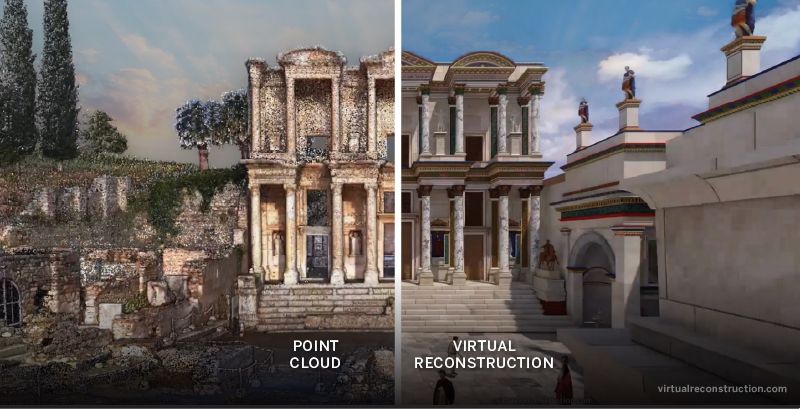
A comparison of the point cloud, created by Trimble, and the virtual reconstruction, created by Ádám Németh using scan data from an X7 laser scanner.
The first attempt: kickin’ it old school
On his first attempt, Ádám searched through architectural drawings made from on-the-ground and aerial measurements. Using photogrammetry, he reviewed publicly available photos and images he’d taken to ascertain the library’s probable scale. It was a time-consuming process that still led to inaccuracies.
“They [traditional methods] are not nearly as precise as laser scanning, because the usual methods have some 10 or 20 centimeters of an error threshold. So it’s not really suitable for doing comparisons between the real building and [virtual] reconstruction.” — Ádám Németh
This created a problem for the reconstruction’s purpose. Ádám wants users to compare the present-day library to its original state via an alternating switch. Ironically, in order to revive this ancient site, he needed to abandon outdated techniques. Enter the scan!
The second attempt: using the power of the point-cloud
Using our point-cloud scan of the Library of Celsus, he was able to create a more-detailed, accurate, and immersive recreation. In order to do this, he needed to convert the 5.5 gigabyte point-cloud into a mesh. By doing so, he was able to create a unique iteration of the library for use in his app.
Conversion: a cloudy memory to a vision of glory
The point cloud covered a lot more ground than the Library, so Ádám started his restoration by selecting the desired portion of the scan and converting it to a mesh with RealWorks.
RealWorks used one point per half centimeter to generate the mesh, unifying the point-cloud into a solid mass; essentially, connecting all of the points like a 3D dot-to-dot. Then, using Cinema 4D he shrunk the mesh from 2 million polygons to a manageable size for the app he is creating.
In the final stages, he projected images onto the mesh to achieve a detailed texture and accurate coloration. And then, the creative part... adding in the details that have been lost to history such as how the marble was painted and missing parts (for example, the entire back wall shown in the reconstruction below!).
The result is the restoration of an ancient memory.
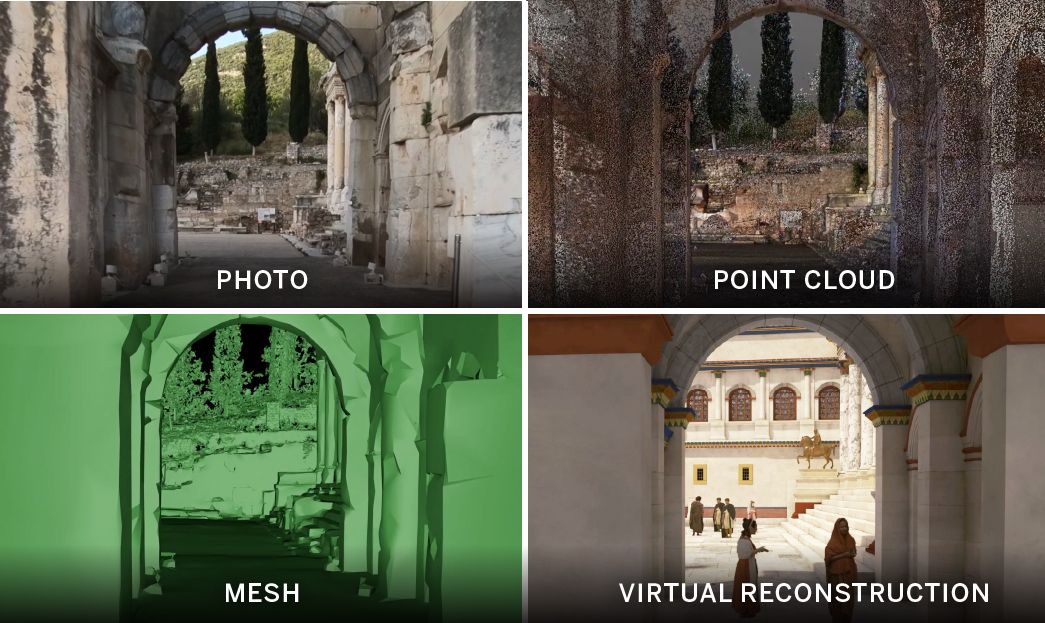
Conjuring a clearer vision
When Ádám compared his original reconstruction with the updated version based on our laser scan of the site, he discovered a 3% difference in the Library’s scale. Apply this to a construction project and you’ll see just how many problems you’ll avoid—and how much money you’ll save in terms of re-work —with the clearer version provided by laser scanning.
Now, he’s one step closer to welcoming people back into the past for a tour of ancient Ephesus, no matter where they are in the world.
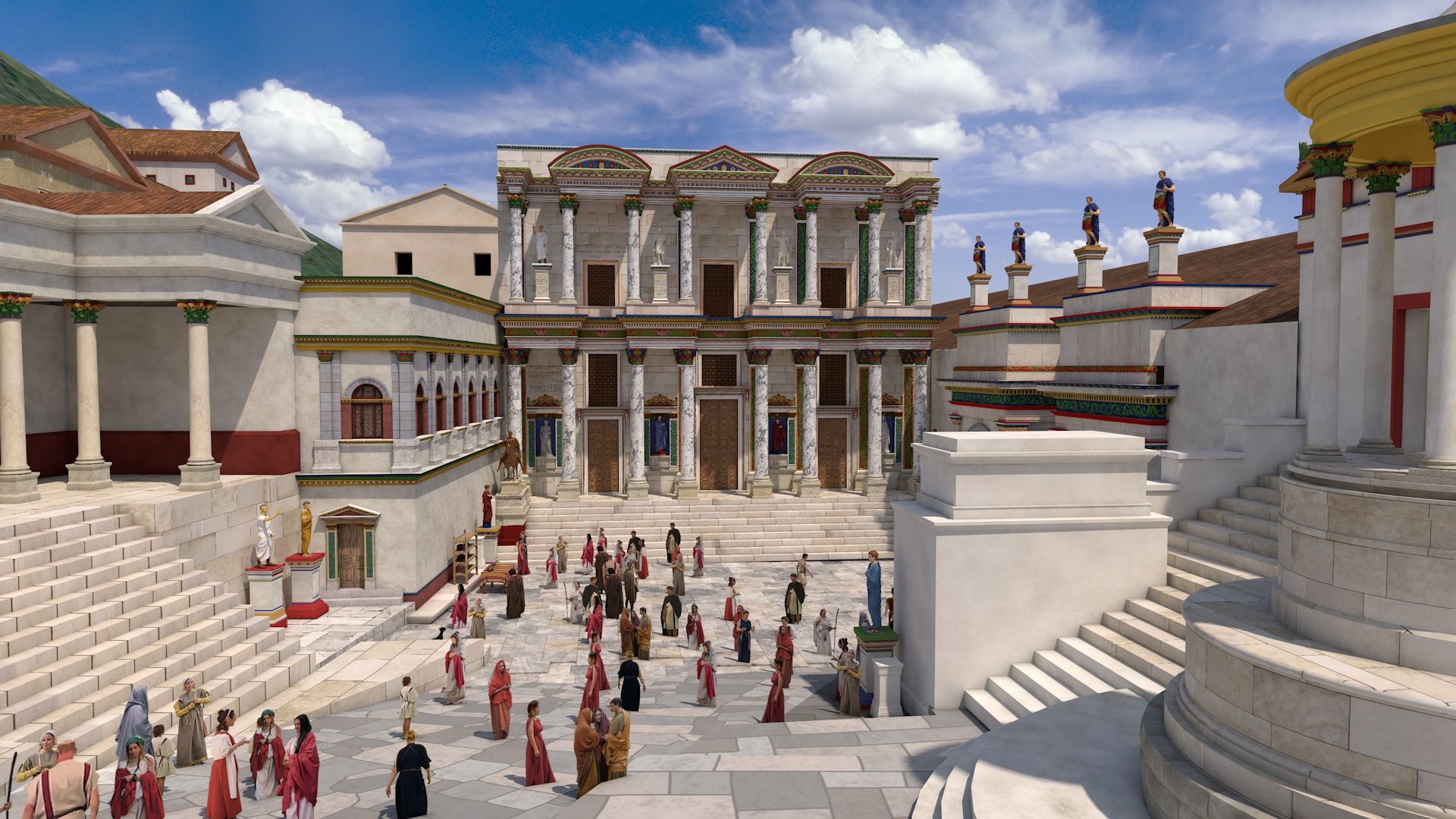
Ádám Németh's virtual reconstruction of the courtyard in front of The Library of Celsus in Ephesus.
“If you are not able to be at the real site in Ephesus, then you can feel and imagine that you are there.” — Ádám Németh
When worlds collide
As we concluded our discussion, we touched on his interest in creating a VR iteration of the Library. The level of immersion this provides has benefits in construction, of course, but the underlying technology is poised to revolutionize education and historical preservation, too. Ádám’s library is an example of what happens when the virtual and the real world collide.
Subscribe to The Great Library as we continue to explore new uses for the tools that make Connected Construction possible. We’ve already made extraordinary friends along our journey. Who knows what revolution in human creativity is around the next corner!

