Esskay Structures is an ISO certified, end-to-end steel detailing services provider adept in detailing steel structure for bridges, stadiums, complex commercial and industrial structures. The company’s mission is to offer world class design and detailing services to customers by leveraging technologies and empowering its employees to consistently deliver a comparable product for its clients in terms of quality, time and cost.
Project Scope:
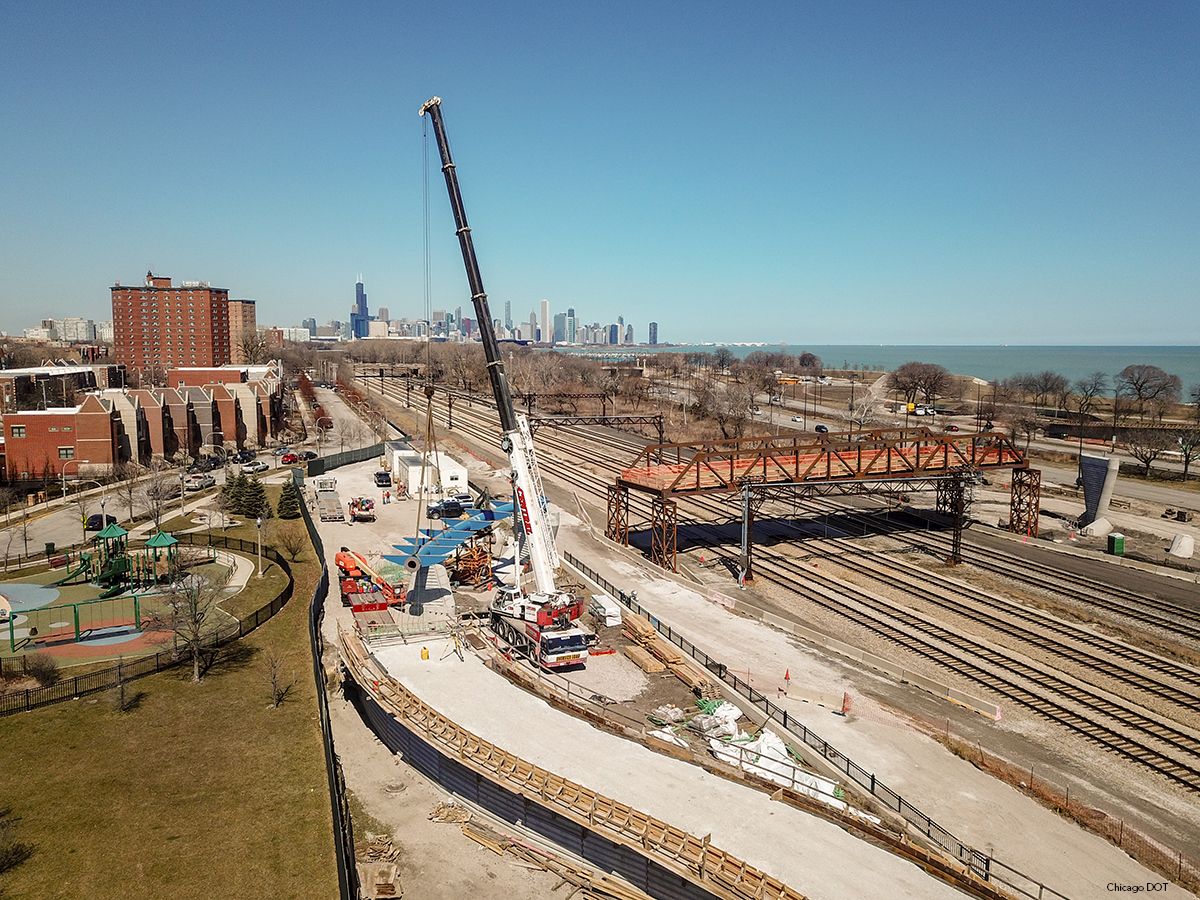
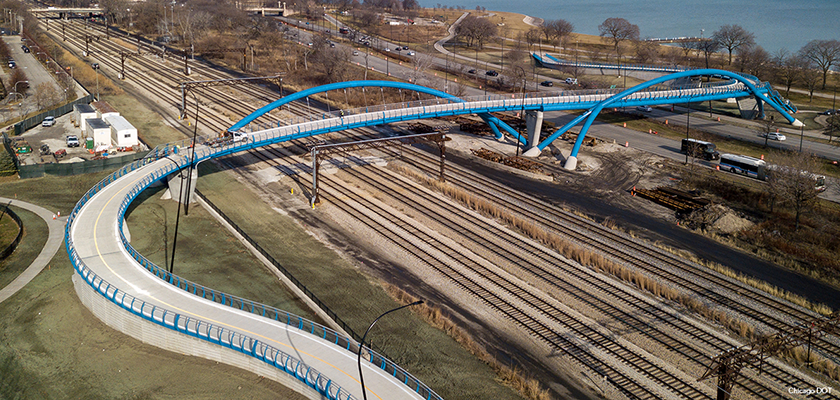
Chicago’s 41st Street Pedestrian Bridge design was an award winner right from the very start. Its inspiring design with curves, and the arch-supported steel concept won an international design competition that eventually led to creation of this marvelous bridge. The bridge span connects the city’s Bronzeville neighborhood with the trail system that runs along Lake Michigan. It provides pedestrians with safe passage over Lake Shore Drive, as well as the Metra Electric/CN Railroads, both of which continued to stay in operation even while the bridge was being constructed.
The bridge features double-curved arch mono trusses to form large, graceful S-curves. It contains three segments in its total span, with the segments being called ‘East & West Approaches’ at the two ends and ‘Main span’ in the middle.
The main span is designed with Steel Rib superstructure support, achieving the objectives of both form and function. The longitudinal Rib-Girder support system accommodates the complex bridges’ need to curve both horizontally and vertically, while providing the desired aesthetics.
With 676 tons of steel used in its construction, and with a length span of 750 feet, along with an average deck width of 24 feet, the 41st Street pedestrian bridge is nothing less than a beautiful marvel, a sight to behold.
“Based on our experience of working with several geometrically complex bridges, we feel bridges of any complexity or type can be easily handled using Tekla. We see a great futuristic role for Tekla to assist bridge fabrication, to ensure accuracy of geometry during fabrication, using automated fabrication equipment.”
- Mr. V. Kesavan, Project Manager, Esskay Design & Structures
Challenges:
From a design perspective, unlike typical arch bridges, which are symmetric in horizontal and vertical directions, this particular design called for spans on reverse curvature and on the long crest curve where the center between the arches is 7 feet higher than the outside ends of the arch at the approaches. The arches incline at 30˚ from vertical, and the deck rib curves on a 400-ft radius, supported by hangers only on one side.
The bridge is a detailer’s dream project. The main span is about 240 feet long, supported and suspended by hangers. The hanger connections at the arches and the bridge were modelled based on the design angles, because hangers contribute significantly to the stability of the bridge. Fixing the hanger at the designed position was challenging, because the main span and arches had different curve geometries. The hangers had to be modelled in the cambered condition and the final position of hangers had to satisfy the design data.
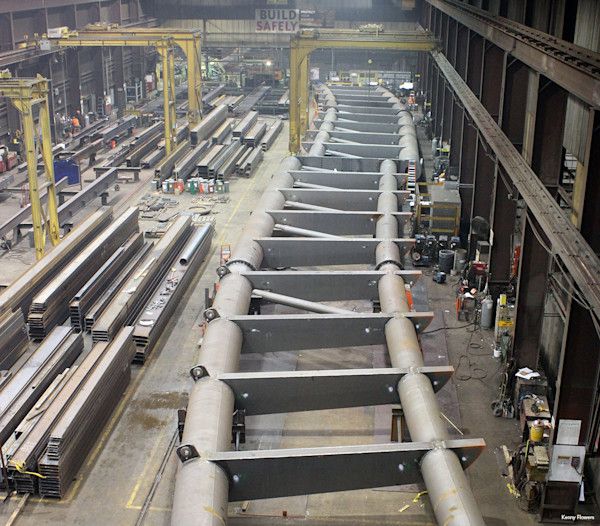
Logistically, the challenge for the team was to find a way ship the large sections of the bridge from fabrication shops to the project site. The bridge components were shop-welded to their fullest extent, resulting in extremely long, wide, and heavy permit required preplanning and coordination. The largest structural piece was 62 feet long, 24 feet 4 inches wide, and weighed 38.3 tons, with the heaviest structural piece being over 42 tons. The bridge was shipped to the job site in 14 built-up sections, including six approach single-pipe spine assemblies and eight main span double-pipe assemblies; the main span including six approach single-pipe spine assemblies and eight main span double-pipe assemblies; the main span assemblies were more than 24 feet wide.
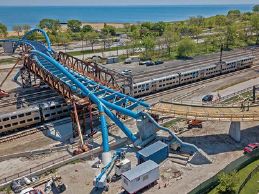
From an erection perspective, this bridge is supported by a pipe in the middle, which is its spine. Using the geometry of the bridge path and the camber values (plan and elevation) between the support piers, the curve should be formed according to the design. Attaching the box girder to the pipe also posed a challenge because the box girder had to follow the span’s path to achieve the bridge geometry.
The Solution:
Version 21.1 of Tekla Structures was used for detailing this project, and while the bridge path curve was prepared outside Tekla, it was imported into Tekla by using the reference model import option. It was very helpful to do the model to suit the bridge geometry, and amply proved the worth of Tekla’s interoperability.
Tekla Structures helped complete this complex project in multiple ways, a few highlights being as follows:
PROFDB & MATDB: Since the pipes were larger in diameter than usual, a custom profile function enabled us to create the various pipe diameters and also various material grades.
POLY BEAM CREATION: The poly beam creator tool was used to create the pipe with multiple points in different planes (X, Y, and Z-axis) to follow the pipe path. Then the camber properties were used to smoothen the curve by giving camber radius at all the points to achieve the smooth curve.
COPY & ROTATE: The box girder was modeled at one location, and the “copy to another plane” tool was useful to copy the box girders at all the locations. The arches were modeled perpendicular to the ground, followed by the work plane to Z and rotation to the required position. The work plane and rotation on the other axis were used to fix.
WORKPLANE: Usage of work planes and sections enabled fixing the hangers as per design data and helped to check and ensure the correctness. The weld edge preparation was carried out by using the Polygon cut tool in the circular edge of the pipe.
BIM for Fabrication & Erection
3D Tekla models were used to assist the fabricators and steel erector in both placement and fabrication of the steel tubes of the arches and deck sections. Paschen used LiDAR laser scanning of the foundations, which were then replicated at Hillsdale Fabricators’ St. Louis shop to meet the quarter-inch tolerances necessary for proper installation. Prior to shipping, the large sections of the bridge were assembled at Hillsdale’s shop for quality control.
In the past on similar complex bridges, Esskay assisted the fabricators on importing cloud point model of the fabricated assemblies (using 3D scanners) into Tekla to ensure that fabrication was within the tolerances and would fit in the site seamlessly. Such complex projects will be impossible to execute without Tekla’s prowess.
“The feature rich BIM coordination capabilities of Tekla enabled easy coordination with other trades and check the accuracy of fabrication in conjunction with the 3D scanned data. Obviously, the fabrication drawings for such geometrically complex assemblies would be complex too, but Tekla made it very easy to create the assembly drawings in the plane that would be easy for the fabrication shop to understand and deliver. Tekla enabled creation of sub assembly drawings to help the fabricator to pre-assemble pieces in the shop to ensure accurate geometry and fit.”
- Mr. V. Kesavan, Project Manager, Esskay Design & Structures