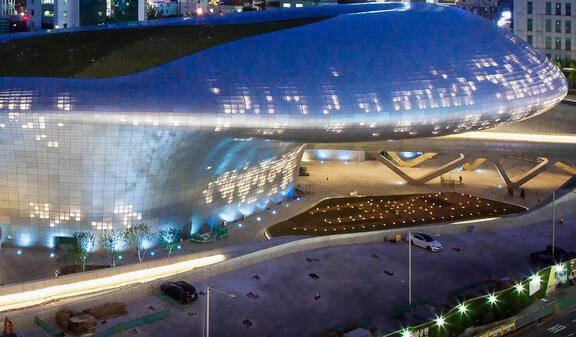
On March 21, 2014, Dongdaemun Design Plaza (DDP), an architectural icon in South Korea, opened in Seoul. designed by world-renowned architect Zaha Hadid, DDP is a world-class design infrastructure.
DDP is located in Dongdaemun, the center of Korea's fashion industry with a 600-year history, with three basements, four floors, and a total floor area of 86,574 square meters. as a complex cultural space that leads the design and creative industries through communication and collaboration with the world, DDP is composed of five facilities (Alimater, Learning Center, Living Center, Design Center, and Dongdaemun Historical and Cultural Park) for various international conferences, new product presentations and exhibitions, performances, business, shopping, and relaxation.
In keeping with the concept of a metaphorical landscape, the undulating, flowing curves of the façade make the DDP stand out as the largest unstructured building in the world, but also make it extremely challenging to construct.
Adoption of BIM solves problems
Samsung C&T, the general contractor for the DDP project, faced challenges from the beginning of the project. The DDP, which was completed in about four years and eight months, faced tight schedules, budget issues, and was impossible to construct using traditional 2D technology. to overcome these challenges, Samsung C&T adopted BIM for the entire process, from the initial excavation to the interiors, facilities, and landscaping.
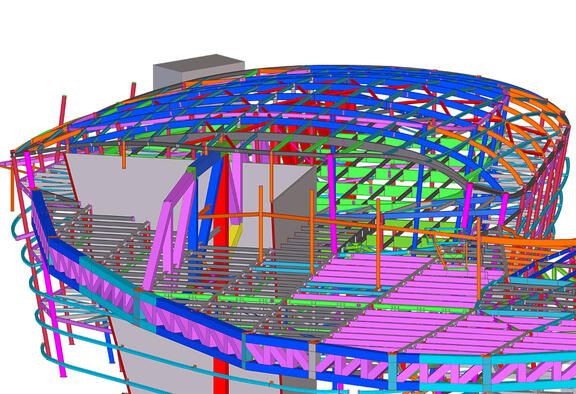
"We received 2D-based steel drawings and 3D models from the architect, but we found that the information was different from each other because we hadn't applied BIM in the design phase, and we hadn't done much 2D drawing and 3D modeling," says Baek Inbeom of Samsung C&T. it was not an easy task to find and correct the different information one by one." Samsung C&T decided to adopt Tekla to solve this problem efficiently.
Samsung C&T created a 3D construction model to compare different information between 2D drawings and 3D models, and the matching of different information was done in just three months without errors. Tekla was also used to review the constructability of the DDP. during the megatruss construction phase, which was introduced to create a large space inside the DDP, Samsung C&T used Tekla to locate the coordinates of the megatruss steel members and check the interference between the steel structure and the 45,133 exterior panels of different sizes to ensure that the DDP's free-curved roof could be constructed reliably. Tekla also enabled double planning and efficient crane operations, saving time and money.
Tekla from production planning to installation
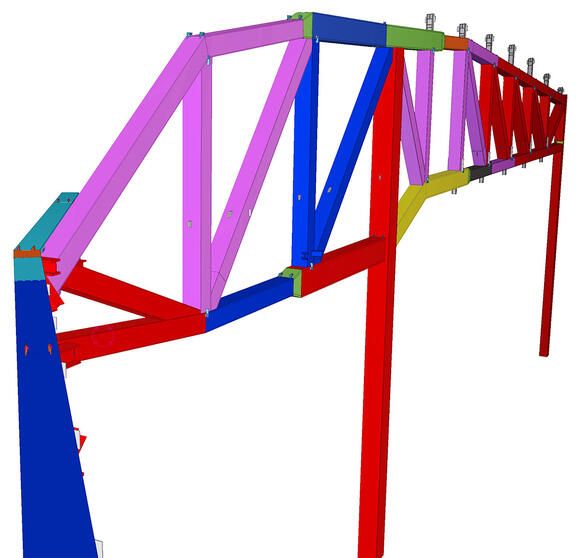
In addition to the design phase, Tekla provided accurate and rich information during the fabrication and installation phases, which improved the efficiency of the work. "As the DDP is an atypical structure, each member has a different radius value, and with Tekla, we were able to accurately calculate the radius value of each member. It also provides all the information needed for production, such as bends, welds, and break points for curved members, so we were able to produce steel members quickly and save money based on this information," says Mr. Baek Inbeom of Samsung C&T.
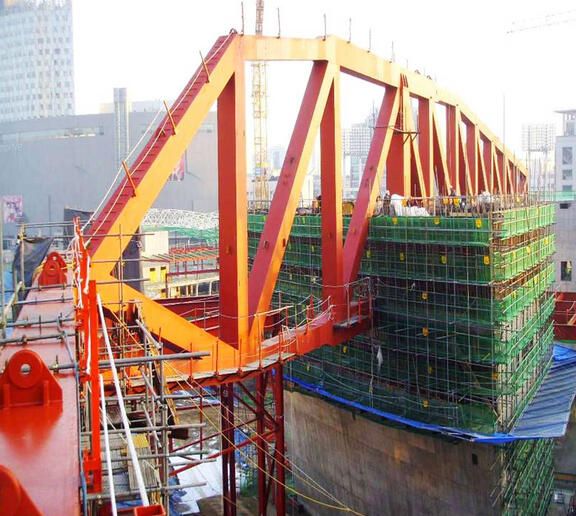
In addition, Tekla is a construction BIM software for construction, not design BIM, so it provides the necessary details, such as quantity takeoffs for fabrication. "Based on the information extracted from Tekla, we were able to order and deliver materials for fabrication at the right time, and it was also easy to create design drawings and construction drawings in Tekla."
A highly architecturally challenging project, DDP was successfully built with Samsung SDI's BIM technology and accurate modeling information from Tekla Structures, and is now a landmark in Seoul.
"Tekla provides us with all the information we need for production, such as bending, welding, and break points for curved members, so we were able to produce steel members quickly and save money."
Inbeom Baek, Assistant Manager, Samsung C&T
Samsung C&T's construction division realizes the best added value for its customers with the highest level of talent and technology in each field, including architecture, civil engineering, plants, housing, and development projects. In particular, in the high-rise sector, we are leading the world's skyscrapers by completing the Petronas Towers in Malaysia and the Burj Khalifa project in the United Arab Emirates, and we have successfully completed the Incheon Bridge, creating the foundation for a centralized country in Northeast Asia.
In the plant business, we are currently building Shinewolseong Units 1 and 2, the UAE Nuclear Power Plant, and the Khuraya Combined Cycle Power Plant in Saudi Arabia, making us a global powerhouse in the plant sector.

