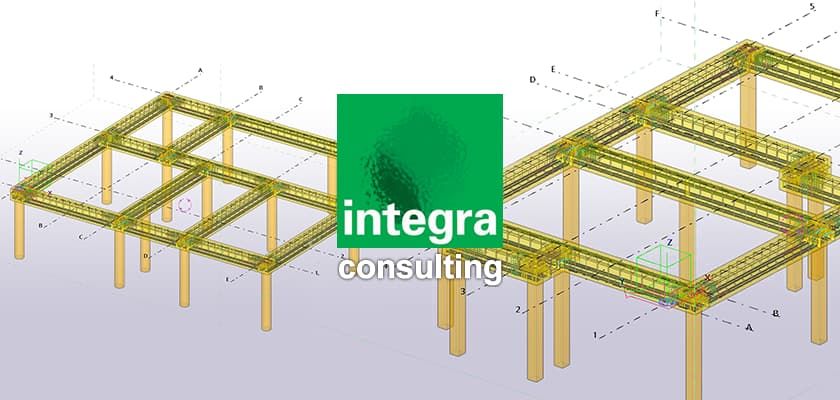
With BIM at the heart of the business, Integra Consulting has been reaping the benefits of using Tekla Structural Designer and Tekla Structures , enabling them to deliver work quickly and efficiently, with enhanced visualization and data accuracy. Here, Integra Consulting director Colin Hadley talks more about the company's expansion into the real estate market, the use of Tekla and his vision for the future of the sector.
Based in Manchester, Integra Consulting specializes in civil, structural, geotechnical and environmental engineering. Familiar with BIM, digital technology represents a large part of Integra's daily workflow, having used Tekla Structures for over 5 years and Tekla Structural Designer and its predecessors for almost 30 years.
Speaking about the company, Colin Hadley, director, said: "Although we have experience in all areas of construction, foundation and beam projects are a common example of the work we do at Integra, especially for the real estate market.
Residential work is a really big growth area for us, as well as for the construction industry in general. In addition to the oft-publicized housing shortage, which drives engineers to build faster, we've also seen the trend towards working from home having an impact more recently. With people spending more time at home than ever before and, in many cases, moving the office home, this encourages people to look at their home and what they need from it differently.
Tekla Structural Designer model (left) imported into Tekla Structures (right).
As Tekla users for some time, we use a combination of Tekla Structures and Tekla Structural Designer, with the two software solutions working in partnership and helping us to offer the best service to our clients. Often, we will receive the initial model from the housing developer, which we will use to model and analyze the balkrame beams in TeklaStructural Designer. We then use this data and information to detail the reinforcement configurations in Tekla Structures. Given the combination of materials, concrete and reinforcement, we needed BIM software that would work well with both, which Tekla solutions do well.
BIM means speed and time savings for the business
Colin continued: Perhaps one of the main advantages of BIM for us as a company is the speed and time savings it offers. The use of intelligent structural analysis and 3D modeling software allows us to work much faster than if we were detailing and analyzing structural elements, such as bucket beams, manually. To quantify this, it can now take us a matter of hours to analyze the bucket beams of a housing project and detail the necessary reinforcement, whereas previously it would have taken the team perhaps a few weeks. The impact of this is huge - it allows us to offer a much greater and more efficient service to our clients.
Adding piles using the pile matrix tool (top left), support pressure contours (bottom left) and 3D visualization of the structure with pile foundations in Tekla Structural Designer.
A truly executable 3D model provides excellent visualization
However, the resulting speed and efficiency is not just limited to the structural analysis and detailing phase, as Colin explained: but also to the review process. The level of detail contained in a 3D BIM model provides greater visualization of the structure or component in question, making it much easier to visually check that everything is correct. Having a clear view of the reinforcement in Tekla Structures also makes it easier to identify possible problem areas and interferences, even without using the software's interference checking tool.
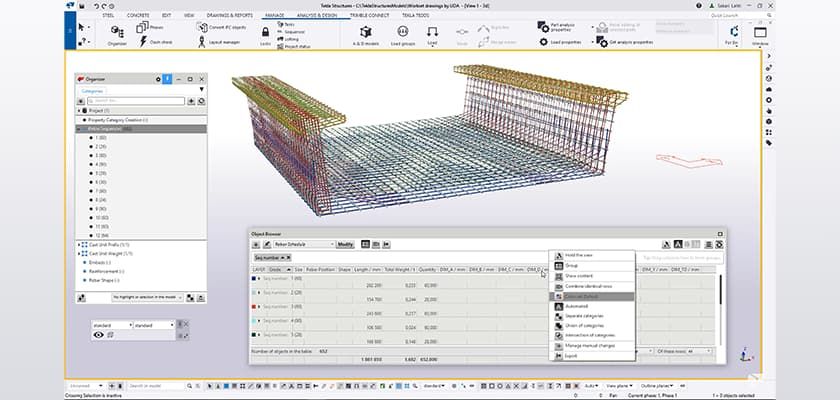
The Tekla Structures Organizer and Object Browser can be used to manage and color the armature sequences. The Object Browser is an Organizer tool used to query, view and report model information based on selected objects in the model.
In many ways, Tekla software solutions are like having a whole team of engineers at your desk and on your computer. This has changed the way we work and also the way we recruit, with many recent engineering graduates being multi-skilled and proficient in analysis and design software, both in Tekla Structural Designer and Tekla Structures.
Use the Tekla Structures functionality to create sequenced manufacturing drawings automatically.
The future is BIM and digital workflows fully integrated into the business
Speaking about the next steps in this digitalization journey, Colin said: CNC machinery is definitely the next step for the construction and manufacturing industry. The potential is huge, with data being able to be sent directly from the 3D model to the machine, without the need for manufacturing drawings. However, this automation requires accurate data, and this is where the need for BIM and digital technology comes in, providing high levels of accuracy down to the last millimeter.
It's clear that engineering consultancies like us need to be ready for the day when CNC machines become standard practice, with BIM and digital workflows fully integrated into the business. The time to adapt and digitize is now.

