

For most contractors and subcontractors in the construction industry, progress billing and AIA billing are nothing new. Pay apps provide ways for contractors and subs to get paid during the course of a long-term project. The documentation that goes along with them is part of the process. Still, the AIA G702 G703 fillable forms come with a few disagreeable terms and a lot of resentment. While it's true that these documents are in no way a perfect solution for professionals in the construction industry, there are some misconceptions about AIA G702/G703 documents.
Misconception 1: AIA-style forms are the only way to submit pay apps
The AIA G702 and G703 are widely recognized as the industry standard for pay apps related to progress billing. Yet, that doesn't mean they're the only option. The AIA produces some of the most commonly used construction contracts in the industry. The contract governs all aspects of the project. They designed the G702 and G703 to correspond with these contracts. However, you can use other documents to achieve the same results. The most common alternatives for the AIA G702 G703 fillable forms include:
Misconception 2: AIA-style forms must be notarized
AIA G702 forms include a section for notarization. As a result people believe that a contractor or subcontractor shouldn't sign off on the AIA G702 without the presence of a notary. However, both parties can agree that notarization isn't necessary for the project. Both parties would then amend the contract to reflect this. Now, without the contractual requirement, the notary can be left blank.
Misconception 3: AIA forms always take a lot of time to fill out
AIA forms are complex legal documents that require specific data entries. Careful step-by-step methods help avoid errors that could result in denial of the pay app. For example, the G703 is essentially a schedule of values. Then the G702 describes each expense incurred during the pay period. As if those calculations don't provide enough room for error, the forms compound on previous calculations until a project is complete. Even worse, errors have a cascading effect when the GC consolidates the pay apps from several subcontractors.
Efforts to streamline and speed up the process have often included reliance on excel spreadsheets. Additionally, companies frequently needed other tools to communicate changes and updates. Furthermore, the use of emails or DocuSign may eliminate the need for physical documents and in-person signatures. However, this threatens accurate version control and offers more room for error. The reality is that spreadsheets aren't optimized for construction. Unfortunately, lack of optimization results in pay app denial due to human error.
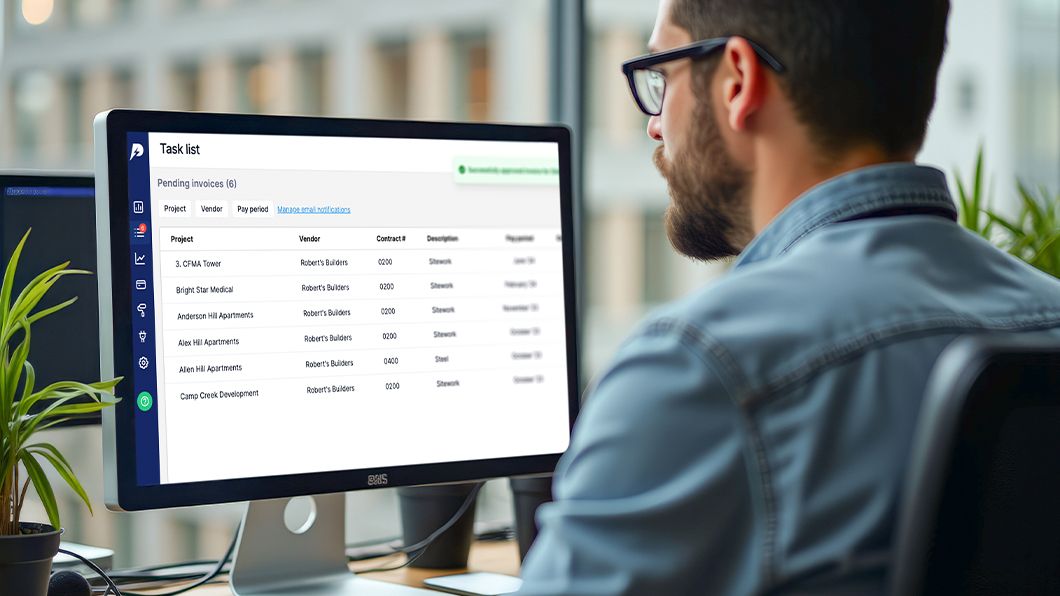
The labor-intensive data entry methods construction professionals were forced to rely on in the past are no longer the only option. Now construction billing software provides companies a way to incorporate billing processes. Standardized digital versions of AIA G702 G703 fillable forms and custom forms integrate into Trimble Pay, formerly Flashtract, construction billing software. Precise information is digitally entered at the worksite while the project is being completed.
Misconception 4: Projects with an AIA contract require the use of AIA-style forms
The AIA provides documentation for a variety of steps in any construction project. They provide contract forms, pay app documents, change orders, lien waiver release forms, and other standardized documents. Property owners and architects may use AIA contracts simply because they're considered the standard. However, AIA contracts don't explicitly state that you must use AIA forms for pay apps. Instead, contractors can use similar methods. Accordingly companies can have their own versions of the documents drafted by lawyers. Similarly, they can use the services listed in the first misconception.
Misconception 5: AIA-style forms should be used as-is
Lastly, AIA contracts and pay app forms are standardized to fit within a generalized idea of construction projects. However, no two construction projects are alike. Furthermore, most construction projects aren't set in stone when the job begins. Basically, using a single document that accurately describes a single document simply isn't possible. AIA Contract Documents agreements are intended to be adapted to suit particular projects. For the same reason that you can modify the contract to eliminate notarization requirements, you can change AIA billing documents.
It is important to note that certain requirements must be followed to retain the legality of the documents.
You must be able to see past edits. This means modifications must strike through the original text instead of completely covering it.
Document titles cannot be deleted or changed.
Documents must still meet federal, state, and local regulations.
Conclusion
Contracts and pay apps are designed to be used in a way that fits each individual project. Whether you need to create clauses that change Retainage, billing period lengths, or other formalities within the documents, it is possible to create a document that meets your needs. Furthermore, AIA contracts are only updated every 10 years. This practice likely became the norm decades ago when frequent changes would have been redundant. AIA contract documents have been around for over 100 years. Updating every decade fails to take into consideration how quickly technology is advancing. Construction companies should take advantage of these advances, regardless of the age of the documents.
In closing, these misconceptions about AIA G702 G703 fillable forms exist for a reason. AIA forms have been time-consuming and complicated to fill out in the past. Now, construction billing software allows contractors and subcontractors to perform all of the duties required in the billing process.
Eliminate errors on AIA documents, automate conditional lien waivers and accelerate payment approvals across every project.


