

By Brooke Stewart, Director of Product Management, Trimble
How much can estimators in the MEP (mechanical, electrical and plumbing) sector really gain when Artificial Intelligence (AI) takes on their tedious takeoff tasks?
Actual results from thousands of contractors using Trimble applications this year tell a compelling story. AI is essentially acting like additional employees that are easy to work with and hard to compete with when it comes to completing repetitive and previously manual tasks with speed and accuracy.
AI capabilities let these contractors add to their bid volume without adding headcount. They also free up actual estimators to spend more time on higher-value, strategic work. MEP leaders know those are essential ingredients for winning more jobs and winning the right jobs at the right margins.
This is a summary of results from more than 4,000 contractors in the U.S. using the AI automation capabilities of Trimble MEP estimating applications in the first half of 2026. Results across a smaller sample size in the UK were almost identical.
Pre-takeoff: Six hours per user per month
The estimators used AI to set an average of 300,000 drawing scales per month automatically, with 97% requiring no manual changes. Eliminating the 15 seconds it would have taken to detect and set each of those scales manually saved a total of 1,213 hours, or two hours per user, each month. Similarly, setting the name across an entire set of plans automatically instead of manually cut 25 seconds per drawing or a total of four hours per user per month.
Object counting: 62%
Counting an object on a drawing manually takes, on average, three seconds. The estimators counted an average of 460,000 objects each month. That would have been a total of 23,000 minutes for manual counting. In contrast, Trimble AI capabilities automatically counted the objects in 13,800minutes, a time savings of 60%.
Estimate comparison: 83%
The estimators did an average of one estimate comparison per week. The traditional method of exporting to Excel, manually comparing and documenting changes takes 60 minutes. The AI assistant in the Trimble application cuts the time by 83% to 10 minutes, providing a comprehensive summary of changes written as though it was passed through the lens of an experienced estimator.
Estimating is in large part about calculations, but material, equipment labor and other cost aspects are only part of the equation. Contractors can gain a competitive advantage when they also calculate their estimating time and resources.
Manually setting drawing scales and names across plan sets, counting objects and measuring lengths are not complicated tasks but they take a lot of time. Contractors can’t hand them off to inexperienced estimators, because accuracy is so critical. Small mistakes lead to lost bids due to overpricing or lost margins due to underbidding. That can leave the best and most experienced estimators spending a disproportionate amount of their time counting objects and tracing lines. Every hour doing this is an hour they can’t spend on analytical and strategic efforts.
AI-assisted takeoff capabilities are emerging as a proven strategy for addressing this fundamental estimating challenge. They’re essentially acting as hyper-productive additions to the estimating staff, allowing contractors to turn out more bids without adding headcount or risking accuracy-related mistakes.
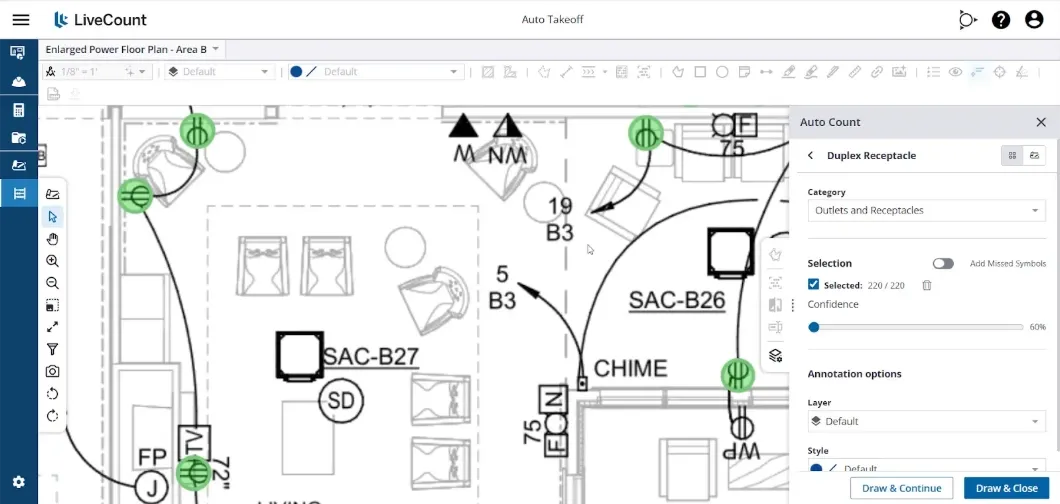
Finally, for contractors using the AI capabilities of Trimble estimating applications, it’s important to note that AI does not complete or finalize any part of the process. Initial counting and classifying of symbols goes to an estimator for review. The AI highlights each detected symbol directly on the drawing, organized by category, so the estimator can work through one category at a time and quickly spot-check against what is actually there. Each count also carries a confidence rating, so the estimator knows exactly where to focus first—reviewing the lowest-confidence detections before moving on. Nothing gets into a bid without a qualified person putting eyes on it.


